
Government unveils PPP pipeline as Islamabad seeks billions in private investment for infrastructure and state assets
ISLAMABAD: Pakistan is stepping up efforts to attract private capital into its economy, with the government positioning public-private partnerships (PPPs) and privatisation as key drivers of future investment, infrastructure development and economic growth.
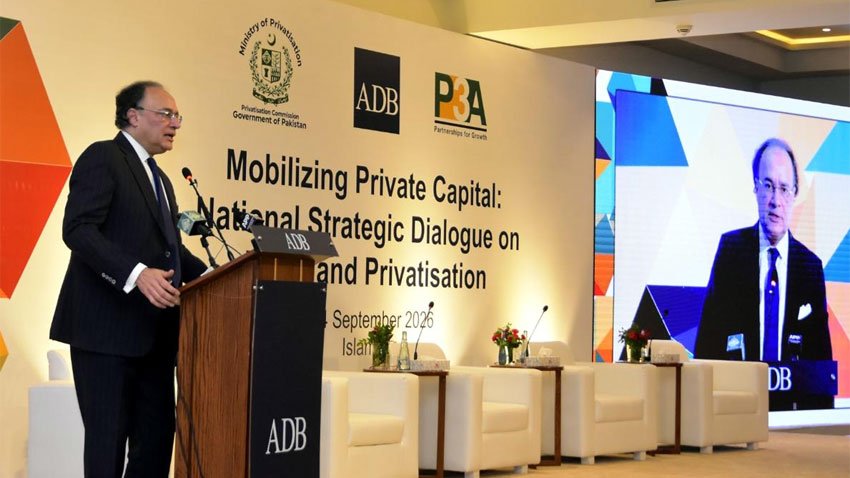
The commitment was reiterated at the National Strategic Dialogue on PPPs and Privatisation in Islamabad on Friday, where the government also launched the Pakistan PPP Monitor, a platform designed to provide investors with greater visibility into the country’s PPP track record and upcoming projects.
The event was attended by Federal Minister for Finance and Revenue Senator Muhammad Aurangzeb, Adviser to the Prime Minister on Privatisation Muhammad Ali, Asian Development Bank (ADB) Vice President for South, Central and West Asia Yingming Yang, senior federal and provincial officials, development partners, financial institutions and private-sector representatives.
Finance Minister Muhammad Aurangzeb said the government was focused on creating conditions that encourage investment and allow the private sector to play a larger role in Pakistan’s economic development.
“The private sector must lead Pakistan’s next phase of growth,” Aurangzeb said, adding that PPPs and privatisation could help attract investment, improve efficiency and expand opportunities for private-sector participation.
He said the government’s priority was to develop a strong pipeline of investable projects and convert those opportunities into actual investment and economic growth.
Government Seeks Bigger Private Role
Privatisation Adviser Muhammad Ali said Pakistan’s infrastructure and development requirements could not be met through public spending alone.
He argued that the private sector needed to take a larger role in financing, developing and managing infrastructure and commercial assets.
According to Ali, PPPs and privatisation should be viewed as complementary mechanisms rather than competing approaches.
While PPPs can bring private financing and expertise into infrastructure and public services, privatisation can introduce private ownership or management into commercial enterprises where it can improve efficiency, investment and service delivery.
“We have already started to give the reins of economic growth to the private sector,” Ali said, calling for the government to continue its privatisation programme, expand the PPP pipeline and complete projects that demonstrate its commitment to private investment.
He also highlighted asset monetisation as another mechanism for bringing private capital, technology, management expertise and accountability into areas where government resources are limited.
Pakistan’s PPP Pipeline Nears $6.5 Billion
The Pakistan PPP Monitor shows that the country has already developed a significant track record in public-private partnerships.
According to the monitor, 154 PPP projects have reached financial close since the 1990s, representing investment of nearly $36 billion.
The current federal PPP pipeline consists of 38 projects estimated at around $6.5 billion, covering sectors including roads, railways, aviation, healthcare and industrial infrastructure.
The government believes greater transparency around these projects could help investors better assess Pakistan’s opportunities and track record.
ADB Vice President Yingming Yang welcomed Pakistan’s efforts to expand private-sector participation and reaffirmed the bank’s support for large-scale private investment.
“Mobilizing private capital and expertise is essential,” Yang said, noting that well-structured PPPs could supplement limited public resources, improve efficiency, support long-term maintenance and enhance public services.
He also welcomed the launch of the PPP Monitor, saying it would give investors and other stakeholders greater visibility into Pakistan’s PPP projects and investment pipeline.
27 Transactions on Privatisation Agenda
Alongside its PPP strategy, the government is advancing a 27-transaction privatisation programme covering power distribution companies, major airports, insurance companies and specialised banks.
The government cited recent progress, including the privatisation of Pakistan International Airlines (PIA) with management control, as part of its broader push to increase private-sector participation.
Work is also continuing on the proposed privatisation of power distribution companies and airport concessions.
The dialogue brought together representatives from provincial PPP institutions, highlighting the need for closer federal-provincial coordination to expand investment opportunities across Pakistan.
Privatisation Commission Secretary Usman Bajwa said the government would maintain momentum on both the PPP and privatisation fronts, with emphasis on a clear project pipeline, coordination, transparency and a predictable environment for investors.
The government said Pakistan now has an established institutional framework, a growing pipeline and a substantial record of PPP investment.
The focus, it added, would now shift towards moving projects from the pipeline to successful transactions and using private capital to support sustained, investment-led economic growth.