
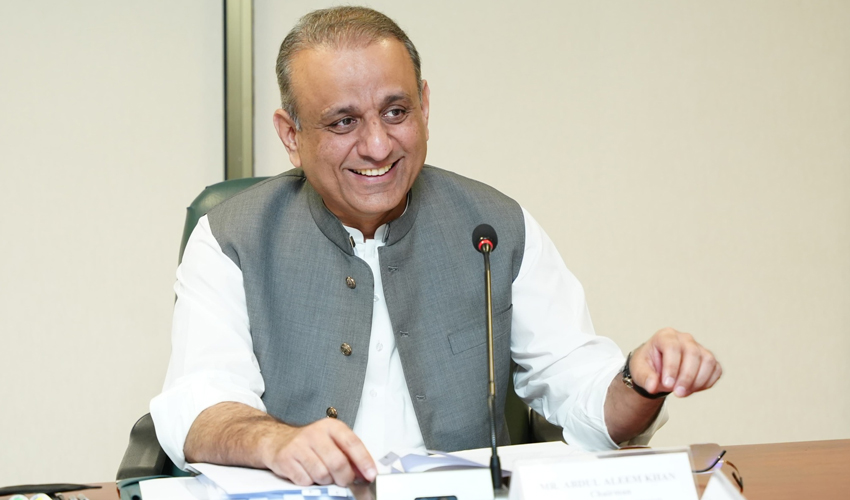
BAKU, September 25 — Federal Minister for Communications Abdul Aleem Khan has said Pakistan is strengthening its position as a key regional trade gateway, using its ports and expanding motorway network to improve connectivity between Central Asia, China, the South Caucasus and global markets.
Speaking at a high-level panel discussion at the Azerbaijan International Investment Forum in Baku, Aleem Khan outlined Pakistan’s strategy for regional economic integration, trade connectivity and infrastructure development.
He said stronger trade links and improved connectivity were essential to Pakistan’s economic growth, particularly at a time when geopolitical tensions, rising fuel costs and higher maritime freight rates were disrupting traditional global trade corridors.
The minister said the government had taken steps to maintain economic stability amid global uncertainty through tighter fiscal discipline and reductions in public expenditure.
Aleem Khan also said Pakistan was seeking to play a constructive diplomatic role during regional conflicts to help reduce tensions and support the long-term continuity of trade.
Highlighting the country’s geographical position, he said Pakistan was emerging as a secure and efficient transit route for regional commerce amid changing trade dynamics.
The ports of Karachi, Port Qasim and Gwadar remain fully operational to support the movement of goods through international supply chains, he said.
According to the minister, Karachi Port Trust handled more than 54.68 million metric tonnes of cargo during the previous fiscal year.
He also highlighted Pakistan’s growing role as a maritime gateway for Central Asian states, saying bilateral trade links had expanded significantly.
Aleem Khan said Pakistan’s exports to Kazakhstan had exceeded $240 million, while exports to Uzbekistan had crossed $118 million.
Turning to domestic infrastructure, the minister highlighted major road projects, including the M-6 Motorway, M-10 and MNJC highways, which he said would help provide faster and more efficient trade routes towards Central Asia and western China.
He also highlighted an arrangement with Azerbaijan involving the exchange of 1,500 road permits annually, facilitating direct transport links between Pakistani ports, the South Caucasus and the Trans-Caspian Corridor.
Aleem Khan said Pakistan was also pursuing public-private partnerships and paperless customs systems to make cross-border trade more efficient.
He reiterated the government’s intention to improve connectivity between the China-Pakistan Economic Corridor (CPEC) and regional networks including the Economic Cooperation Organization (ECO), Central Asia Regional Economic Cooperation (CAREC) and Shanghai Cooperation Organisation (SCO).
The broader objective, he said, was to develop a sustainable economic bridge connecting Asia and Europe through stronger transport and trade corridors.
Azerbaijan’s Economy Minister Mikayil Jabbarov and Türkiye’s Treasury and Finance Minister Mehmet Şimşek also participated in the panel discussion.
Ministers and deputy prime ministers from Uzbekistan, North Macedonia, Syria, Tajikistan and Montenegro were among other participants in the forum.