

Every morning, students stream through the Khurshid Gate of Zamindar College in Gujrat, Punjab, and pass a grave. It lies just inside, in front of the main building, where a visitor might expect a statue or a flagpole. Few of them break stride. The man beneath the stone, Nawab Sir Fazal Ali, died on 30 October 1942 and was buried at the threshold of his own creation, as though the founder had been appointed its gatekeeper. Friday marks 84 years since.
His district sits on the Chenab, and its scholars liked to call it the “Land of the Greeks”. In 1911, only 3.1 percent of its people could read, and it had not one college. The nickname was a memory. The reality was a silence.
The man who broke that silence never earned a degree. Fazal Ali was four in 1876 when his father, the zaildar of Ajnala, a hereditary revenue headman, died and left the office to his youngest son. An uncle raised the boy and saw the world changing. When the district’s one mission school had taught him all it could, there was nowhere to go, because Gujrat had no high school. On a deputy commissioner’s advice, he was sent to Aligarh, to the college Sir Syed Ahmad Khan had founded to equip India’s Muslims for the age of their rulers. The cricket field held him more firmly than the lecture hall, and he came home without a diploma. But he carried back Sir Syed’s conviction that a community which does not school itself will be governed by those who do.
He began with debt, not classrooms. In 1907 he founded a cooperative society at Ajnala, whose bank and small loans began loosening the moneylender’s grip on the village. A farmer who lives in a creditor’s ledger does not send his son to school, and Fazal Ali seems to have grasped this before most reformers did.
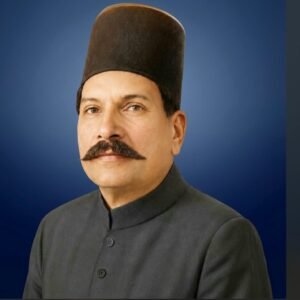
On 28 January 1914 he gathered the district’s landlords at his own house. They pledged one-twelfth of their spring-harvest income to education, and the Zamindar Educational Association was born, with Fazal Ali as secretary. He pursued donations at weddings, between the congratulations and the sweets, exactly as Sir Syed once had. A middle school opened in 1915, with a hostel in an old pavilion. In 1925 the governor of Punjab laid the foundation stone of a college building. In 1937 the finished building was inaugurated, and Fazal Ali used the occasion to demand what it had all been for: college status. On 6 September 1937 the school became an intermediate college. Twenty-three years separate the landlords’ pledge from that day. He waited, and kept collecting.
One story survives, told by his grandson, who had it from the elders. It is family tradition, not archive. Before a visit by the provincial education minister, Fazal Ali is said to have dressed the teachers in white clothes and turbans at his own expense and stationed them in groups along the road from the Chenab bridge to the courthouse. When the minister halted his car to ask what was happening, they answered as one voice that their first priority was the college. Whatever the exact details, the outcome is not in doubt. A generation of first graduates in Attock, Mianwali, Sargodha, Sialkot and Gujranwala came out of Zamindar College.
So far this is the familiar tale of the benefactor. But Fazal Ali’s contemporary at Aligarh was Zafar Ali Khan, who drew on the same inspiration and became one of the fiercest pens of the freedom movement. The British jailed him again and again. Years afterwards he reportedly conceded that their whole generation had sworn to build such institutions in their home regions, and that Fazal Ali alone had kept the vow. The man who went to prison for freedom admitted that the loyalist had out-built him.
Both facts are true, and neither is comfortable. Fazal Ali was Sir Syed’s “loyal Mohammedan” in its purest form. He recruited soldiers for the Raj in the First World War and was rewarded with an MBE. Khan Bahadur followed, then the OBE, then in 1932 the title of Nawab, and in 1942 a knighthood. Each honour was paid in the same currency. While Aligarh’s other graduates carried the cause of freedom across the province, the movement found no foothold in his district.
That was the price, and it was real. In the Punjab of those years, a college for one district could be had only at the government’s counter, and the government sold only to those it trusted. Fazal Ali paid in loyalty, but it was not he who bore the cost. The district bore it, in the political voice it might have raised and did not.
The harder question is what the price bought. The institution was named for the zamindar, the landlord, and its magazine was called Muhib-e-Kissan, “Friend of the Peasant”. Did the tenant farmer’s son pass through the Khurshid Gate? Did the weaver’s? Did anyone’s daughter? The surviving accounts are silent, and the silence is not innocent. Consider what the landlords gave: a twelfth of a harvest, in exchange for an institution that would educate their own sons for government service. A literate peasantry is a dangerous thing to the people who own the land. A school whose doors open mostly to the owners endangers no one, and a pledge that threatens nobody is easy to sign. It may be why that room full of landlords opened its purse so quickly.
That is a suspicion, not a finding, and the college’s admission registers could settle it. Someone should open them. The worth of the founder’s story hangs on what they say.
Tolstoy asked how much land a man needs, and gave his Pahom six feet. Fazal Ali’s six feet are the most visible in Gujrat. They lie not in a quiet cemetery but at the point every student must cross.
The gate stands open each morning, and it is the open gate that makes the grave a monument. But a gate has two sides. Inside, a founder rests in the shade of his own success, and students walk in with books and expectations. Outside, beyond the wall, are the district’s farmers’ sons, still waiting to learn whether they were ever meant to enter. The founder paid for the college with his loyalty. Who pays for the question of who is let in?