
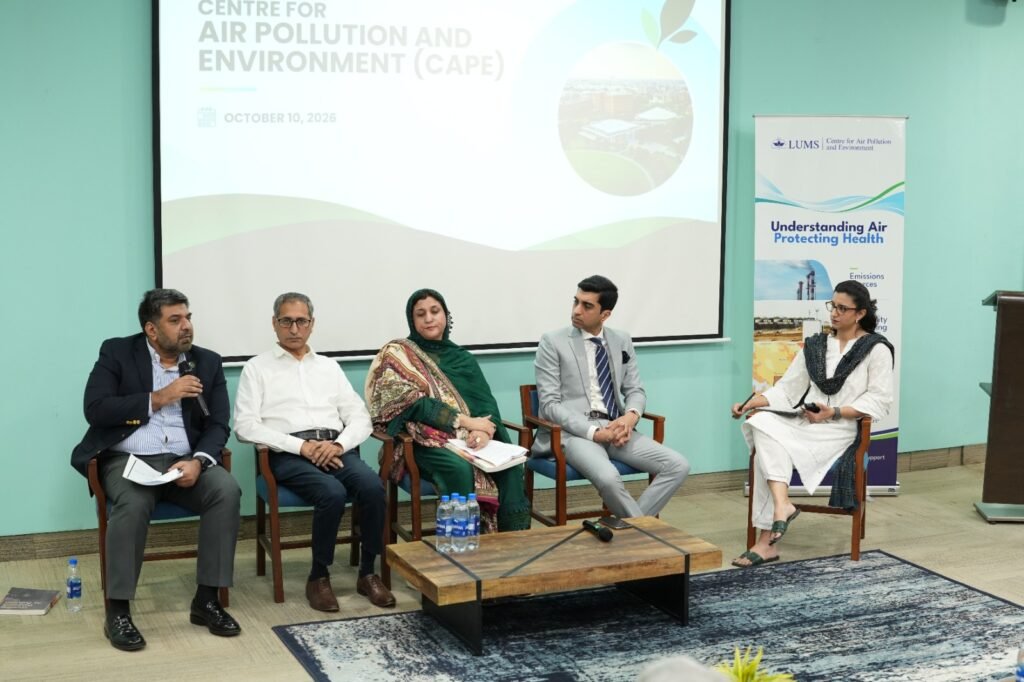
LAHORE: The Lahore University of Management Sciences (LUMS) has launched the Centre for Air Pollution and Environment (CAPE) to investigate the major sources of air pollution across Punjab and generate scientific evidence to support effective pollution-control policies.
The centre has been established with a major grant from Coefficient Giving to fund a multi-year, multi-site research project aimed at identifying and quantifying the main contributors to particulate air pollution across the province. The initiative also includes the establishment of a state-of-the-art laboratory for the chemical analysis of air pollutants.
Dr Qasim Imtiaz, a faculty member in the Department of Chemistry and Chemical Engineering at LUMS, has been appointed the centre’s founding director. Dr Farah Said, Dr Shahana Khurshid and Dr Walther Schwarzacher are also part of the CAPE team.
The launch brought together university leadership, government departments, researchers, air-quality organisations, development partners and members of CAPE’s Policy Advisory Board to discuss Punjab’s air pollution challenges and the scientific evidence needed to address them.
Research to Identify Pollution Sources
Speaking at the launch, LUMS Provost Dr Tariq Mahmood Jadoon highlighted the need for stronger scientific evidence to tackle air pollution. Dr Walther Schwarzacher, Dean of the Syed Babar Ali School of Science and Engineering, also discussed the establishment of the centre within the school.
Presenting CAPE’s mission and research plans, Dr Qasim Imtiaz said systematic measurements were essential to determine which sources contribute to particulate pollution and the extent of their impact.
He said the centre would build an evidence base and work with government agencies, researchers and communities to translate findings into targeted interventions aimed at protecting public health.
CAPE’s research will focus on identifying pollution sources, assessing their impacts, examining indoor air quality in schools and strengthening collaboration between scientists, communities and policymakers.
The centre’s source-apportionment study will analyse the chemical composition of particulate matter collected from different locations across Punjab to determine the contribution of various pollution sources.
Government and Air-Quality Experts Discuss Priorities
During a session moderated by Dr Shahana Khurshid, representatives of the Punjab Environment Protection and Climate Change Department, the Urban Unit and the Pakistan Air Quality Initiative presented their ongoing work on smog mitigation, air-quality monitoring, sectoral emissions inventories, air-quality action plans and citizen-led monitoring.
The discussions examined existing monitoring systems and available data, as well as gaps in scientific evidence that need to be addressed to better understand Punjab’s pollution burden.
The event also featured a panel discussion moderated by Dr Farah Said. Participants included Muhammad Hassaan Ahsan, Secretary of the Provincial Transport Authority in the Transport and Mass Transit Department; Muhammad Ahsan Younas, Managing Director of the Punjab Safe Cities Authority; Zahida Azhar, Additional Secretary for Universities in the Higher Education Department; and Dr Muhammad Zaman, Professor at the School of Sociology, Quaid-i-Azam University.
The panel discussed research priorities for CAPE, including ways to evaluate pollution-control measures and improve the evidence available to policymakers.
Participants highlighted initiatives involving vehicle-emissions testing and the potential use of Safe City systems to monitor environmental violations. They also stressed the need for reliable data and further scientific research to measure pollution sources, assess the effectiveness of interventions and guide evidence-based decisions.
LUMS Board of Trustees member Osman Khalid Waheed presented shields to the speakers at the conclusion of the event. LUMS Rector Shahid Hussain delivered the closing remarks, thanking participants and partners for their contributions.
Air Pollution Poses a Major Public Health Challenge
Air pollution remains a significant environmental and public-health concern in Pakistan. Estimates cited in the project announcement suggest that reducing ambient air pollution to international health guideline levels could increase average life expectancy by approximately 2.6 years in Karachi, 4.6 years in Islamabad and 5.3 years in Lahore.
These estimates highlight the potential health benefits of cleaner air and more effective pollution management.
Through scientific research, laboratory analysis and collaboration with government departments and communities, CAPE aims to strengthen understanding of Punjab’s air pollution and help develop more targeted responses to the province’s smog and air-quality challenges.