
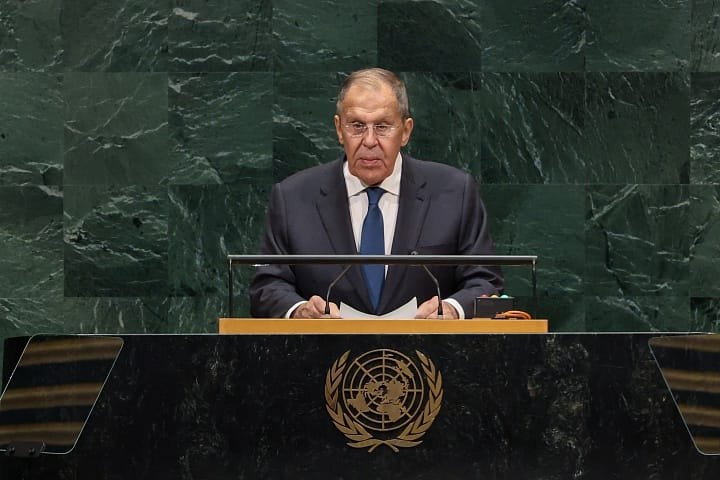
NEW YORK, September 26 — Russian Foreign Minister Sergey Lavrov told the 81st United Nations General Assembly that countries across the Global South and East were emerging as increasingly influential centres of development and security, while accusing Western powers of resisting the shift towards a multipolar international order.
Addressing the General Debate in New York, Lavrov presented Moscow’s vision of a changing global system in which developing and emerging countries play a greater role in international decision-making.
He said countries of the Global South and East were increasingly asserting themselves as sovereign centres of development and taking greater responsibility for security in their regions.
Lavrov said Russia regarded this trend as consistent with its own foreign policy and pointed to cooperation through organisations including BRICS, the Shanghai Cooperation Organisation and the Commonwealth of Independent States.
Lavrov accuses West of resisting global power shift
The Russian foreign minister sharply criticised Western countries, arguing that they were attempting to preserve privileges accumulated during centuries of global dominance.
He accused Western powers of relying increasingly on force and pressure to maintain their influence, presenting Russia’s support for multipolarity as an alternative approach to international relations.
The remarks reflected Moscow’s longstanding argument that international institutions and global governance should give greater weight to emerging economies and countries outside the traditional Western power structure.
Russia criticises US actions in Venezuela
Lavrov also used his UN address to condemn US actions in Venezuela.
He accused Washington of violating international law in its intervention in the country and criticised the detention of Venezuelan President Nicolas Maduro and his wife.
The comments represented Russia’s position on the episode and formed part of Lavrov’s broader criticism of what Moscow describes as unilateral Western intervention in other countries.
Lavrov also condemned the killing of Iran’s Supreme Leader Ayatollah Ali Khamenei, members of his family and members of Iran’s military and political leadership, describing the use of force as unacceptable.
Lavrov invokes lessons of Nuremberg
The Russian foreign minister also referred to the legacy of the Nuremberg trials as the 80th anniversary of the tribunal’s conclusion approaches.
He said the historic proceedings established a clear legal and moral condemnation of Nazism but argued that their lessons had not been universally observed.
Lavrov accused some European political leaders of promoting what he characterised as extremist and anti-Russian views.
He also criticised the Ukrainian leadership over its treatment of historical figures associated with Nazi Germany. These assertions reflected Moscow’s position in its continuing political and military confrontation with Kyiv and European governments.
Russia says Ukraine objectives will be pursued
Turning to the war in Ukraine, Lavrov reiterated Moscow’s stated justification for launching its military operation in February 2022, saying Russia had acted to protect people in Donbas and territories Moscow refers to as Novorossiya.
Ukraine and its Western partners have rejected Russia’s justification for the invasion.
Lavrov told the General Assembly that Moscow intended to continue pursuing its stated objectives, including what it describes as eliminating threats to Russian security and restoring peaceful conditions.
His speech placed the Ukraine conflict within Russia’s broader argument for a multipolar international system and its opposition to what Moscow portrays as Western dominance of global affairs.