
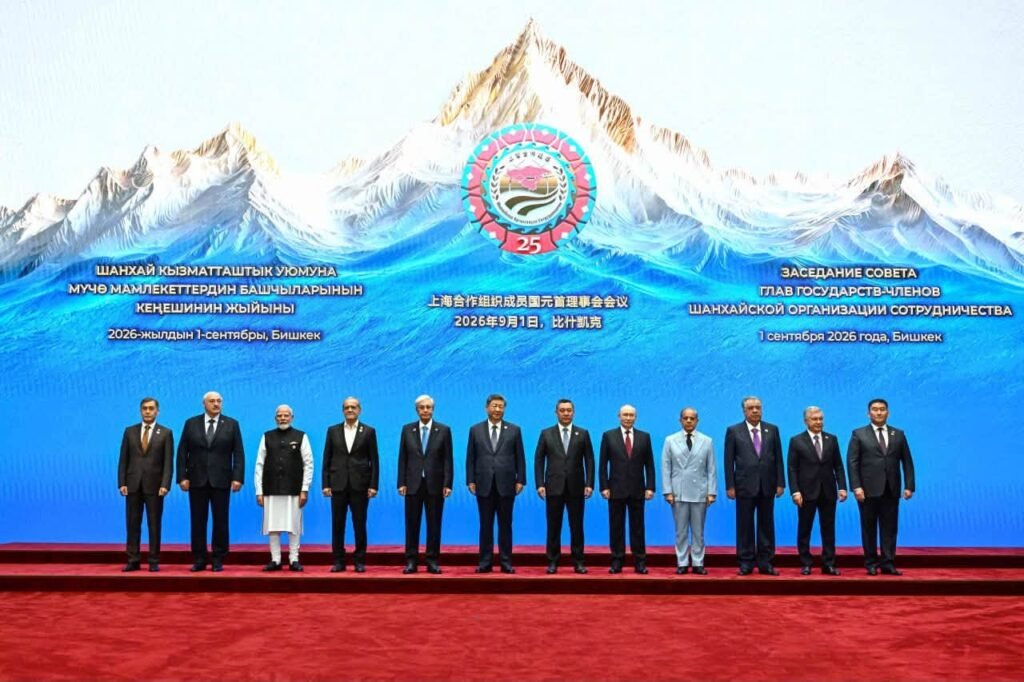
BISHKEK, Sept. 1, 2026 — Kazakhstan is ready to consistently strengthen its comprehensive strategic partnership with China and expand cooperation across trade, transport, technology, energy and other sectors, President Kassym-Jomart Tokayev said in an exclusive written interview with Xinhua News Agency.
Tokayev said relations between Kazakhstan and China have reached an unprecedented level, with the two countries seeking to deepen economic and political ties while expanding cooperation in emerging areas such as artificial intelligence, digitalization and advanced manufacturing. China is currently Kazakhstan’s largest foreign trade partner.
The Kazakh president highlighted the countries’ long shared border and history of neighborly relations, saying continued political dialogue remains a foundation of bilateral cooperation.
Trade, Transport and the Middle Corridor
Transport and logistics have become a major area of Kazakhstan-China cooperation, with Kazakhstan positioning itself as a key connection between Asia and Europe.
Tokayev said joint projects under the Belt and Road Initiative and the Trans-Caspian International Transport Route, commonly known as the Middle Corridor, are reshaping transport links across Eurasia.
The two countries are working on new railway lines, expanded dry ports and logistics terminals, as well as upgraded border infrastructure. Tokayev said Kazakhstan and China also attach importance to digitalizing customs procedures, including electronic documentation, integrated information systems and automated border processes.
He described the Middle Corridor as a priority area and said both sides want to make the route more competitive as a trade link between China and Europe.
Artificial Intelligence and Digital Cooperation
Tokayev said technological cooperation is becoming increasingly important as Kazakhstan accelerates its digital transformation.
China has developed strong capabilities in artificial intelligence, robotics, digital technologies, new energy and high-tech manufacturing, while Kazakhstan has declared 2026 the Year of Digitalization and Artificial Intelligence.
During a recent visit to Shanghai for the World Artificial Intelligence Conference, Tokayev said he met executives of major Chinese technology companies to discuss potential cooperation in digital industries, smart manufacturing, e-commerce, scientific research and workforce development.
He also said Kazakhstan joined 28 other countries as a founding member of the World Artificial Intelligence Cooperation Organization (WAICO) in Shanghai in July, describing the move as part of efforts to develop international coordination on artificial intelligence.
Tokayev said AI should contribute to global development and that countries should have equitable access to modern technologies, knowledge and computing resources.
Coordination on International Issues
Kazakhstan and China also cooperate through international organizations, including the United Nations, the Shanghai Cooperation Organization (SCO) and the Conference on Interaction and Confidence Building Measures in Asia (CICA).
Tokayev said the two countries share positions on strengthening the role of the United Nations, respecting international law, supporting mediation and multilateralism, and resolving conflicts through peaceful means.
He reaffirmed Kazakhstan’s adherence to the One-China policy and said Astana would continue coordination with Beijing within the UN, SCO and other regional frameworks.
The SCO is marking its 25th anniversary in 2026. Tokayev said the organization’s principles of mutual trust, equality, dialogue, respect for cultural diversity and common development remain important for international cooperation.
Growing People-to-People Ties
The partnership extends beyond government and economic relations, with education, culture and tourism also expanding.
Tokayev said tens of thousands of Kazakh students are currently studying in China, while an increasing number of Chinese students are attending universities in Kazakhstan. Chinese university branch campuses and Luban Workshops are also operating in Kazakhstan, alongside expanding academic exchange programs.
The mutual visa-free regime has contributed to increased tourism between the two countries. According to Tokayev, 962,000 Chinese tourists visited Kazakhstan in 2025, a 47 percent increase from 2024.
The president also highlighted the Kazakhstan-China Cross-Year of Culture in 2026 as an example of growing cultural exchanges.
Next year will mark the 35th anniversary of diplomatic relations between Kazakhstan and China, providing another milestone for the two countries as they seek to broaden their long-term strategic partnership.