
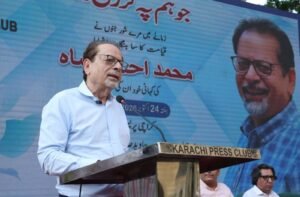
KARACHI: The Karachi Press Club (KPC) hosted a special evening honouring Arts Council of Pakistan Karachi President Muhammad Ahmed Shah, celebrating his journey from a young literature enthusiast to a prominent figure in Pakistan’s cultural and performing arts sector.
Organised by the club’s Literary Committee, the event, titled *“Jo Hum Pe Guzri: Muhammad Ahmed Shah Ki Kahani, Khud Un Ki Zubani,”* brought together writers, journalists, artists and Shah’s longtime associates to reflect on his life, literary interests and efforts to promote arts and culture.
Addressing the gathering, Shah stressed that protecting a nation’s cultural identity was as important as safeguarding its geographical borders.
“When a society loses its culture, its foundations begin to weaken,” he said, emphasising the need to preserve Pakistan’s diverse languages, traditions and artistic heritage.
A showreel highlighting his literary and cultural contributions was also screened.
From Nazimabad childhood to cultural leadership
Recalling his early years in Karachi’s Nazimabad No. 4, Shah shared memories of walking to school with friends, playing football and witnessing the 1965 war.
He spoke about his family’s migration history and the influence of his father, whose interest in religion, poetry and literature helped shape his intellectual outlook.
Shah said character and knowledge, rather than wealth or social status, should determine an individual’s standing in society. He expressed concern over growing materialism and class divisions.
Describing his student years at the University of Karachi, he recalled the influence of teachers, writers and friends who encouraged his interest in literature, philosophy and public debate.
His association with the Karachi Press Club began in 1981, providing opportunities to interact with prominent political and literary personalities.
Shah also recalled the restrictions on freedom of expression during General Zia-ul-Haq’s era, stressing that creative and intellectual freedom remained essential for a healthy society.
Transforming the Arts Council into a cultural centre
Reflecting on his leadership at the Arts Council, Shah said the institution initially operated with limited resources, including an annual grant of approximately Rs1 million.
He and his colleagues subsequently worked to strengthen its administrative structure, amend its constitution, introduce elections and expand participation.
One of the major milestones was the launch of the International Urdu Conference in 2008.
Shah recalled that financial constraints initially forced organisers to accommodate visiting guests in friends’ homes and guesthouses and arrange transport using an old van.
Despite these difficulties, the conference developed into an important platform for literary discussion and cultural exchange.
Its success encouraged further initiatives, including youth festivals, the Pakistan Literature Festival and the World Culture Festival.
Shah said these programmes helped bring together artists, writers and performers from different linguistic and cultural backgrounds while expanding Pakistan’s international cultural engagement.
Creating opportunities for young artists
Highlighting his commitment to emerging talent, Shah said children from underprivileged communities possessed enormous creative potential but often lacked opportunities and guidance.
He referred to young artists from Lyari, Lalukhet and Orangi Town whose paintings were being exhibited in Ireland and Canada.
Such opportunities, he said, helped young people develop confidence, gain recognition and pursue careers in creative fields.
Shah also discussed efforts to expand cultural activities beyond Karachi through arts councils in Sukkur, Larkana, Mirpurkhas and Khairpur.
He maintained that every Pakistani language, region and community deserved representation in the country’s cultural institutions.
Reflecting on his personal journey, Shah acknowledged that his commitment to cultural activities had demanded considerable sacrifices, including limited time with his family.
He credited his wife for managing family responsibilities while he devoted much of his time to the Arts Council.
Shah also recalled receiving death threats during his career but said support from writers, artists and intellectuals had strengthened his determination to continue.
Karachi Press Club praises Shah’s achievements
Earlier, Karachi Press Club President Fazil Jamili praised Shah’s contribution to transforming the Arts Council into a nationally and internationally recognised cultural institution.
He said the Arts Council’s activities had once been limited, but sustained efforts under Shah’s leadership had expanded its role considerably.
Jamili also recalled that the Karachi Press Club had awarded Shah lifetime membership in recognition of his literary and intellectual contributions.
Explaining the purpose of the “Jo Hum Pe Guzri” series, he said it provided distinguished personalities an opportunity to share their life experiences, including hardships, struggles and achievements.
Karachi Press Club Secretary Muhammad Aslam Khan also commended Shah’s efforts to promote theatre, literature and cultural activities despite challenging circumstances.
He particularly highlighted the International Urdu Conference and World Culture Festival as significant contributions to Karachi’s cultural identity.
Concluding the event, Shah thanked KPC President Fazil Jamili, Secretary Muhammad Aslam Khan, Literary Committee Secretary Javed Saba and his friends for their continued support.
He reiterated that dialogue, tolerance and mutual respect were essential for strengthening cultural institutions and resolving differences.