
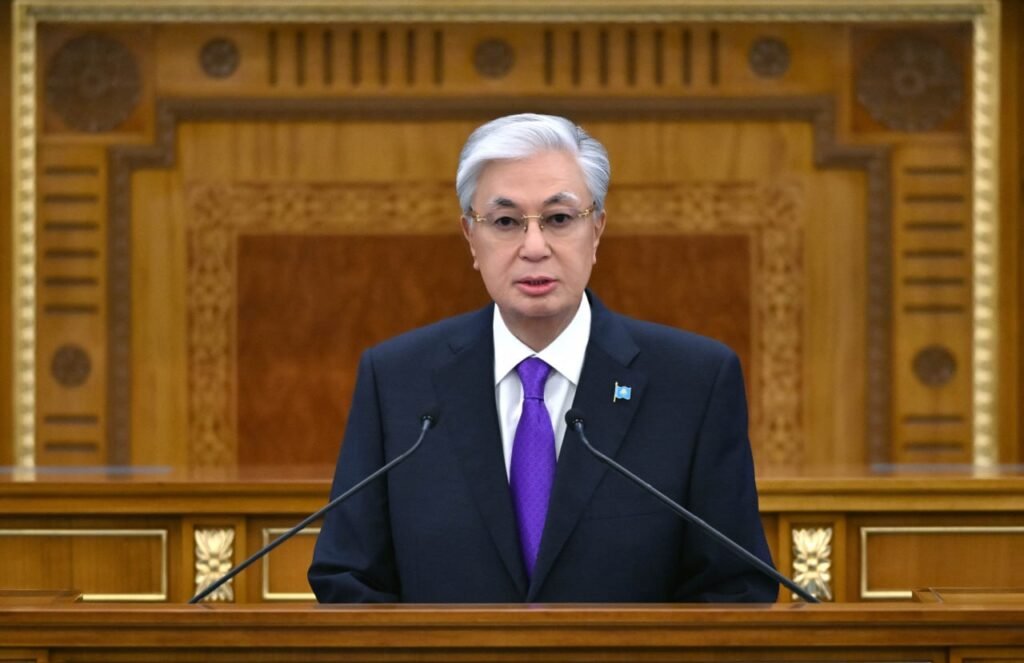
ASTANA: Kazakhstan has entered a new phase of political restructuring after President Kassym-Jomart Tokayev opened the first session of the country’s new unicameral Kurultai, outlining a broad reform agenda spanning government formation, artificial intelligence, investment, migration, social protection and foreign policy.
Speaking at the opening session on August 28, Tokayev said the new legislature marks the beginning of a renewed political system under Kazakhstan’s new Constitution, which was approved through a nationwide referendum. The Kurultai now replaces the previous parliamentary structure as the country’s unicameral legislature and will exercise wider powers in law-making, senior appointments and government oversight.
The president linked the new institution to Kazakhstan’s historic tradition of convening kurultais at important national moments, but stressed that the present body is intended to support modern state-building rather than revive an old political model.
As part of the legislature’s formation, Tokayev nominated Aibek Dadebay for the position of Chair of the Kurultai under Article 57 of the Constitution and called on deputies to support his candidacy.
The government, meanwhile, has relinquished its mandate before the newly elected legislature. Once the Kurultai’s internal structure is finalised, Tokayev said he will submit nominees for vice-president and prime minister, consult lawmakers and then move ahead with the appointment of government members.
He also announced that the Kazakhstan People’s Council, or Halyk Kenesi, will be formed in the second half of September. The body is expected to serve as a supreme consultative institution representing the country’s ethnic, regional, social and political diversity and will have the constitutional right to initiate legislation.
Kurultai Gets Wider Oversight Powers
Under the new constitutional arrangement, the Kurultai will play a larger role in senior institutional appointments and government accountability.
Appointments to the Constitutional Court, Central Election Commission and Supreme Audit Chamber will require agreement with the legislature, while lawmakers will also appoint and dismiss Supreme Court judges on the president’s proposal.
The Kurultai will additionally have the power to approve reports on the execution of the national budget, hear the Constitutional Court’s annual address and express no confidence in the government. Deputies may also recommend the dismissal of individual ministers.
Tokayev said one of the first major tasks for lawmakers will be to review existing sectoral legislation and bring it into line with the new Constitution.
He called for laws that are clear, fair and responsive to current conditions, while urging deputies to avoid both bureaucratic delay and superficial law-making.
AI, Digital Regulation Put High on Legislative Agenda
Technology and artificial intelligence featured prominently in Tokayev’s address.
He called for the rapid introduction of the E-Parliament system, which is intended to integrate digital services into parliamentary work and help identify legal and regulatory risks at an earlier stage.
Tokayev also encouraged lawmakers to use artificial intelligence to improve the quality of legislation and reduce corruption risks, while warning that AI cannot replace professional legal expertise.
Strategically important legislation, he said, must still undergo comprehensive expert scrutiny.
The government is also expected to prepare new legal measures linked to the Digital Qazaqstan strategy, the use of AI in secondary education and development of the digital-assets industry.
The Kurultai will also consider regulation of online platforms and mass media, with the stated aim of strengthening citizens’ rights in the information space.
Golden Visa, Migration and Investment Reforms Planned
On the economy, Tokayev said Kazakhstan’s structural reforms are aimed at improving living standards through industrialisation, infrastructure development and stronger investment.
He highlighted new production projects supported by both public spending and foreign direct investment, along with the need to modernise transport, energy, water and municipal infrastructure.
Tokayev also defended the use of National Fund resources for projects capable of generating long-term social and economic returns.
A key part of the investment agenda is Kazakhstan’s proposed Golden Visa, which is designed to attract highly qualified professionals, advanced technology and foreign capital.
The president called for wider migration reform and asked the government to submit the necessary legislation for expedited consideration.
Energy security was another priority, with lawmakers expected to accelerate legislation aimed at improving the technological resilience of the energy sector and supporting alternative energy development.
Kazakhstan Positions Itself as a Middle Power
Tokayev also used the address to set out Kazakhstan’s foreign-policy outlook at a time of growing global uncertainty.
He described the international environment as increasingly fragmented, with declining trust among major powers and a weakened multilateral system.
Against that background, he said regional organisations and middle powers are playing a more important role and explicitly placed Kazakhstan in that category.
Tokayev argued that sovereignty in the modern world depends not only on political independence but also on national capacity in the economy, science, defence, diplomacy and human development.
Kazakhstan, he said, will continue to protect its national interests while promoting peace, friendship and mutually beneficial partnerships.
Children’s Protection and Under-16 Social Media Ban
Social policy also featured heavily in the speech.
Tokayev called for a new law providing comprehensive support for children with disabilities, including better access to education, medical care and social services.
He proposed dedicated support centres in every regional capital and large district, while also encouraging responsible private-sector and sponsor participation alongside the state.
The president also backed the government’s proposal to ban children under the age of 16 from registering on social-media platforms and asked lawmakers to treat the matter as a priority.
A new law on libraries and publishing is also expected to be prepared during the current year.
Tokayev Highlights Turnout, Political Renewal
Tokayev said more than 74 percent of eligible citizens participated in the Kurultai election, while around 800 international observers visited Kazakhstan.
He described the vote as open, fair and well organised.
The Adilet party secured the largest share of voter support and won a constitutional majority in the new legislature. Tokayev said that result gives the party particular responsibility to help unite society and drive reform.
He also highlighted the increased presence of women and young people in the Kurultai compared with the former parliament, presenting leadership renewal as a key objective of Kazakhstan’s wider political reforms.
The president urged lawmakers to reject populism and empty promises and instead build a political culture based on law, transparency, responsibility, mutual respect and pluralism.
He said the public will ultimately judge the success of the wider reform programme by how effectively the new Kurultai performs.
Tokayev concluded by calling for a national outlook focused on knowledge, science, work, discipline and progress, arguing that unity remains the foundation for building what he described as a Just, Safe, Clean and Strong Kazakhstan.
Also Read: President Kassym-Jomart Tokayev’s Speech at the Informal Summit of the Organization of Turkic States