
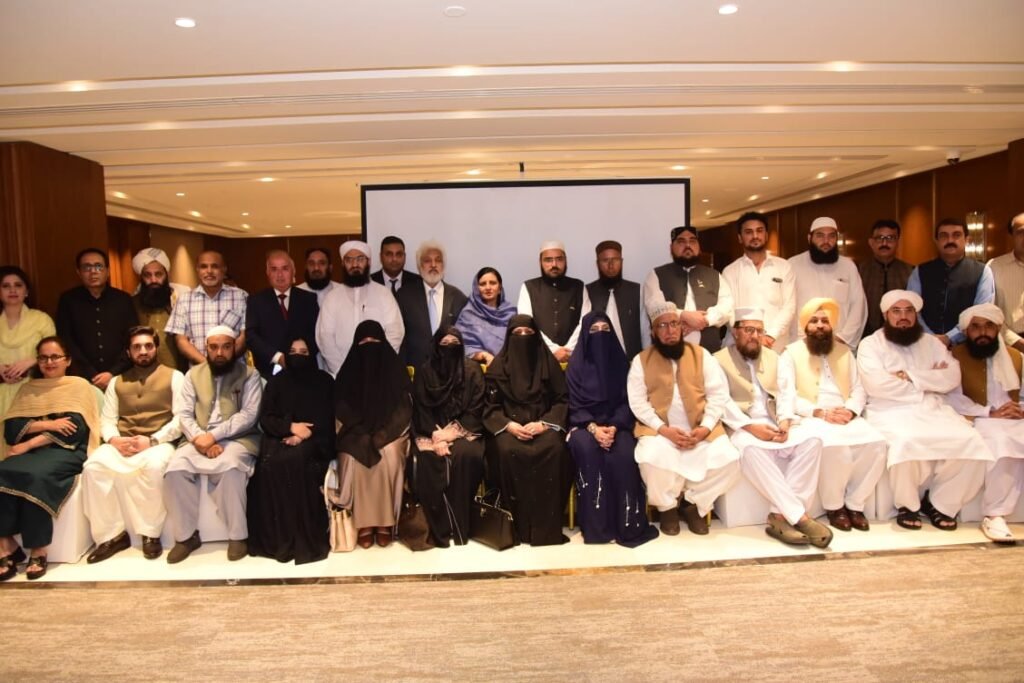
ISLAMABAD: A consultation workshop on the Constitution and Manifesto of Jamiat Ulema-e-Islam (JUI) was held in Islamabad under the auspices of the Aurat Foundation with the cooperation of the United Nations Development Programme (UNDP).
JUI leaders and lawmakers discussed the party’s constitutional framework, manifesto and organisational structure, with particular focus on democratic principles, constitutional supremacy, parliamentary governance, rule of law and internal accountability.
Focus on Constitution and Democratic Framework
JUI Deputy General Secretary and former adviser to the Chief Minister Maulana Muhammad Rahim Haqqani, Provincial Information Secretary Abdul Jalil Jan, MNA Shahida Akhtar Ali and MNA Naeema Kishore participated in the discussion.
The speakers said the supremacy of the Constitution, implementation of the 1973 Constitution, a strong Parliament, respect for the public mandate, rule of law and a democratic system are among the party’s key objectives.
They also identified the elimination of interest by 2028 and implementation of commitments concerning the registration process for religious seminaries under agreements with JUI and Wifaq-ul-Madaris Al-Arabia as major priorities.
Women and Minorities Discussed
The JUI representatives said the party’s Constitution contains separate provisions covering major segments of society, including women and religious minorities.
According to the speakers, the Constitution recognises women’s rights and status in accordance with Islamic principles. They also highlighted the participation and performance of JUI’s women legislators in parliamentary proceedings and committees.
The speakers cited their attendance, interventions on points of order and participation in the Public Accounts Committee and other parliamentary committees as examples of their role in legislative affairs.
They said JUI nominates women for legislative assemblies on the basis of merit and supports their participation in parliamentary and legislative activities.
The speakers also highlighted the role of JUI’s minority legislators in public welfare and said their contributions could be assessed alongside those of other members of the assemblies.
JUI Highlights Internal Electoral Structure
The JUI leaders said the party maintains an organisational structure extending from the Union Council level to tehsil, district, provincial and central levels.
They said elections at different organisational levels provide a mechanism for selecting party representatives, while major policy decisions are formulated through the Central General Council.
According to the speakers, organisational bodies remain accountable to the Central General Council, while amendments or repeal of provisions in the Constitution and Manifesto require the prescribed constitutional procedure, including a two-thirds majority where applicable.
They said the structure provides an institutional framework for consultation, accountability and decision-making within the party.
Aurat Foundation Thanks Participants
JUI leaders thanked the Aurat Foundation and UNDP for organising the consultation workshop and providing an opportunity to discuss the party’s Constitution and Manifesto.
Aurat Foundation Executive Director Naeem Mirza thanked participants for their contribution and announced Foundation membership for Maulana Muhammad Rahim Haqqani, Deputy General Secretary of JUI Khyber Pakhtunkhwa, and MNA Shahida Akhtar Ali.
Also Read : PSO Recognises Top Dealers as It Unveils Major Retail Transformation Plan