
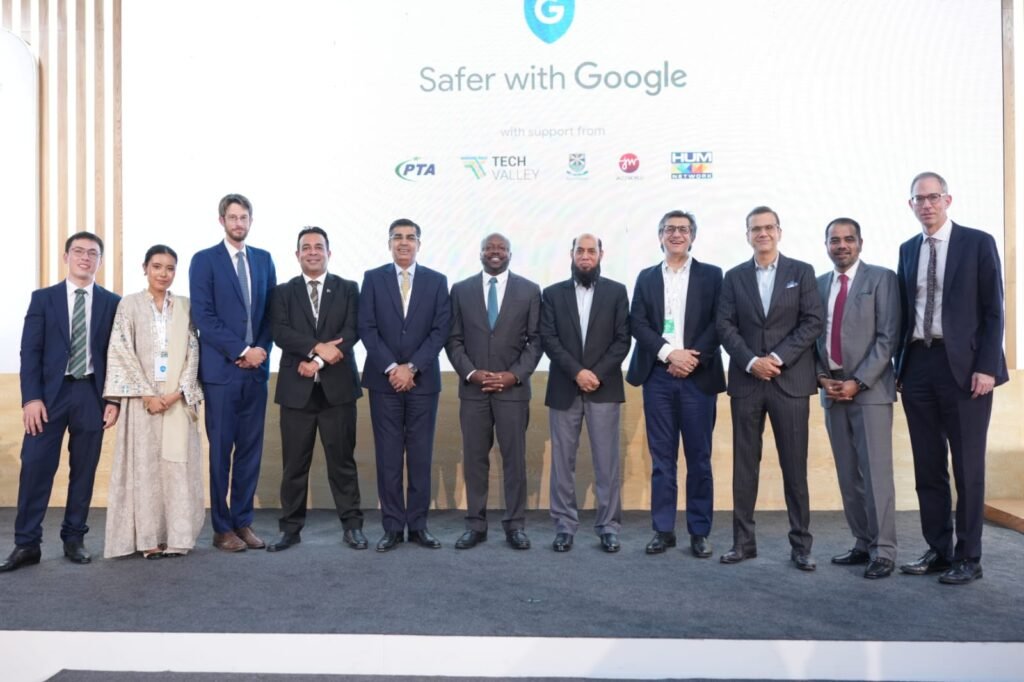
LAHORE: Google has launched Digital Pasban, a nationwide online safety initiative aimed at helping Pakistani parents and children navigate digital risks more safely, with plans to reach 200,000 households through Urdu-language resources, training and community outreach.
The initiative was announced on Thursday at the Safe Raho with Google event in Lahore as internet use continues to expand across Pakistan for education, entertainment, communication and everyday services.
Google said Digital Pasban would provide families with Urdu safety toolkits, instructional videos and practical workshops designed to improve digital literacy and help parents manage their children’s online experiences.
The programme brings together the Pakistan Telecommunication Authority, Tech Valley, Beaconhouse School System, Jazz World and HUM Network, with support from the Ministry of Information Technology and Telecommunication, Ministry of Federal Education and Professional Training and Ministry of Inter Provincial Coordination.
Google.org is also committing $500,000 to support digital citizenship and artificial intelligence safety programmes in Pakistan.
The funding will be used with local partners to expand online safety education for young people and adults and help families better understand issues ranging from inappropriate content and scams to privacy, screen time and responsible use of artificial intelligence.
Digital Pasban focuses on four areas of online safety, including parental controls, age-appropriate content, digital citizenship and responsible AI use.
Google’s Family Link service allows parents to manage screen time, approve applications, apply content filters and monitor device location.
The initiative also promotes YouTube safety and time-management tools. Google said parents can control the amount of time children spend watching YouTube Shorts, including reducing the limit to zero when they want children to focus on schoolwork or other activities.
Another part of the programme uses Google’s Be Internet Awesome resources to teach children aged seven to 12 about safe online behaviour, including avoiding scams, protecting passwords, sharing information carefully and reporting harmful content.
The programme will also introduce families to safety features in Gemini, Google’s artificial intelligence assistant.
Google said Gemini would be presented to children as a digital tool rather than a human-like companion, while safeguards for minors are designed to restrict inappropriate content and certain potentially harmful role-playing interactions.
Its Guided Learning feature is also being promoted as an educational tool that can help students understand difficult subjects by breaking problems into smaller steps and guiding them through questions rather than simply providing answers.
Digital Pasban will be taken into communities through schools, broadcast media, SMS campaigns and partner platforms.
Parent and guardian safety clinics will form a major part of the initiative, allowing families to take part in practical workshops and work through common online safety situations.
PTA Chairman Major General (retd) Hafeez Ur Rehman said the programme reflected a shared effort to create a safer digital environment for children and families.
He said practical tools, local-language resources and school-based engagement could help parents guide children towards safer and more responsible internet use.
Farhan Qureshi, Google’s Cluster Director for Pakistan, the Philippines, Thailand and Frontier Markets, said Pakistan’s digital ecosystem was continuing to expand as more people came online to learn, create and communicate.
He said the objective should be to protect children in digital spaces rather than prevent them from accessing technology, adding that online safety required cooperation between technology companies, government institutions, schools and families.
Tech Valley CEO Umar Farooq said many Pakistani parents were struggling to keep pace with the speed at which children’s digital lives were changing.
He said Digital Pasban was intended to turn that concern into practical knowledge through workshops, safety resources and parental guidance.
JazzWorld CEO Aamir Ibrahim said greater internet use had increased the need to help families understand digital risks and make informed choices.
According to Google, Digital Pasban builds on its earlier digital citizenship programmes in Pakistan.
The company said its Digital Safar initiative had trained more than 300,000 students and 5,000 educators in digital citizenship, while other partnerships had expanded access to AI-powered education and online safety resources.
With Digital Pasban, Google is now seeking to take those efforts directly into Pakistani households as concerns around children’s online exposure, scams, screen time, privacy and AI use become increasingly important for parents.
Also Read: Why Google is betting bigger on Pakistan in 2026: 3 reasons