
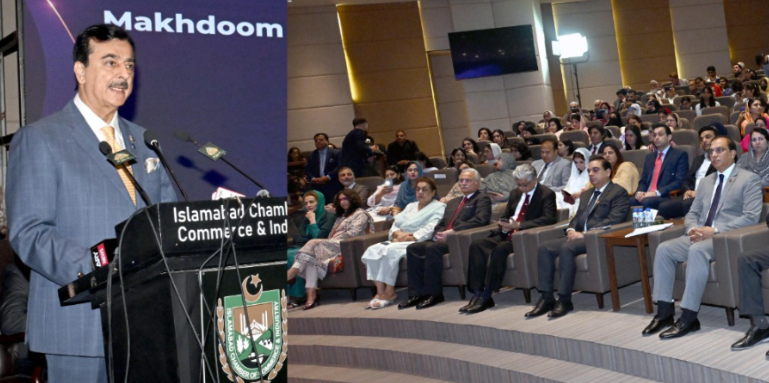
ISLAMABAD, September 9, 2026: Acting President Syed Yousaf Raza Gillani has called for greater participation of women in Pakistan’s economy, institutions and policymaking, saying the country cannot realize its full potential without women playing an equal role in national development.
Addressing the Pakistan Women Leadership and Policy Summit 2026, organized by the Islamabad Chamber of Commerce and Industry (ICCI), Gillani said Pakistan’s democratic strength, economic progress and social cohesion depended on women having meaningful opportunities to contribute.
“If the country is to unlock its full economic potential, we must ensure that women are not only beneficiaries of development, but active drivers of it as entrepreneurs, professionals, policymakers, innovators and leaders,” he said.
Gillani commended the ICCI and its partners for organizing the summit, saying it brought together two important national priorities: women’s leadership and effective public policy.
He highlighted the contributions of prominent Pakistani women, including Fatima Jinnah, Begum Rana Liaquat Ali Khan, Begum Shaista Ikramullah and former prime minister Benazir Bhutto, as well as women business leaders and CEOs participating in the summit.
Referring to Benazir Bhutto’s political legacy, Gillani said her becoming the first woman to lead a Muslim-majority country had broken barriers and continued to inspire women to enter public life, lead institutions and participate in national decision-making.
Equal Access to Opportunities
The Acting President said the real measure of Pakistan’s progress would be whether women, regardless of their background or region, had equal access to education, finance, technology, markets and decision-making.
“The challenge before us is therefore not whether women can lead, but whether we are prepared to create the systems that allow them to lead, succeed and shape Pakistan’s future,” he said.
Gillani said legislative measures, institutional reforms and policy initiatives undertaken during his government had established a legal and policy foundation for the protection and socio-economic and political empowerment of women.
He cited measures addressing workplace harassment, acid violence, forced marriages and vani, as well as the declaration of December 22 as Working Women’s Day.
He also highlighted the establishment of the Women’s Parliamentary Caucus, saying it helped ensure that women’s rights and concerns remained part of parliamentary discourse.
BISP Highlighted as Empowerment Initiative
Gillani described the Benazir Income Support Programme (BISP) as one of the initiatives he was particularly proud of, saying that placing financial assistance directly in the hands of women strengthened their role as economic decision-makers within their households.
He said the programme represented a shift from dependence toward greater dignity and empowerment.
“Women’s empowerment is not a narrow social concern. It is central to national development,” Gillani said, stressing that Pakistan could not afford to remain passive in the face of inequality.
He urged stakeholders to pursue a practical agenda centered on access to finance, digital inclusion, women-led businesses, safe workplaces, leadership development, mentorship and stronger connections with markets.
Call for Greater Institutional Support
Gillani called on financial institutions to improve women’s access to capital, educational institutions to develop relevant skills and the private sector to provide inclusive and dignified workplaces.
He also urged chambers of commerce to strengthen mentorship, professional networking, market access and support for women-led enterprises.
“Our shared objective must be to build systems that enable women to succeed, not by lowering standards, but by removing barriers and ensuring a level playing field,” he said.
The Acting President said Pakistan needed an economy where women could establish businesses with confidence, workplaces where they could contribute with dignity, institutions where they could lead with authority and a democracy in which their participation was substantive rather than symbolic.
He concluded by saying that when women lead, families prosper; when women participate fully in economic life, nations advance; and when women help shape public policy, democracy becomes more representative, responsive and just.
Gillani wished the Pakistan Women Leadership and Policy Summit 2026 success and concluded with “Pakistan Paindabad.”