
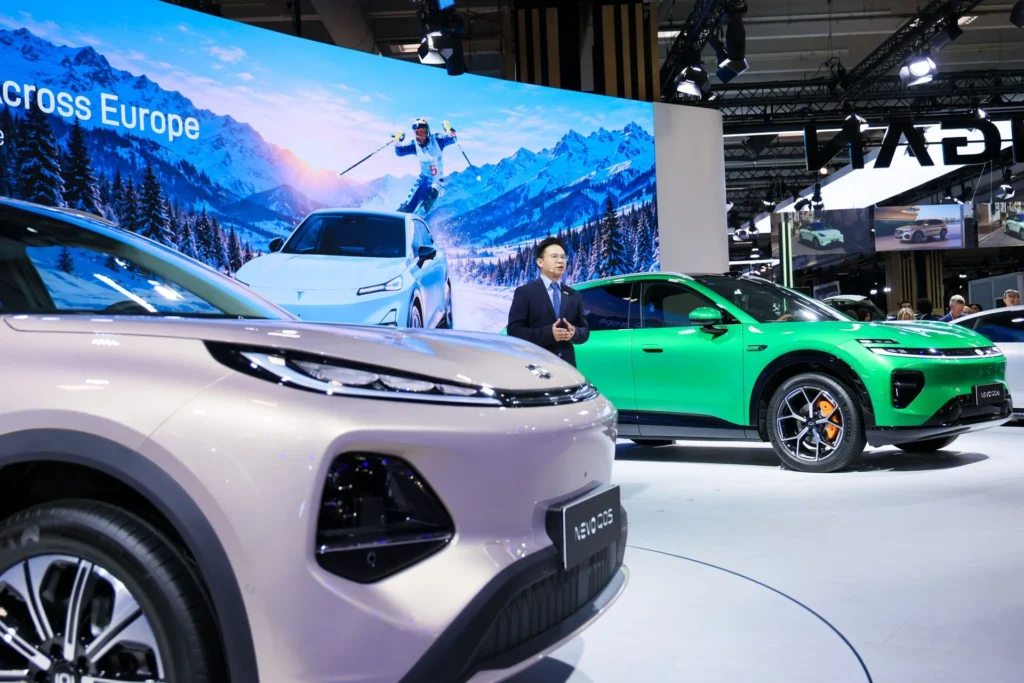
PARIS: Chinese automakers have emerged as one of the biggest forces at the 2026 Paris Motor Show, arriving with a broader range of electric vehicles, plug-in hybrids, range extenders, pickups and premium SUVs as they intensify competition with established European manufacturers.
Around 20 Chinese automotive brands are represented at this year’s show, more than double the number seen in 2024.
Their presence also reflects a wider shift in strategy. Chinese manufacturers are no longer relying only on battery-electric vehicles to expand overseas. Plug-in hybrids, range-extender electric vehicles and premium models are increasingly becoming part of their international push.
According to Reuters, Chinese brands now account for around 10.7% of the European car market, while their share of the plug-in hybrid segment has surpassed 26%.
For Pakistan, the developments are particularly relevant because several manufacturers displaying new vehicles in Paris — including BYD, Chery, Deepal and Zeekr — are already operating in the local market.
Not every model unveiled in Paris is expected to reach Pakistan, but the technologies and product strategies on display provide a useful indication of where the market may be heading.
BYD Pushes Faster Charging and More Hybrid Models
BYD has brought one of the broadest Chinese lineups to the Paris Motor Show, led by the new Atto 8, a seven-seat electric SUV.
The Atto 8 uses BYD’s second-generation Blade Battery with a capacity of 115 kWh and a manufacturer-claimed WLTP range of up to 653 km.
Charging performance is one of the model’s biggest highlights.
BYD claims its Flash Charging technology can charge the battery from 10% to 70% in five minutes and from 10% to 97% in nine minutes when connected to compatible high-power charging infrastructure.
Those figures bring charging times close to the duration of a conventional fuel stop, although such performance depends heavily on the availability of specialised charging equipment.
BYD is also showcasing the Dolphin G DM-i, which brings plug-in hybrid technology to a compact European-focused model.
The vehicle offers a claimed electric range of 105 km and a combined WLTP range of up to 1,040 km.
The Shark pickup, Atto 2 DM-i and Sealion 5 DM-i are also part of BYD’s Paris display.
Pakistan’s Charging Infrastructure Faces the Bigger Test
BYD has already announced plans for local assembly of the Sealion 6 PHEV in Pakistan.
Its Paris lineup shows how the company is expanding beyond imported electric vehicles and moving deeper into hybrid categories.
However, the Atto 8 also highlights an important challenge for Pakistan. Ultra-fast charging has limited practical value if compatible infrastructure is not available.
As charging technology advances, Pakistan’s charging network will have to evolve alongside the vehicles themselves.
Chery Expands With Hybrid SUVs and a Compact EV
Chery is making its first Paris Motor Show appearance under its main brand, bringing a range of electrified vehicles rather than relying on a single headline model.
The Tiggo 4 Hybrid is making its French debut with a 1.5-litre hybrid system producing a manufacturer-claimed 224 hp.
The larger Tiggo 7 is being offered in hybrid and plug-in hybrid versions, while the Tiggo 8 continues Chery’s PHEV strategy.
Chery is also displaying the Chery Q, a compact electric hatchback powered by a 41 kWh battery and a 121 hp motor.
The company claims a 400 km NEDC range for the model. That figure cannot be directly compared with WLTP range estimates quoted for other vehicles at the show.
Smaller Electrified Cars Could Matter More in Pakistan
Pakistani buyers already know Chery through the locally assembled Tiggo 8 PHEV.
The Paris lineup suggests how the company could eventually broaden its range below that larger SUV.
Smaller hybrid vehicles and electric hatchbacks could appeal to a wider segment of Pakistani buyers if they are introduced at competitive prices.
Omoda and Jaecoo Broaden Their Crossover Lineups
Omoda and Jaecoo are expanding beyond the larger SUVs that initially established their presence in international markets.
The Omoda 4 is making its French motor-show debut alongside the Omoda 5 Next.
The larger Omoda 7 and Omoda 9 PHEVs complete the upper end of the brand’s display.
Jaecoo, meanwhile, is showcasing the Jaecoo 5 Hybrid, Jaecoo 5 EV and electrified Jaecoo 7 variants.
The Jaecoo 5 Hybrid combines a 1.5-litre petrol engine with an electric motor using Chery Group’s hybrid technology.
Omoda Already Has a Pakistan Connection
The Omoda 4 has already attracted attention in Pakistan.
In September, the PakWheels team spotted a camouflaged Omoda C4 undergoing testing in Lahore.
A test vehicle does not confirm a commercial launch, but it gives local buyers and enthusiasts a reason to follow the model.
Jaecoo already competes in Pakistan through the J7 PHEV, which goes up against models such as the Deepal S05 REEV.
That rivalry also reflects a broader shift in the local market, where Chinese manufacturers are increasingly competing against each other rather than only challenging established Japanese and Korean brands.
Changan Uses Deepal and Nevo to Expand in Europe
Changan is using the Paris Motor Show to strengthen its European presence, showcasing Deepal while also introducing its Nevo brand to the region.
The Deepal S05 and S07 are among the models on display as Changan broadens its global electrification strategy.
Rather than depending entirely on battery-electric vehicles, the company is pursuing several different powertrain technologies for different markets.
Pakistani Buyers Will Need to Understand EV, PHEV and REEV Differences
Pakistan already has the Deepal S05 REEV, making range-extender technology familiar to some local buyers.
A REEV differs from a conventional plug-in hybrid in a key way.
In a typical PHEV, the petrol engine can directly drive the wheels. In a REEV, the petrol engine primarily generates electricity, while electric motors provide propulsion.
Both technologies offer petrol-powered backup, but their driving characteristics and energy-management systems differ.
As more Chinese manufacturers introduce EVs, PHEVs and REEVs, Pakistani consumers will increasingly need to understand these differences before deciding which type of electrified vehicle best suits their needs.
Zeekr Takes Aim at Premium European SUVs
Not every Chinese manufacturer at Paris is competing mainly on affordability.
Geely-owned Zeekr is targeting premium European brands with the 9X Super Hybrid and an updated version of the 7X electric SUV.
The refreshed Zeekr 7X delivers up to 680 hp, a manufacturer-claimed WLTP range of as much as 627 km and DC charging capability of up to 450 kW, depending on the variant.
Those specifications place the model in territory traditionally associated with high-end performance vehicles.
Pakistan’s Premium EV Market Is Entering a New Phase
The Zeekr 7X is already available in Pakistan, although the updated European version has not been confirmed for the local market.
Zeekr’s approach demonstrates how Chinese manufacturers are moving beyond their earlier reputation for affordable cars.
Performance, fast charging and luxury features are increasingly becoming part of their competitive strategy.
For Pakistani buyers, however, premium ownership will depend on more than headline specifications.
Warranty coverage, servicing, parts availability and practical charging access will remain equally important.
GAC AION Adds a Compact Electric Crossover
GAC has introduced the AION UT Cross at the Paris Motor Show, giving its compact electric hatchback platform a more crossover-oriented design.
The UT Cross features additional body cladding, roof rails and a more rugged appearance.
GAC claims a WLTP range of up to 400 km and 30% to 80% DC charging in 24 minutes under specified conditions.
The company is also displaying the GS7 plug-in hybrid SUV as it broadens its electrified portfolio.
Could the AION UT Cross Work in Pakistan?
GAC already has a connection to Pakistan through Lucky Motor Corporation and its AION vehicles.
The UT Cross could appeal to buyers seeking a compact EV with crossover practicality, although no Pakistan launch has been announced.
Its potential in the local market would depend heavily on pricing, ground clearance, equipment levels and after-sales support.
Why Chinese Automakers Are Bringing More Hybrids to Paris
The growing number of plug-in hybrids at the 2026 Paris Motor Show is not accidental.
European tariffs on Chinese-built battery-electric vehicles have influenced manufacturers’ export strategies, making hybrid models more commercially attractive.
But tariffs are only part of the explanation.
Not every buyer has convenient access to charging infrastructure.
PHEVs combine electric driving with petrol flexibility, while REEVs offer another approach to reducing dependence on regular charging stops.
Pakistan faces similar ownership questions, even though local market conditions are different.
A plug-in hybrid is not automatically cheaper to operate than a pure EV.
Running costs depend on charging habits, petrol consumption and daily mileage, making a proper understanding of PHEV technology important for buyers.
What the Paris Motor Show 2026 Signals for Pakistan
Chinese manufacturers are no longer trying simply to establish themselves in the global electric-car market.
They are building lineups for almost every type of buyer.
BYD is pushing battery and charging technology. Chery is expanding into smaller hybrids. Omoda and Jaecoo are broadening their crossover ranges. Changan is diversifying its powertrains, while Zeekr is targeting premium European competitors.
Pakistan is already experiencing parts of this transition.
However, impressive specifications alone will not determine which brands ultimately succeed in the local market.
Competitive pricing, reliable after-sales service, spare-parts availability and practical charging options will have the final say.
The competition is no longer only about EVs.
The next phase will be about which manufacturers can make electrified vehicles genuinely practical to own.