
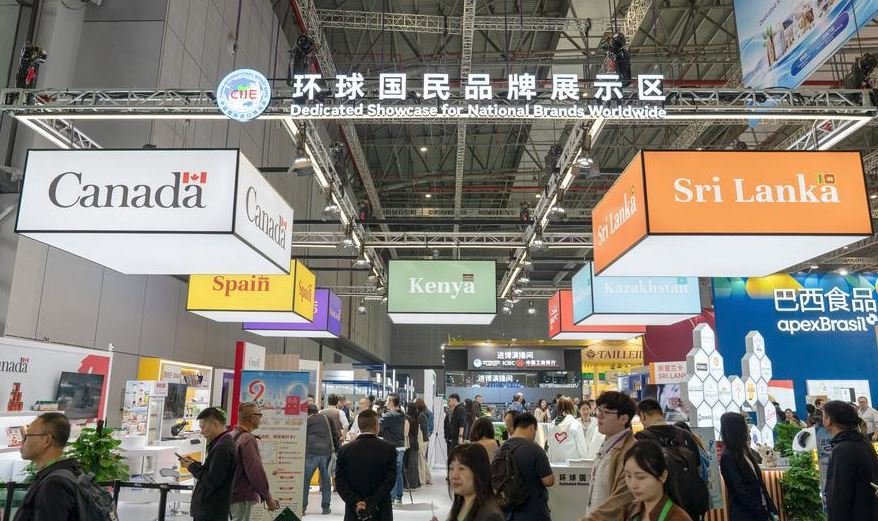
SHANGHAI, November 8, 2026: The ninth China International Import Expo (CIIE) in Shanghai is strengthening industrial cooperation across the Asia-Pacific region, as international businesses expand partnerships with Chinese manufacturers, technology providers and supply chains beyond traditional merchandise trade.
Companies from New Zealand, Australia, Japan, Thailand, Malaysia and other economies are using the expo to explore manufacturing partnerships, product innovation and access to China’s consumer market.
The event comes ahead of the Asia-Pacific Economic Cooperation (APEC) Economic Leaders’ Meeting scheduled to take place in Shenzhen later in November, with openness, innovation and cooperation identified as key priorities.
Participation from APEC economies has expanded, reflecting growing business interest in China’s market and industrial capabilities.
Canadian and New Zealand exhibitors have secured their largest exhibition areas in the expo’s history, while Australian companies have increased their exhibition space by 25 percent compared with last year.
US exhibitors have maintained the largest exhibition area for the eighth consecutive edition.
Since its launch in 2018, the CIIE has facilitated intended trade agreements worth more than $580 billion during its first eight editions, while over 3,400 new products, technologies and services have made their debuts at the event.
Businesses expand manufacturing and supply chain partnerships
New Zealand-based Pacific Alpacas illustrates how participation in the import expo can lead to long-term industrial cooperation.
After selling out its alpaca quilts during its first appearance in 2021, the company shipped 3.3 tonnes of alpaca fibre to China for processing the following year.
It subsequently established partnerships with Chinese textile manufacturers, marketing agencies and e-commerce platforms.
A textile mill in Jiangsu Province helped improve product quality, while a marketing agency in Shandong Province supported the company’s expansion into livestream commerce.
Pacific Alpacas director Hu Tao said the expo’s importance extended beyond transactions completed during the exhibition, creating additional business opportunities through long-term partnerships.
Japanese electronics manufacturer Panasonic is similarly expanding its integration with Chinese industrial networks.
The company, participating in the expo for the ninth time, is moving from its earlier “China for China” approach towards a “China for Global” strategy.
Panasonic executive Masaharu Nakayama said the company was using its network of more than 3,000 Chinese suppliers to strengthen research, development and supply chain capabilities.
Under the strategy, innovations and products developed in China are increasingly being introduced to international markets.
Thai and Malaysian companies explore new opportunities
Thailand’s TCP Group, associated with the Red Bull brand, is using the expo to introduce products developed specifically for Chinese consumers.
Its new vitamin electrolyte beverage combines a product concept originating in Thailand with flavours tailored to Chinese preferences.
The product was developed and manufactured by China-based teams in cooperation with local supply chain partners.
TCP Group has also expanded its manufacturing presence through production facilities in Sichuan Province and Guangxi Zhuang Autonomous Region.
The company said the expo provided opportunities to assess consumer demand, introduce new products and establish business partnerships.
Malaysian agricultural producers are also using the event to reach Chinese buyers, showcasing premium tropical fruits, including Musang King and Black Thorn durians.
Industry representatives said improved trade connectivity and market access were helping smaller businesses develop international sales channels.
APEC cooperation supports regional economic integration
According to official APEC statistics, the organisation’s 21 member economies represented approximately three billion people and accounted for 61.6 percent of global real GDP in 2025.
Ng Yih Pyng, president of the Associated Chinese Chambers of Commerce and Industry of Malaysia, expressed hope that the upcoming APEC CEO Summit would encourage smoother trade flows, stronger industrial partnerships and new commercial opportunities.
Paijit Viboontanasarn, vice chairman and secretary general of the Thai Chamber of Commerce in China, said the CIIE offered businesses opportunities beyond identifying importers.
He explained that companies could use the platform to build brands, connect with online and offline distribution networks, test business models and establish manufacturing partnerships.
The growing participation of Asia-Pacific companies highlights the expo’s evolving role as a platform connecting international businesses with China’s manufacturing, innovation and consumer markets.