
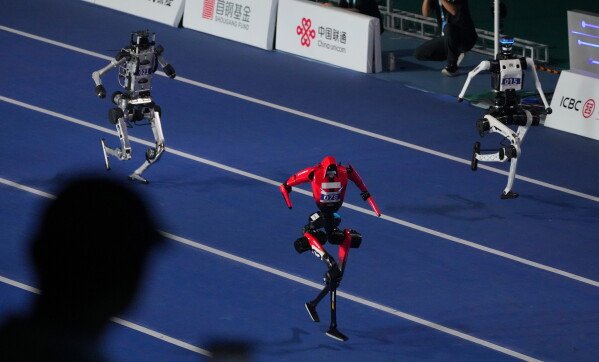
BEIJING: Chinese humanoid robots have posted performances faster than long-standing human records at the second World Humanoid Robot Games in Beijing, highlighting rapid advances in embodied artificial intelligence while also exposing the technical challenges that remain before widespread real-world deployment.
The five-day competition at Beijing’s National Speed Skating Oval has brought together 2,056 robots from 666 teams across 16 countries, competing in 51 events ranging from sprinting and football to factory work, retail tasks and household services.
One of the most closely watched performances came from Tiangong Ultra, developed by the Beijing Humanoid Robot Innovation Center, which completed the 100 metres in 9.39 seconds.
The time was numerically faster than Usain Bolt’s men’s world record of 9.58 seconds, set in 2009, although robot performances are not part of World Athletics records and are not directly comparable with official human competition.
Another robot, Honor’s Lightning, finished the race in 9.47 seconds, according to Reuters. Both machines were substantially faster than the winning time at last year’s inaugural competition.
Games test more than speed
Organisers are using the World Humanoid Robot Games not only to showcase athletic performance but also to test whether robots can operate reliably and independently in complex environments.
Competitions include industrial assembly, warehouse logistics, food preparation, retail services and precision tasks requiring robots to manipulate small objects.
More than 40 per cent of the competitions require full autonomy, according to Reuters, placing greater emphasis on robots’ ability to perceive their surroundings and make decisions without direct human control.
Track and sporting events have also expanded this year, with table tennis, weightlifting and tug-of-war among the new additions.
Robots have competed in football matches, tennis demonstrations and other events designed to test balance, vision, coordination and rapid decision-making.
The increased emphasis on autonomy marks a shift from earlier robot exhibitions, where machines were often remotely controlled or demonstrated in carefully prepared environments.
Embodied AI takes centre stage
The performances come amid growing investment in embodied AI, a field that combines artificial intelligence with physical machines capable of interacting with their surroundings.
China has identified humanoid robotics as a strategic technology sector, and companies are increasingly trying to move machines from laboratories into factories, warehouses and consumer settings.
The World Robot Conference, held in Beijing during the same week, featured humanoid robots sorting parcels, packing products and performing household tasks as manufacturers sought to demonstrate practical uses for the technology.
The sector has also attracted significant investor attention following the Shanghai stock market debut of Unitree Robotics.
Unitree shares surged as much as 629 per cent on their first day of trading before closing around 460 per cent above their offer price, giving the company a market value of about $50 billion.
Reliability remains a major hurdle
Despite the eye-catching results, robotics engineers say speed and strength alone do not determine whether humanoid machines are ready for everyday use.
High-speed and long-distance movement can place considerable strain on joints, motors and structural components, while practical deployment requires robots to repeat tasks reliably over long periods.
That limitation was visible even in the sprint competition, where some high-speed robots crashed after crossing the finish line.
Real-world tasks can prove even more difficult because robots must cope with unpredictable environments, objects placed slightly out of position and situations they have not encountered before.
Industry specialists increasingly view such tests as more significant than headline-grabbing athletic records because commercial robots will ultimately be judged by whether they can perform useful work safely, consistently and autonomously.
The expanding scale of the Beijing games reflects the rapid growth of the humanoid robotics sector and the intensifying effort to turn advances in embodied AI into machines capable of operating outside controlled laboratory environments.
Also Read: China robotics boom takes centre stage at packed Beijing fair