
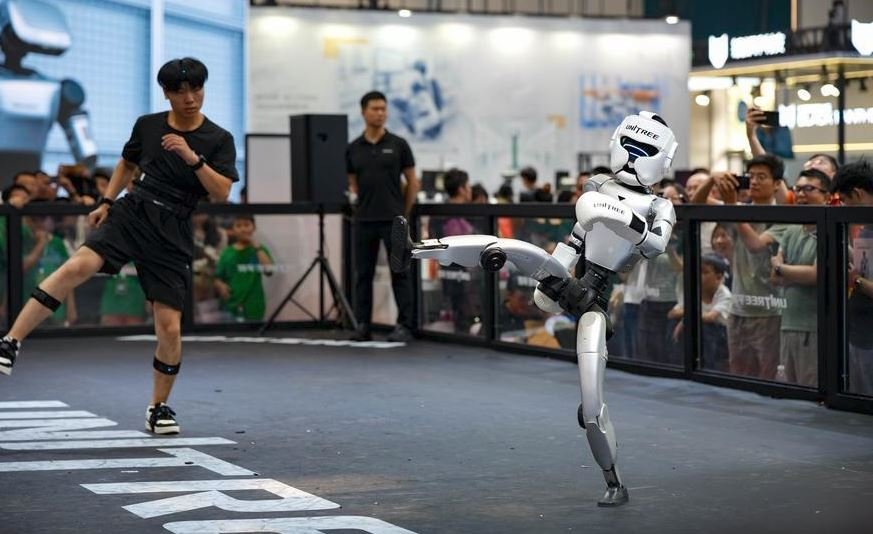
BEIJING: China’s rapidly expanding robotics industry is drawing large crowds and fresh investment as the 2026 World Robot Conference in Beijing showcases thousands of products ranging from humanoid machines to industrial automation systems.
The event comes during a high-profile week for the sector, marked by the stock market debut of Unitree Robotics and the World Humanoid Robot Games. Together, the developments highlight China’s push to move robotics beyond demonstrations and into factories, logistics, healthcare and consumer services.
China’s robotics sector has grown sharply in recent years. Revenue at industrial enterprises above designated size in the industry exceeded 300 billion yuan, or about $44 billion, in 2025, according to official data cited by state media.
The World Robot Conference has also expanded significantly. More than 300 exhibitors are taking part this year, displaying around 3,000 products, including hundreds of new launches. Many incorporate large AI models, cloud computing and other forms of advanced automation.
Humanoid robots move closer to real-world use
China has emerged as the dominant producer of humanoid robots, with domestic manufacturers accounting for the overwhelming majority of global shipments in the first half of 2026, according to industry estimates.
At the Beijing exhibition, companies are focusing increasingly on practical applications rather than purely experimental displays.
Demonstrations include logistics robots capable of sorting parcels, dexterous robotic hands assembling packaging and humanoid machines performing industrial loading and unloading tasks.
UBTECH is among the companies demonstrating robots for automotive manufacturing, while technology and consumer electronics groups are also displaying machines designed for factory and household use.
The conference floor also features robots developed for retail, coffee preparation, domestic assistance and companionship, reflecting efforts by manufacturers to find commercially viable applications in China’s large consumer market.
Industry executives say the shift towards real-world deployment is becoming one of the defining features of the sector.
“Robots are no longer only about flashy concepts and specs. They’re increasingly focused on tackling real-life challenges,” Ren Jingwei of Zhiyuan Research Institute said.
Unitree IPO adds momentum
Investor interest in the sector intensified after Hangzhou-based Unitree Robotics made its debut on Shanghai’s STAR Market on August 19.
The company’s shares opened at 1,100 yuan, up 629.44 per cent from an IPO price of 150.8 yuan, briefly valuing the company at nearly 445 billion yuan.
Unitree develops humanoid and quadruped robots and has become one of China’s most prominent robotics companies.
Its founder and chief executive Wang Xingxing said at the conference that embodied artificial intelligence could reach a major technological breakthrough comparable to the “ChatGPT moment” within the coming years.
Wang said such a breakthrough would involve robots being able to understand instructions and perform a wide range of tasks in unfamiliar environments. He cautioned, however, that the transition could still take between two and 10 years.
Supply chain broadens
Another notable feature of this year’s conference is the growing presence of companies supplying components rather than complete robots.
Sensor manufacturers, joint-module makers, chip developers and producers of dexterous robotic hands are taking a more prominent role as China’s robotics supply chain becomes increasingly specialised.
Industry experts say growth in humanoid robots could drive demand across precision transmission systems, smart sensors, AI chips and intelligent software, creating opportunities across research, manufacturing and after-sales services.
China’s large manufacturing base is also providing a testing ground for embodied AI systems. More than 70 robot training facilities had been established across the country by June, with dozens more under construction or being planned, according to industry data.
The growing emphasis on training, industrial deployment and specialised components suggests the country’s robotics sector is moving towards a broader commercial ecosystem.
For now, significant technical challenges remain. Industry experts note that humanoid robots still struggle with many complex tasks and are often less efficient than human workers in practical settings.
Even so, the scale of this year’s Beijing conference, strong investor interest and the rapid growth of domestic manufacturers are reinforcing China’s position as one of the world’s most active centres for robotics development.
Also Read: China activates flood emergency response as Typhoon Narra threatens south