
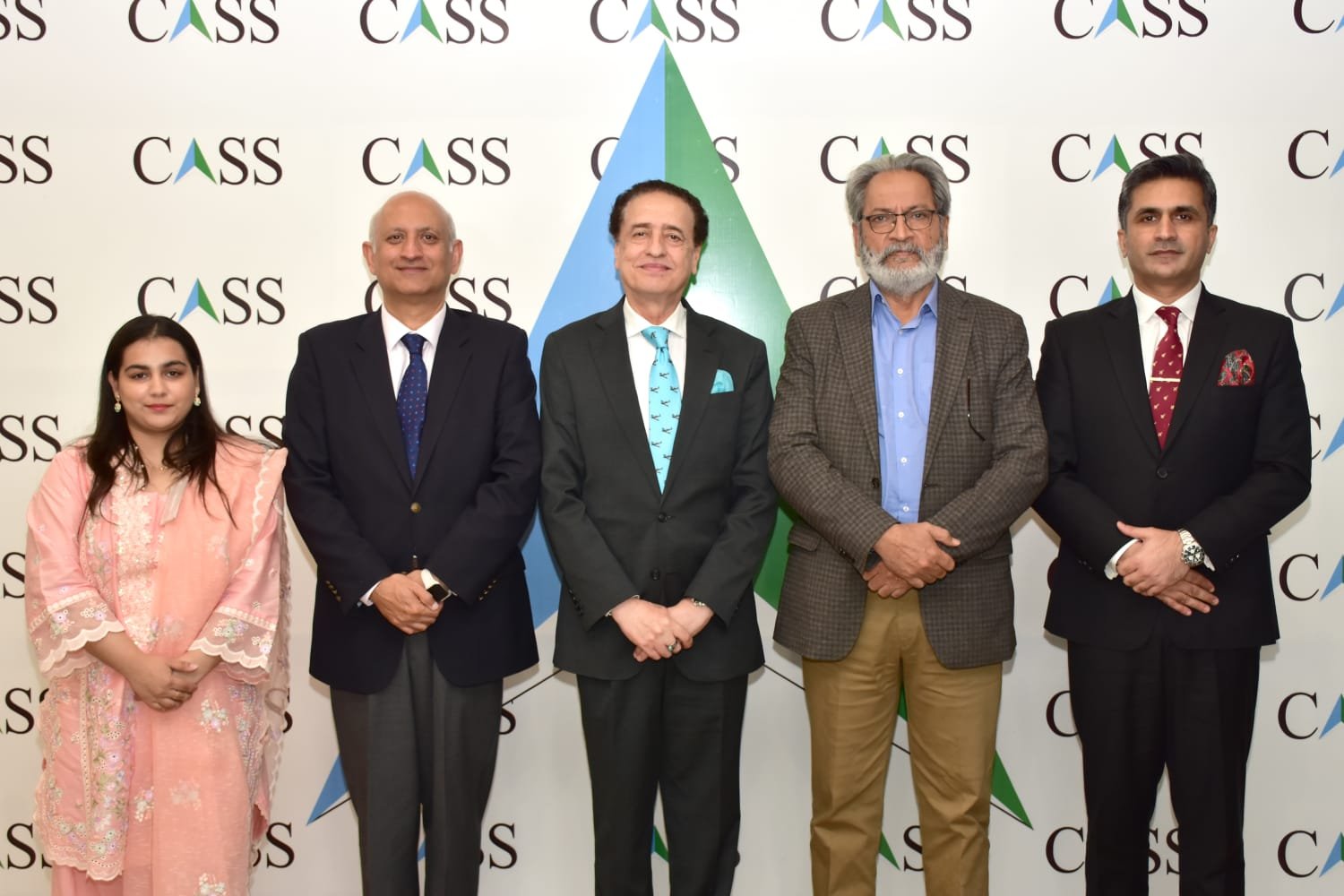
LAHORE: Pakistan must convert its geopolitical importance and strategic partnerships into investment, technology transfer, industrial capacity and export competitiveness if it is to achieve sustainable economic growth, experts said at a policy dialogue organised by the Centre for Aerospace and Security Studies (CASS) Lahore.
The event, titled “Redefining Power: Geoeconomics, Technology and Security in an Era of Strategic Competition,” brought together academics, policy specialists, intellectuals and security experts to examine how economic strength, technology and national security are increasingly shaping global power.
Ms Sibra Waseem, Research Assistant at CASS Lahore, delivered the opening remarks at the session held on August 19.
Speaking at the event, Haroon Sharif, Chairman of PREF Islamabad, said Pakistan should build on its geopolitical relevance by transforming strategic relationships, including the China-Pakistan Economic Corridor (CPEC), into tangible economic outcomes.
He said Pakistan’s location offered significant opportunities, but those advantages would have to be backed by investment, technology transfer and stronger industrial ecosystems.
Sharif also called for greater diversification of Pakistan’s energy mix to reduce the economy’s exposure to imported oil. He noted that imported oil accounts for around 85 per cent of the country’s requirements, making energy security an important economic and strategic concern.
Highlighting Pakistan’s employment challenge, he said the country also needed to create opportunities for around four million people entering the labour market every year.
He advocated greater focus on sectors capable of generating value addition, higher productivity and exports, supported by research and development, knowledge partnerships and increased private-sector participation.
Dr Safdar Sohail, Executive Director of SPRC Islamabad, said Pakistan needed to connect its geopolitical relationships more closely with its economic transformation.
He argued that strategic opportunities arising from relations with major partners, including the United States and through CPEC, should be channelled into manufacturing capacity, technology partnerships and stronger export competitiveness.
With Pakistan still dependent on a relatively narrow export base, Sohail stressed the importance of development finance and a coherent industrial policy.
He also highlighted the growing economic role of provinces following the 18th Constitutional Amendment, saying stronger data systems, standards and closer integration among finance, manufacturing and small and medium enterprises could help build a more self-sustaining economy.
During his remarks, Sohail also praised the Pakistan Air Force’s performance during the May 2025 Pakistan-India conflict, particularly in the context of the country’s financial constraints.
Concluding the discussion, Air Marshal Asim Suleiman (Retd), President CASS Lahore, said conventional military capability remained critical, but national power could no longer be assessed through military strength alone.
He said economic resilience, technological capacity and national security had become deeply interconnected, with disruption in one area capable of affecting the others.
For Pakistan, he added, the changing nature of strategic competition was particularly important because of the country’s geostrategic location, regional connectivity and expanding digital economy.
Suleiman said these advantages needed to be converted into sustained economic gains rather than remaining largely geopolitical assets.
He also underlined the importance of human capital development and referred to Air Chief Marshal Zaheer Ahmed Baber Sidhu’s emphasis on making effective use of skilled personnel and available resources within the Pakistan Air Force.
The speakers broadly agreed that Pakistan’s future influence would depend increasingly on its ability to combine security capability with economic strength, technology adoption, industrial development and a competitive export sector.
The session concluded with an interactive discussion on economic geography, growth models and the policy framework needed to support long-term development.
Participants appreciated CASS Lahore’s initiative in bringing together experts to examine the changing relationship between geoeconomics, technology and national security.
Also Read: Pakistan, Sri Lanka Discuss Future Warfare, Defence Technology Cooperation at CASS Islamabad