
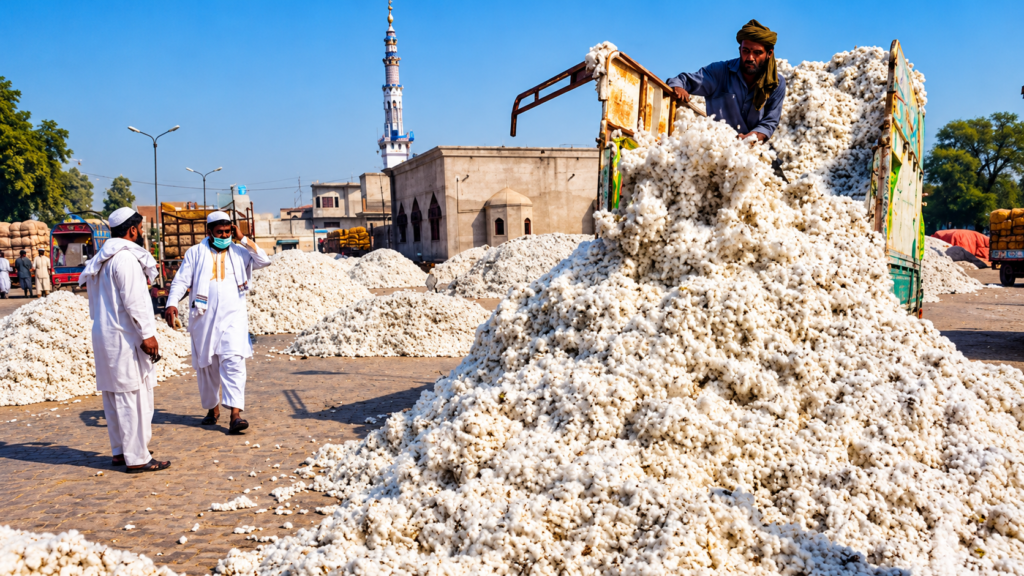
KARACHI, November 22, 2026: Cotton prices in Pakistan remained largely unchanged despite a sharp decline in international markets, as limited supplies of high-quality cotton prevented local rates from falling. Buying activity by domestic textile mills also slowed considerably during the week.
Cotton traded at a maximum of Rs18,500 per maund in local markets, while Balochi cotton remained at Rs19,600 per maund. The New York Cotton Exchange, meanwhile, recorded a decline of 3.62 cents per pound in December cotton futures contracts during the previous week.
The contrasting market trends were highlighted by Cotton Ginners Forum Chairman Ehsanul Haq in comments carried by Express News, which linked the international downturn to expectations of reduced trade tariffs between the United States and China following a meeting involving the leaders of the US, China and Russia.
Haq said the decline in global cotton prices had prevented any upward movement in Pakistan’s cotton market, although the shortage of quality produce continued to support domestic prices.
Turning to agricultural policy, he disclosed that the newly established National Agriculture and Food Security Advisory Council (NAFSAC) had held its first meeting to discuss measures for increasing cotton production and improving yields of other major crops.
He expected three agricultural institutions — the Pakistan Central Cotton Committee, Pakistan Agricultural Research Council and Pakistan Cotton Standards Institute — to be merged into the proposed council.
The Cotton Ginners Forum chairman also referred to a recent meeting between a senior delegation of the All Pakistan Textile Mills Association (APTMA) and Federal Secretary for National Food Security and Research Aamir Ali Ahmed in Islamabad.
The discussions focused on measures to restore Pakistan’s annual cotton production to 15 million bales.
Haq maintained that the revival of the cotton industry would remain difficult without strict enforcement of crop zoning regulations.
He urged the prime minister and the Ministry of National Food Security to implement these regulations immediately, calling for a complete ban on sugarcane cultivation in designated cotton-growing areas and the closure of sugar mills operating in those zones.
Such measures, he argued, would help Pakistan reduce its dependence on cotton and edible oil imports, which cost the country billions of dollars annually.