
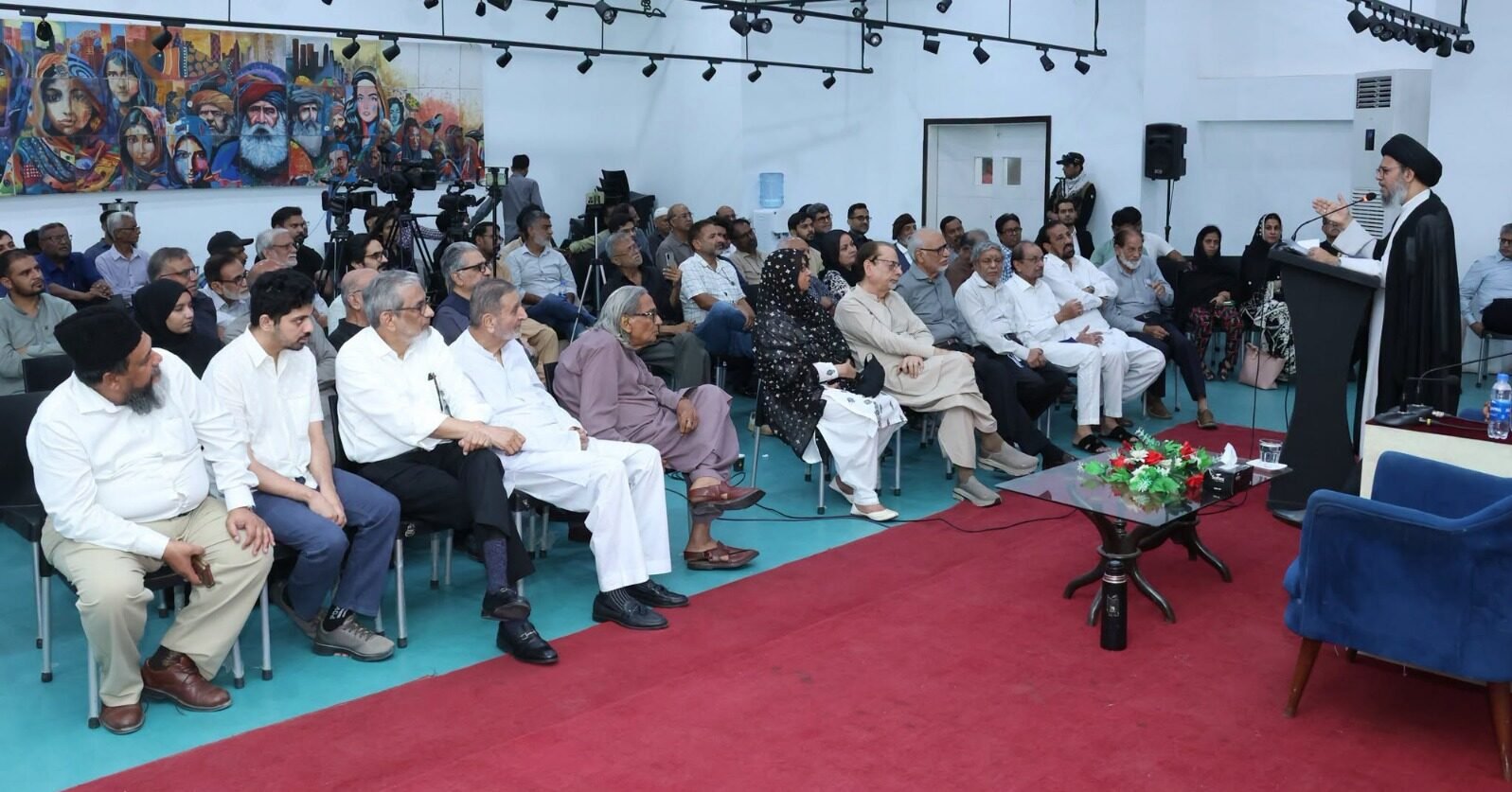
The Arts Council of Pakistan Karachi hosted an extended lecture by renowned scholar, researcher and literary figure Ayatullah Allama Syed Aqeel-ul-Gharavi, who explored the literary tradition of Salam in Urdu poetry and highlighted its independent status as a distinct poetic genre.
Held at Haseena Moin Hall, the event brought together writers, poets, researchers, academics, students and literature enthusiasts. The lecture focused on the creative and critical dimensions of Salam, emphasizing its literary heritage, spiritual significance and the need for further academic research. The session was moderated by Syed Javed Hassan, while Arts Council President Mohammad Ahmed Shah welcomed the guest speaker.
Scholar highlights literary significance of Salam
Speaking on the topic, “The Genre of Salam in Urdu Poetry: A Study in Creative Tradition and Critical Insight,” Ayatullah Aqeel-ul-Gharavi said the tradition of Salam in Urdu literature is both rich and extensive. He noted that although many works have already been published, a significant body of literature remains undocumented and requires scholarly research.
He said Salam may not match the ghazal in terms of volume, but it holds a distinctive place in Urdu literature because of its intellectual and literary value.
The scholar explained that many forms of Urdu poetry trace their origins to Persian literary traditions influenced by Arabic literature. He added that the ghazal itself evolved from Arabic into Persian before becoming a central part of Urdu poetry.
Salam is an independent poetic genre
Discussing the Arabic concept of Qasida, Ayatullah Aqeel-ul-Gharavi said the term has a broader meaning than its common usage in Urdu, encompassing poetic forms such as manqabat, marsiya, nauha and, in some contexts, even the ghazal.
He emphasized that Salam is neither derived from the ghazal nor a subgenre of it. Instead, he said classical forms including Qasida, Hamd, Naat, Salam, Marsiya and Manqabat share similar poetic structures while differing in their themes and stylistic approach.
According to the scholar, the ghazal primarily explores human emotions and worldly experiences, whereas Salam reflects spirituality, reverence, purity and devotion, giving it a unique identity within Urdu literature.
Call for further research on Urdu literary traditions
Ayatullah Aqeel-ul-Gharavi encouraged scholars to undertake further research on Salam and Qasida, noting that many works in both genres share identical poetic metres. He said these similarities offer valuable opportunities for literary and critical studies in Urdu and Persian poetry.
Speaking about Marsiya and Salam, he stressed that while expressing grief over the tragedy of Karbala remains central to the tradition, literature should also highlight the patience, courage, steadfastness and moral character of Imam Hussain (AS). He said Imam Hussain should be remembered not only as a symbol of suffering but also as an enduring example of dignity and resilience.
He added that mourning reflects the emotional response of believers, while literature has the responsibility of preserving and presenting the greatness and enduring legacy of Imam Hussain. He also referred to Mirza Ghalib’s treatment of the subject in his literary works.
Arts Council president praises scholar’s contribution
Arts Council of Pakistan Karachi President Mohammad Ahmed Shah described Ayatullah Aqeel-ul-Gharavi as an accomplished scholar known for combining philosophy, literature, Islamic studies and logical reasoning in his lectures.
He said audiences have benefited from the scholar’s lectures on philosophy, Allama Iqbal, Islam, science and other subjects, each offering fresh intellectual perspectives. Shah noted that the lecture underscored the literary importance of Salam and encouraged further academic discussion and research.
Recalling a period when the scholar was unable to visit Pakistan, Shah said many admirers continued to follow his lectures delivered from the United Kingdom. He welcomed his return, saying it had strengthened the Arts Council’s role as a platform for scholarly dialogue.
He also expressed interest in organizing a future interactive session with university students to promote critical thinking and academic engagement.
Following the lecture, Mohammad Ahmed Shah accompanied Ayatullah Aqeel-ul-Gharavi on a visit to the Josh Malihabadi Library, where he introduced him to its collection of rare books, manuscripts and research materials. The scholar praised the library as an important academic resource for researchers, scholars and students.
Also Read :Arrested Militant Reveals Recruitment, Training and Attack Network in Balochistan