
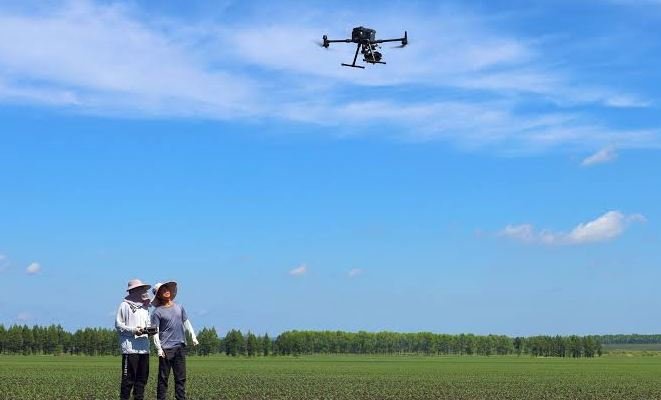
HARBIN: Agricultural drones are transforming farming practices across the vast black-soil farmlands of northeast China’s Heilongjiang Province, helping farmers improve productivity, reduce operational costs and adopt precision agriculture.
From sowing and fertilisation to pesticide spraying and crop protection, intelligent agricultural drones are becoming an increasingly important component of China’s agricultural modernisation.
Wang Zhenguo, a rice grower in Wuchang, Heilongjiang Province, purchased his first DJI agricultural drone in 2019 and has since upgraded his equipment annually.
He currently operates a DJI T100S drone to apply fertilisers and pesticides across more than 40 hectares of rice fields.
“Fertilizing the entire plot took just over two days. Manual labor could never match that throughput,” Wang told Xinhua.
Growing Adoption of Agricultural Drones
DJI Agriculture, a Shenzhen-based agricultural drone technology company, has witnessed a significant shift towards direct ownership of drones by farmers.
According to company data, farmers accounted for 60 percent of its agricultural drone customer base nationwide in 2025, compared with around 10 percent in 2016, when most growers relied on professional aerial spraying services.
Approximately 33,000 DJI smart crop-protection drones were operational in Heilongjiang in 2025, completing cumulative field operations covering nearly 40 million hectares.
The company has also trained 45,000 drone operators across the province, contributing to the emergence of a digitally skilled agricultural workforce.
Higher Efficiency and Reduced Pesticide Consumption
Heilongjiang’s extensive and relatively flat agricultural landscape provides favourable conditions for drone-based farming operations.
Agricultural drones are particularly useful in densely planted cornfields and rice paddies, where conventional machinery and manual spraying face operational challenges.
Lin Zhengping, a researcher at Heilongjiang’s plant protection and quarantine station, said drones enabled more efficient and uniform pesticide application while reducing chemical consumption.
According to Lin, compared with manual spraying, agricultural drones offer:
More than 20 times higher operational speed.
Over 50 percent reduction in water consumption.
Between 20 and 40 percent reduction in pesticide consumption.
Drone technology also enables farmers to respond more rapidly to sudden crop diseases and pest outbreaks, helping minimise potential agricultural losses.
China Advances Smart Agriculture
The widespread adoption of agricultural drones in Heilongjiang forms part of China’s broader strategy to modernise agriculture through intelligent machinery, precision farming and low-altitude technologies.
Chinese Vice Minister of Agriculture and Rural Affairs Zhang Xingwang said technological advancements were continuing to improve agricultural productivity.
According to figures cited by Zhang, China has more than 300,000 active agricultural drones, collectively covering over 30 million hectares of farmland annually.
The growing integration of drone technology into agricultural operations highlights China’s transition towards more efficient, technology-driven and resource-conscious farming practices.