

The sun took its time setting over the gardens of Jati Umra that evening, as though it wanted to watch a little longer. A daughter, raised on years of tenderness and prayer, was stepping toward a new chapter of her life. Mah Noor’s nikah to Azan Jabbar was solemnized in that hushed, sacred stillness where joy needs no audience, and where bonds are tied in the language of prayer. But the moment glimpses of that private evening reached the public eye, something else surfaced too — proof that among us lives a tongue more practiced in wounding than in blessing.
Speech is the gift that sets us apart from every other creature, and it is also our sharpest trial. The same tongue that pronounces a nikah can just as easily spread a slander. The same voice that offers a prayer for the bride can turn, in an instant, into a blade aimed at her photograph. The difference is never in the tongue itself — it is in the heart behind it. The Prophet Muhammad (peace be upon him) said that whoever believes in God and the Last Day should speak what is good, or say nothing at all. That is not a passing piece of etiquette. It is an entire philosophy of living — one that tells us silence, when there is nothing kind to say, is itself a form of worship.
A daughter’s farewell from her father’s house is, in our tradition, no ordinary occasion. It is the fulfillment of a trust carried for years. When a girl raised within the same four walls finally crosses into a new home, that moment belongs equally to everyone who loves her — a mother’s eyes well up, a father’s silence carries a lifetime of unspoken prayer, and the elders of the family watch, smiling, as another generation quietly turns its page. That was the scene in Jati Umra. For Chief Minister Maryam Nawaz Sharif, it was, before anything else, a mother’s evening. For Captain (Retd.) Muhammad Safdar, a father’s quiet prayer. And for Mian Muhammad Nawaz Sharif, watching his granddaughter begin this new journey carried the particular ache and pride every grandfather knows. To this entire family, we offer our heartfelt congratulations and warmest prayers — may God fill Mah Noor and Azan’s life together with love, stability, and lasting peace.
And yet, no sooner had this sacred moment become visible than certain voices turned it into a stage for their own bitterness. Political rivalry, personal grudges, or simply the quiet unease some feel at the sight of another’s happiness — all of it converged into commentary that reflected neither decency nor upbringing. Old, tired political accusations were dragged back out and mockingly attached to a wedding that had nothing to do with them. Others busied themselves pricing the bride’s outfit and jewelry, as though someone’s family joy were a transaction to be appraised rather than a moment to be honored.
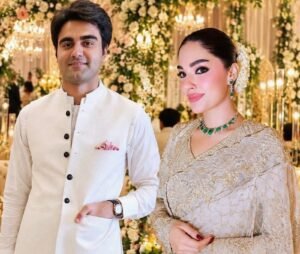
Here is a simple question, and most people already know the answer in their hearts: which parents, in our society, do not give more than they can afford when it comes to their daughter’s wedding? A poor father borrows to provide a dowry. A middle-class family empties years of savings in a single day. A family of greater means spends according to what it has. The circumstances differ; the love does not. It is the same instinct everywhere — the wish to give a daughter the very best one can manage. Anyone who sits down to calculate the price of another family’s wedding attire is not commenting on wealth. They are insulting the very love every father carries for his daughter, whether he expresses it in gold or in nothing more than a heartfelt prayer.
And there is something else that needs saying, perhaps more than anything else: those quick to aim their criticism at someone else’s daughter’s wedding — do they, even for a moment, picture their own mother, their own sister, their own daughter? Would they accept the same treatment turned back on their own household — their sister’s wedding photos picked apart, their daughter’s dowry priced in public comments? If the answer is no — and it always is — then this is not principle. It is hypocrisy wearing the mask of opinion. Political disagreement is one thing. But when that disagreement forgets the basic truth that every daughter, every sister, deserves the same dignity, it stops being disagreement. It becomes hostility toward the very values that hold a society together. For God’s sake, let disagreement never be allowed to travel that far — to the point where simple humanity gets left behind.
None of this is an argument against political criticism itself. Disagreement is healthy, even necessary — questioning policy, holding leadership accountable, debating openly: these are the marks of a functioning society. But that kind of scrutiny has a boundary, and the boundary is government, not the family dinner table. It does not climb over someone’s garden wall and follow their daughter down the aisle. Once it crosses that line, disagreement curdles into hostility, and criticism collapses into simple rudeness.
The Quran describes backbiting through an image so visceral it should stop anyone in their tracks — eating the flesh of one’s own dead brother. That is not a mild warning. It is a description of what actually happens when we turn someone’s dignity, their private joy, into material for our tongues: we consume something of our shared humanity. The Companions of the Prophet lived by a different instinct entirely — they showed up fully for each other’s joy, offered prayers at every wedding, and even when a private grievance sat quietly in their hearts, they never let it eclipse someone else’s happiness. That is the standard worth returning to.
Social media has placed something more powerful than speech itself into every hand — a pen that can reach millions in seconds. That kind of reach demands an equal weight of responsibility. Every finger that types mockery of someone else’s joy is, in that instant, broadcasting something about its own upbringing, its own household’s values, its own state of heart. Words are never empty vessels. They always carry a trace of the soul that sent them.
What is needed now is simple, and it starts with a question each of us can ask before we type anything at all: will this word comfort a heart, or wound one? Will this comment spread love, or resentment? The day we start asking that question honestly, our words will become instruments of blessing instead of injury.
For Mah Noor and Azan, the prayer is simple — a life together full of love, trust, and quiet contentment. And for the rest of us, the prayer is this: that God grant us the grace to join in each other’s happiness wholeheartedly, and that before we lift a pen to criticize, we remember the face of our own mother, our own sister, our own daughter. Because a society that forgets how to bless another’s joy has, without realizing it, lost the capacity for its own.