

By Syeda Amnah Batool
At a time when the Middle East stood dangerously close to a wider conflict, and direct communication between Iran and the United States had nearly collapsed, a quiet but consequential diplomatic channel began to take shape. That channel was Pakistan. What unfolded in March and early April 2026 was not loud or theatrical diplomacy, but something far more difficult measured engagement in a highly volatile environment where even a small misstep could have triggered irreversible escalation.
As tensions rose, Pakistan did not confine itself to routine statements or symbolic gestures. Instead, it stepped into a role that very few countries were capable of playing. Reporting by Reuters repeatedly described Pakistan as a “key intermediary”, highlighting its ability to relay messages and facilitate indirect engagement between adversaries who were no longer speaking directly. In a widely cited analysis, Reuters went further, calling Pakistan’s role a transformation “from international outcast to mediator”, underscoring how quickly Islamabad had repositioned itself in a moment of global crisis.
This was not ceremonial diplomacy it was real-time crisis management. According to Reuters’ correspondents Ariba Shahid and Gibran Peshimam, communication between Washington and Tehran was, at critical points, being sustained through Pakistani channels. A senior Western diplomat, quoted in their reporting, acknowledged that Pakistan had become “one of the few countries able to talk to both sides at the same time.”
Analysts tracking the crisis also reinforced this assessment. Michael Kugelman, a South Asia specialist at the Wilson Center, noted in policy commentary that Pakistan’s ability to engage both sides simultaneously made it “uniquely positioned to serve as a backchannel when others cannot.” His observation reflects a broader consensus among strategic analysts that access not alignment was Pakistan’s greatest diplomatic asset in this crisis.
What made this possible was not coincidence, but consistency. Pakistan maintained working relationships with both Tehran and Washington when many others had lost access. Analysts cited in international coverage pointed out that Islamabad had preserved direct communication lines with both capitals, allowing it to transmit proposals and reduce the risk of miscalculation at a highly sensitive stage.
The leadership approach during this period reflected a careful balance. Under Shehbaz Sharif, diplomatic outreach remained steady and focused on de-escalation. At the same time, the role of Asim Munir added institutional credibility. Reuters reporting noted that Pakistan’s military leadership had helped “rebuild trust with Washington”, a factor that strengthened Islamabad’s ability to operate as a credible interlocutor.
Recognition of Pakistan’s role came directly from global leadership. Iranian President Masoud Pezeshkian, in his engagement with Pakistan’s leadership, emphasized that “trust is essential for talks” and acknowledged Pakistan’s diplomatic outreach as a constructive step. On the American side, reporting confirmed that the office of U.S. Vice President JD Vance had been in contact with Pakistani intermediaries during key moments, reflecting confidence in Islamabad’s ability to carry sensitive communication.
Regional voices further reinforced this perception. Coverage in Al Jazeera described Pakistan’s role as central to ongoing de-escalation efforts, with one analysis referring to it as part of a “Pakistan-led push to revive negotiations.” Meanwhile, Dawn, in its editorial commentary, observed that Pakistan’s offer to mediate reflected “growing diplomatic confidence” and a willingness to step beyond reactive foreign policy. Even beyond media, policy circles took note. Analysts at the Chicago Council on Global Affairs highlighted Pakistan’s emergence as a practical intermediary, noting that Islamabad was actively passing messages and coordinating with multiple stakeholders. Their assessment reinforced the idea that Pakistan’s role was not symbolic, but operational.
At the public level, the emotional dimension of the crisis was equally visible. Demonstrations across parts of the region reflected strong reactions to developments in Iran, and in some instances symbolic displays including Pakistani flags appeared alongside expressions of solidarity. This illustrated how Pakistan’s position resonated not only at the diplomatic level but also within broader public consciousness.
At home, however, the picture was more complex. Political criticism, from opposition, questioned aspects of the government’s approach. Some voices dismissed the mediation effort as overstated, while others raised concerns about transparency. Yet such reactions are not unusual. As Michael Kugelman has observed in broader commentary on diplomacy, backchannel engagement often appears ambiguous while it is underway, but its value becomes clearer in retrospect. What remains undeniable is that Pakistan was among the very few countries trusted by both sides during a moment of extreme tension. In global politics, that kind of trust is neither accidental nor easily earned.
This moment also reflects a deeper historical continuity. In the early 1970s, Pakistan quietly facilitated the opening between the United States and China, leading to Richard Nixon’s historic visit to Beijing. That episode reshaped global geopolitics. Today’s situation, while different in context, echoes that legacy Pakistan once again acting as a bridge between adversaries unable to engage directly. At the same time, Pakistan’s response extended beyond diplomacy. Steps were taken to secure maritime routes, manage economic risks, and maintain internal stability during a period of heightened tension. These actions reflected an understanding that diplomacy must be supported by preparedness.
It is important to remain clear about outcomes. Pakistan did not end the conflict. However, it played a role that is often more critical it helped keep diplomacy alive when escalation appeared increasingly likely. By facilitating communication and offering neutral ground, Pakistan contributed to preventing the situation from crossing dangerous thresholds. For years, Pakistan has often been viewed through the lens of its challenges. Yet in this moment, it demonstrated something different strategic patience, diplomatic credibility, and the ability to act as a stabilizing force in a divided world.
Pakistan did not project power in the conventional sense. It built trust where very little existed. And in today’s geopolitical environment that may well be the most meaningful form of influence any country can exercise.


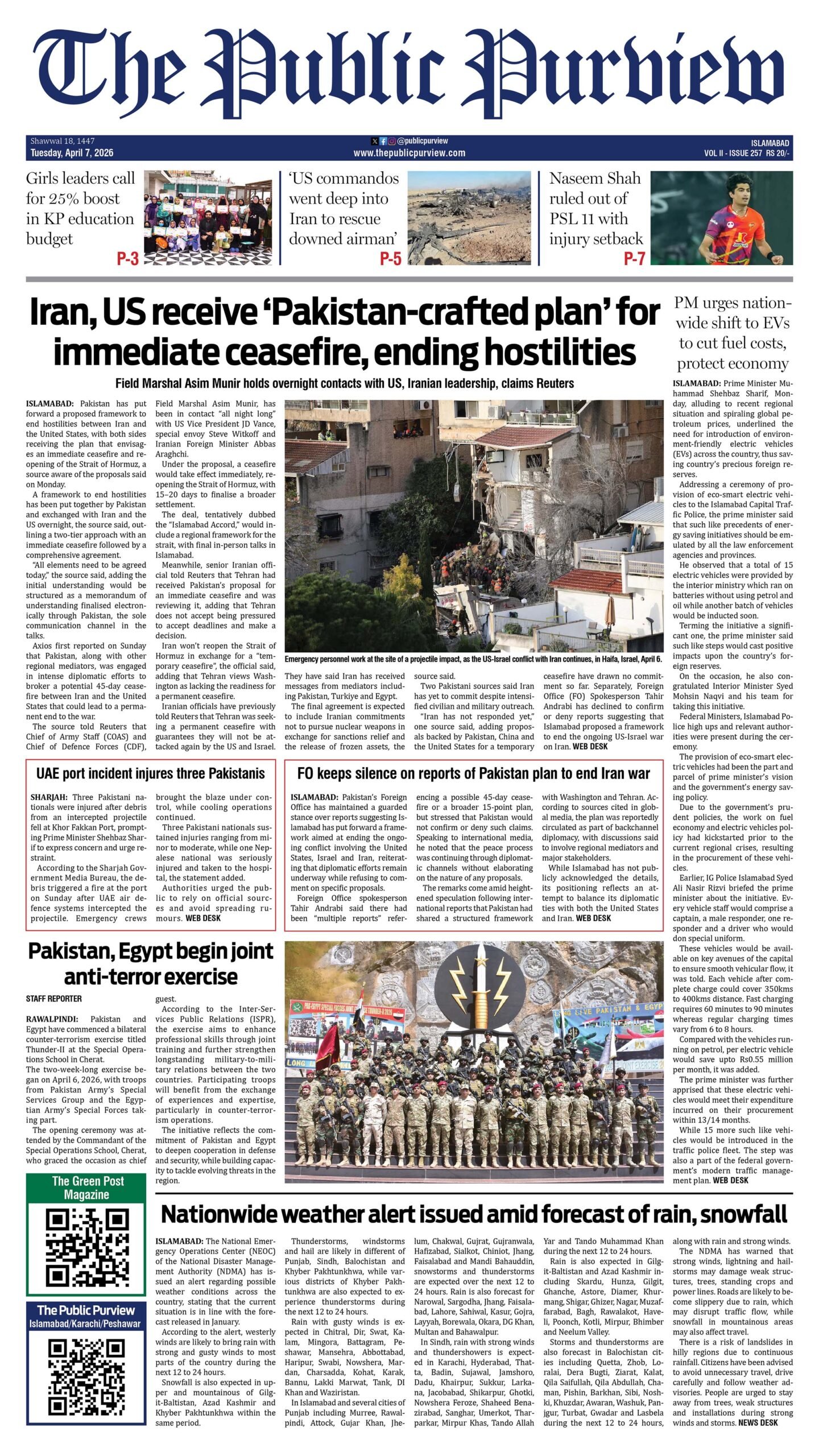 Today's E-Paper