
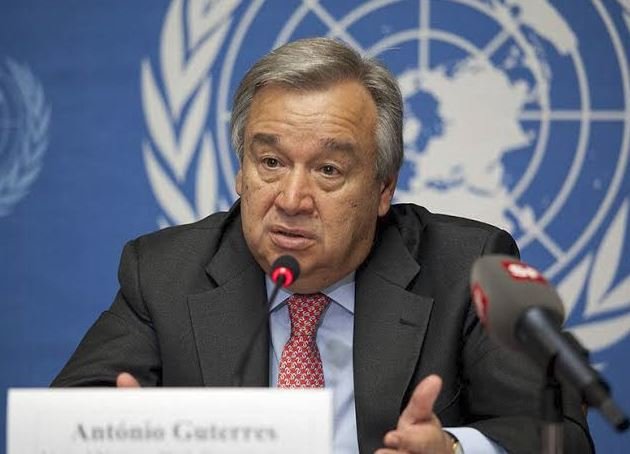
ISLAMABAD: UN Secretary-General António Guterres on Tuesday praised Pakistan’s role as a trusted mediator between the United States and Iran, saying Islamabad’s credibility with opposing sides helped create space for negotiations and de-escalation in one of the world’s most dangerous conflicts.
Speaking alongside Deputy Prime Minister and Foreign Minister Ishaq Dar at a joint press stakeout at the Ministry of Foreign Affairs, Guterres described Pakistan’s diplomatic initiative in the Gulf crisis as “remarkable” and said trust was central to bringing adversaries to the negotiating table.
“What Pakistan has done in relation to the conflict in the Gulf, namely between the United States and Iran, is a remarkable initiative,” the UN chief said. He added that Pakistan’s ability to maintain the confidence of countries in conflict had been essential in creating conditions for peace talks.
Guterres said Islamabad’s diplomatic efforts helped pave the way for the June 17 Islamabad Memorandum of Understanding, the subsequent ceasefire and a framework for future negotiations.
“Pakistan has been an extremely important example of mediation,” he said, highlighting the value of bridge-building at a time of deep international divisions.
Ishaq Dar said Pakistan’s efforts had helped bring the United States and Iran into direct dialogue after 47 years. He described Islamabad’s contribution as a modest but meaningful diplomatic effort based on sovereign equality, territorial integrity, non-interference, self-determination and the peaceful settlement of disputes.
The UN chief urged all parties to end conflict, return to diplomacy and fully restore navigational rights and freedoms in accordance with international law.
Gaza, Palestine remain central concerns
Guterres warned that the world’s attention on the wars in Ukraine and the Gulf must not overshadow the suffering of Palestinians.
He said the scale of death and destruction in Gaza was unprecedented during his tenure as UN secretary-general and called for an immediate end to the suffering of Palestinians and full implementation of the peace plan.
He also voiced concern over violence and settlement decisions in the West Bank, warning that such developments could further undermine the prospects of a two-state solution.
Guterres reiterated that lasting peace required recognition of the Palestinian people’s right to self-determination and the establishment of Palestine and Israel as two states living side by side in peace and mutual respect.
Dar said Pakistan had consistently supported diplomatic efforts for peace in Gaza and recalled Islamabad’s participation, alongside seven other Arab and Muslim countries, in engagement with US President Donald Trump. He said the group’s sole objective was to secure peace in Gaza, contributing to the formulation of a 20-point peace plan.
Kashmir and Indus Waters Treaty raised
The deputy prime minister also raised Pakistan’s concerns over Jammu and Kashmir and welcomed continued UN reference to the international legal framework and Security Council resolutions on the dispute.
Dar urged the international community to ensure implementation of UN Security Council resolutions on both Kashmir and Palestine.
He also criticised India’s decision to hold the Indus Waters Treaty in abeyance, calling it a violation of international law and urging New Delhi to stop “weaponizing water” and fulfil its obligations under the treaty.
Afghan refugees and terrorism concerns
Guterres highlighted Pakistan’s decades-long humanitarian role in hosting Afghan refugees, noting that millions of Afghans had found protection in the country over the years.
He said the United Nations would work with Pakistan to uphold protection principles and ensure that any return of Afghans was voluntary, safe and dignified.
Dar, meanwhile, raised Pakistan’s concern over the continued use of Afghan territory for attacks against Pakistan and called for greater international engagement to address the issue.
The UN secretary-general acknowledged Pakistan’s own struggle against terrorism, saying legitimate security concerns must be addressed while ensuring that security measures remain consistent with international law, human rights and the rule of law.
Guterres backs UN reform
Both leaders also called for reforms to the international system, including the UN Security Council and global financial institutions.
Guterres said the Security Council no longer adequately reflected the world of today. He pointed to the absence of permanent African representation and said the current structure raised serious questions of legitimacy and effectiveness.
He also criticised paralysis caused by divisions among the five permanent members, saying major powers sometimes initiated conflicts or violated international law, fuelling perceptions that powerful states could act without consequence.
The UN chief called for a more representative and legitimate Security Council and said developing countries required greater access to development finance, debt relief and concessional funding.
Dar said Pakistan had consistently supported multilateralism and had promoted negotiation, mediation and preventive diplomacy during its current tenure on the Security Council.
He cited Pakistan’s initiative on Resolution 2788 on strengthening multilateralism and the peaceful settlement of disputes and also called for reform of the global financial architecture, which he said no longer reflected present-day realities.
UN chief pays tribute to Pakistani peacekeepers
Guterres also praised Pakistan’s longstanding contribution to UN peacekeeping, noting that Pakistani personnel had served in some of the world’s most difficult missions.
He said more than 180 Pakistani peacekeepers had lost their lives in the service of international peace and paid tribute to their sacrifice.
The UN chief also praised Pakistan and Denmark for their leadership on Security Council Resolution 2823, aimed at strengthening accountability for crimes against UN peacekeepers. He said 156 countries co-sponsored the resolution, the highest number for a Security Council resolution in UN history.
Climate change also on agenda
Climate change featured prominently in the discussion, with Guterres recalling his visit to Pakistan during the catastrophic 2022 floods.
He said Pakistan remained on the front lines of the climate crisis despite contributing only a small fraction of global emissions and praised the country’s role in advancing the international agenda on loss and damage and cleaner energy.
Guterres said vulnerable developing countries could not bear the burden alone and urged the G20, responsible for around 80 per cent of global emissions, to make much deeper emissions cuts during the current decade.
He also called on developed countries to honour commitments made at COP29 and provide finance, technology and other support required for climate resilience and a just energy transition.
Earlier, Dar met Guterres in Islamabad for discussions covering Palestine, Jammu and Kashmir, Afghanistan, counter-terrorism and the future of multilateralism.
According to the Foreign Office, Dar briefed the UN chief on Pakistan’s positions on Kashmir and the Indus Waters Treaty and highlighted Islamabad’s role in facilitating talks between the United States and Iran.
Guterres, in turn, appreciated Pakistan’s contribution to the United Nations and its broader diplomatic efforts to promote dialogue, mediation and de-escalation.