
TOKYO: Japanese automakers Toyota and Honda are developing artificial intelligence-powered robots to automate vehicle production, improve manufacturing efficiency and reduce physically demanding tasks traditionally performed by factory workers.
According to a report by Automotive News, both companies are exploring advanced robotic technologies capable of handling complex manufacturing operations, including installing components, managing wiring and inspecting vehicles.
However, the two automakers are pursuing different strategies. Toyota is developing robots designed to work alongside human employees, while Honda is considering changes to vehicle design that could make future cars easier for robots to assemble.
Toyota develops ELEY robot for car factories
Toyota is working on an AI-powered robot called ELEY, short for Embodied Learning Robot for Enhanced Yield, to support manufacturing operations.
Unlike conventional humanoid robots that walk on two legs, ELEY moves on wheels and uses robotic arms and grippers to handle vehicle components.
The system is being developed to transport, position and manage parts during vehicle assembly, potentially reducing repetitive physical work on production lines.
Toyota is adopting a gradual approach to robotic automation because AI-powered machines still face challenges in performing complicated physical tasks with consistent accuracy.
The company aims to improve production efficiency while allowing human workers to concentrate on operations requiring experience, decision-making and specialised skills.
Honda plans vehicles designed for robotic assembly
Honda is exploring a different approach by considering how future vehicles could be designed to simplify assembly by intelligent robots.
Honda CEO Toshihiro Mibe has discussed incorporating robotic manufacturing requirements into the vehicle development process.
This could involve modifying the positioning, connections and installation methods of vehicle components so robots can assemble them more efficiently.
Rather than requiring robots to adapt to every existing manufacturing process, Honda could develop vehicles with robotic assembly in mind from the beginning.
Such changes may eventually reduce production complexity and manufacturing costs.
However, Honda has not announced a timetable for introducing robot-oriented vehicle designs into mass production.
Honda demonstrates Avatar Robot with AI assistance
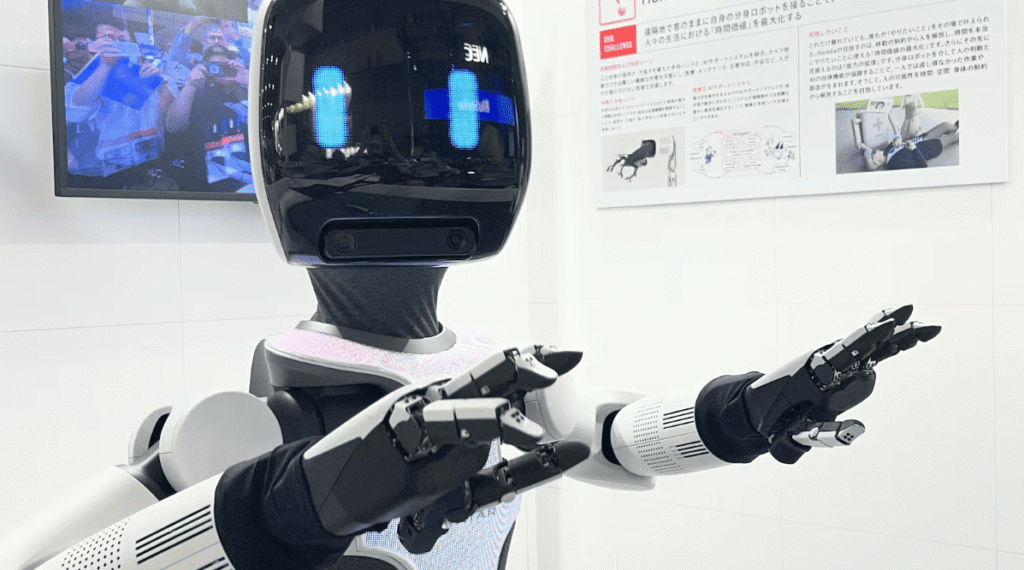
Honda is also advancing its Avatar Robot technology, which combines remote human operation with artificial intelligence.
The company demonstrated the system at CEATEC 2026, held in Japan from October 13 to 16.
The Avatar Robot features multi-fingered robotic hands capable of handling objects and tools, while AI assists with movement and grip control.
The technology allows a human operator to control the robot remotely, potentially enabling specialised tasks to be performed without requiring the operator’s physical presence.
Honda sees potential applications beyond automotive manufacturing, including healthcare, facility maintenance and disaster response.
However, the technology remains under development, and its demonstration does not indicate that Honda has deployed fully autonomous humanoid robots throughout its factories.
How AI robots could change the automotive industry
Traditional industrial robots have long been used in automobile factories for repetitive operations such as welding, painting and assembling components.
AI-powered robots represent a further development because they are being designed to learn new tasks and adapt to changing working environments.
This flexibility could allow manufacturers to automate operations that previously required human intervention.
The technology may also help address labour shortages, improve workplace safety and reduce physically demanding tasks.
However, widespread deployment will depend on whether these systems can operate safely and accurately alongside human workers.
Manufacturers must also consider equipment costs, maintenance requirements and the reliability of AI-powered systems before introducing them on a large scale.
Will robots replace human car factory workers?
Although Toyota and Honda are investing in intelligent robotics, their current initiatives do not establish that human workers will be replaced entirely.
Toyota’s approach focuses on collaboration between employees and robotic systems, while Honda is examining how vehicle manufacturing could evolve to accommodate greater automation.
For now, the developments indicate that artificial intelligence is becoming increasingly important not only in the vehicles automakers produce but also in the factories where those vehicles are built.