
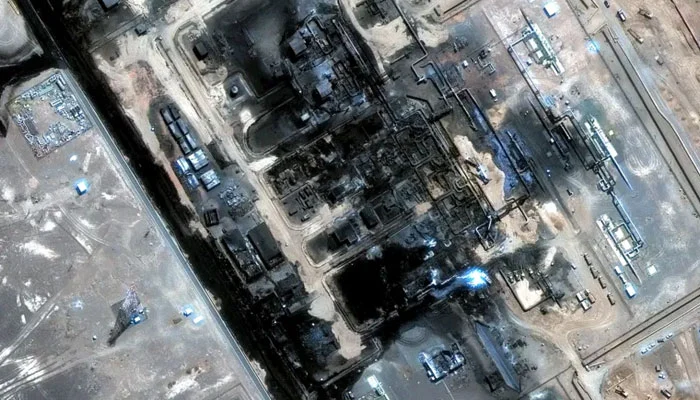
RIYADH, September 15: Saudi Arabia has temporarily suspended operations on its strategically important East-West oil pipeline following drone attacks, raising concerns over global crude supplies at a time when flows through the Strait of Hormuz are already constrained, according to Arab media reports.
The approximately 1,200-kilometre pipeline connects Saudi Arabia’s eastern oil-producing regions with the Red Sea port of Yanbu, providing the kingdom with a critical alternative route that bypasses the Strait of Hormuz.
The pipeline can normally transport around 4 million to 5 million barrels of crude oil per day to the western coast, while its maximum capacity is reported at around 7 million barrels per day.
Saudi Arabia’s Energy Ministry said the pipeline was damaged by drone attacks in the Riyadh and Madinah regions and operations were suspended as a precaution. The attacks also left several people injured, according to the reports.
Saudi authorities have said the drones were launched from Iraq’s southeastern Maysan province near the Iranian border, an area where Iran-aligned armed groups have operated.
Why Saudi Arabia’s East-West Pipeline Matters
Built in 1981, the East-West pipeline has assumed greater strategic importance because it allows Saudi crude to reach the Red Sea without passing through the Strait of Hormuz.
The waterway has traditionally been one of the world’s most important energy transit routes.
Recent Houthi attacks in and around the Red Sea had already reduced the use of the western export route. Around 2 million barrels per day reportedly moved through the pipeline in August, its lowest monthly level since January.
Arab media reports said Saudi Arabia had earlier increased westward oil flows to around 4 million to 5 million barrels per day as disruptions affected the Hormuz route during the conflict involving Iran.
At that level, the pipeline could carry crude equivalent to roughly 4 to 5 percent of global oil supply, highlighting its significance to international energy markets.
Oil Markets Face Another Supply Risk
The pipeline shutdown comes as oil movements through the Strait of Hormuz have already been disrupted.
Before the conflict, roughly 20 million barrels of oil per day moved through Hormuz, according to figures cited in the report. Current flows are estimated at around 6 million to 9 million barrels per day.
A prolonged disruption to Saudi Arabia’s alternative western route could therefore tighten supplies further.
Oil inventories at Yanbu are estimated to be sufficient to maintain exports for approximately five to seven days, while Saudi crude stored at Egypt’s Ain Sokhna and Sidi Kerir facilities could provide additional short-term supply, according to the report.
The International Energy Agency was also cited as saying Saudi oil production fell in August to its lowest level in more than three decades.
The report further projected that global oil supply could decline by around 5.7 million barrels per day this year, equivalent to roughly 6 percent of worldwide supply.
Could Oil Reach $150 a Barrel?
Oil prices have so far avoided an extreme surge partly because inventories and emergency reserves released by various countries have helped offset supply disruptions.
However, analysts cited by Arab media warned that a prolonged interruption could rapidly draw down available stocks and place renewed upward pressure on crude prices.
Some analysts suggested that crude oil could potentially approach $150 per barrel if global inventories fall to critically low levels, although such a scenario would depend on the duration and scale of supply disruptions.
Another risk would emerge if security threats forced the closure of the Yanbu port, where more than 1 million barrels of oil are refined daily.
Such a disruption could further strain global refining capacity at a time when international energy supply chains are already under pressure.
Pipeline Repairs Could Take Weeks
Arab media reports suggested that fully restoring Saudi Arabia’s East-West pipeline could take five to six weeks, although other sources indicated that operations could resume earlier.
The duration of the shutdown will be closely watched by international oil markets because the pipeline serves as one of Saudi Arabia’s most important alternatives to the Strait of Hormuz.
With disruptions already affecting major Middle Eastern energy routes, an extended shutdown could increase pressure on global crude supplies, inventories and prices in the weeks ahead.