
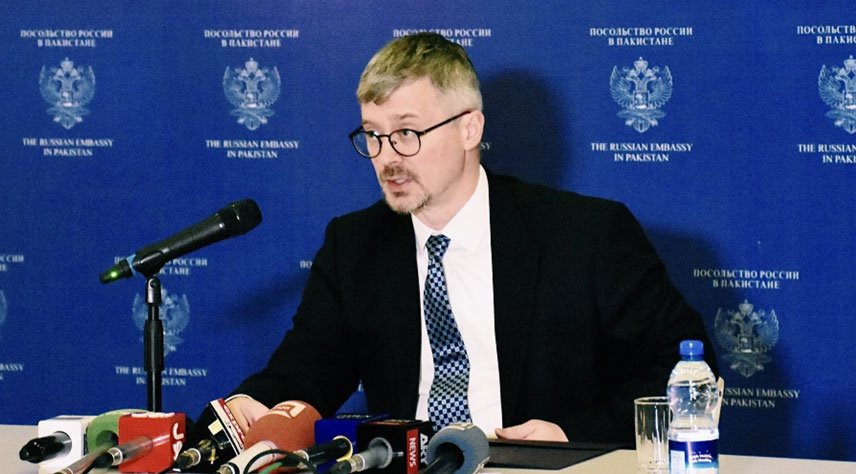
ISLAMABAD: Russia remains open to a political and diplomatic settlement of the war in Ukraine but says any renewed negotiations must take its national interests into account, Russian Ambassador to Pakistan Albert P. Khorev said on Thursday.
Speaking during a briefing on the situation in and around Ukraine, Khorev said Moscow was willing to continue the negotiating process but criticised what he described as renewed Western sanctions pressure and continued military assistance to Kyiv.
He said Russia regretted what it viewed as a shift by the United States towards greater sanctions pressure despite Washington having previously assumed a mediating role in efforts to resolve the conflict.
Khorev also rejected suggestions that Moscow was preparing for military action against European Union or NATO countries, citing earlier statements by Russian President Vladimir Putin and Foreign Minister Sergey Lavrov that Russia had no such plans.
Much of the ambassador’s briefing focused on Russia’s criticism of Ukraine and Western governments over the conduct and consequences of the war.
He accused NATO countries of providing intelligence, communications support and assistance in planning military operations for Ukraine, while saying Western military aid to Kyiv between 2022 and 2025 exceeded $160 billion. These figures and allegations were presented by the Russian side and were not independently verified in the briefing material.
Khorev also argued that Western sanctions had failed to achieve their intended objectives against Russia and were instead contributing to higher economic costs in Europe and disruptions to international trade and financial flows.
He said restrictions on Russia’s use of the dollar and euro were accelerating the use of national currencies and encouraging the development of alternative financial mechanisms within groupings including BRICS, the Shanghai Cooperation Organisation and ASEAN.
The ambassador also criticised Western action against vessels linked to Russia’s so-called “shadow fleet”, arguing that European sanctions could not override freedoms provided under international maritime law.
Khorev further accused Ukraine of carrying out attacks on civilian vessels in the Black Sea and Azov Sea and said such incidents posed risks to global food and energy security. These assertions reflect Russia’s position and remain part of a broader contested narrative surrounding responsibility for attacks and maritime disruption during the war.
Separately, Khorev referred to a June 15, 2026 award in arbitration between Russia and Ukraine concerning coastal-state rights in the Black Sea, Sea of Azov and Kerch Strait.
The Permanent Court of Arbitration confirms that an award was issued in the case on June 15, 2026. The dispute concerned competing claims under the UN Convention on the Law of the Sea relating to coastal-state rights in those waters.
Khorev said the tribunal had rejected a number of Ukrainian claims, presenting the ruling as evidence that not all international legal institutions supported positions advanced by Kyiv and Western governments.
The Russian envoy also raised Moscow’s longstanding criticism of Ukraine over the treatment of the Ukrainian Orthodox Church and rejected allegations concerning the forced transfer of Ukrainian children, describing international claims on the issue as misleading.
Russia and Ukraine, along with their respective international supporters, have repeatedly presented sharply conflicting accounts of civilian casualties, attacks on infrastructure, responsibility for maritime incidents, religious freedom and the treatment of children during the conflict.
Khorev concluded by reiterating that Moscow favoured a negotiated settlement but insisted that any diplomatic process would have to address what Russia describes as its national security interests.
The comments came as diplomatic efforts around the Ukraine conflict continue alongside military operations, sanctions and competing international initiatives aimed at shaping the terms of any future settlement.