
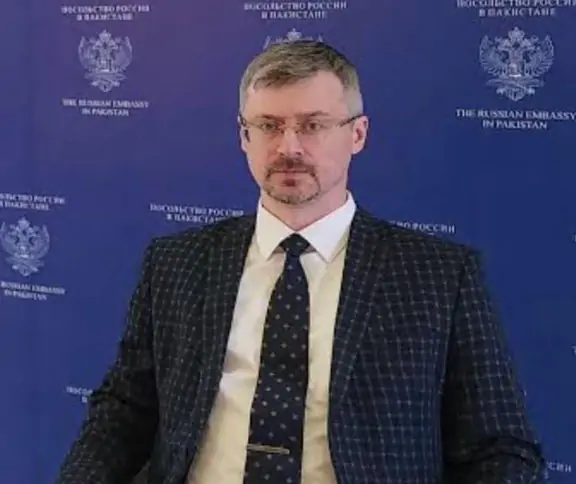
ISLAMABAD — Russia’s Ambassador Albert P. Khorev has expressed concern over the escalating conflict in the Middle East, urging all parties to avoid further military confrontation and pursue a political and diplomatic resolution in line with international law.
In a statement issued on March 17, the envoy criticized recent military actions against Iran, describing them as a serious escalation with far-reaching consequences for regional stability and global security. He said the situation reflects years of mounting tensions and external pressure on Iran.
Concerns over use of force and sanctions
The ambassador noted that economic sanctions imposed on Iran have had a significant humanitarian impact, particularly on ordinary citizens, citing concerns previously raised by the United Nations High Commissioner for Human Rights.
He also questioned the justification for military action, referring to remarks by the International Atomic Energy Agency (IAEA), which stated there was no evidence that Iran was developing nuclear weapons.
also read: Pakistan faces $3–$4 billion remittance risk as Middle East tensions threaten overseas jobs
Condemnation of attacks and civilian casualties
Khorev strongly condemned the reported assassination of Iran’s Supreme Leader Ayatollah Ali Khamenei and other senior officials, calling it a violation of international law and established norms governing relations between states.
He also denounced an attack on a girls’ school in the Iranian city of Minab, which reportedly resulted in the deaths of around 170 children, describing it as a grave humanitarian tragedy.
Call for diplomacy and regional stability
The Russian envoy urged all parties to exercise restraint and resolve their differences through dialogue, emphasizing the need for a settlement based on the United Nations Charter and the Treaty on the Non-Proliferation of Nuclear Weapons.
He added that any future framework should ensure the security interests of Gulf countries and neighboring states, while promoting stability across the region.


 Today's E-Paper