
By: Izmi Herlani
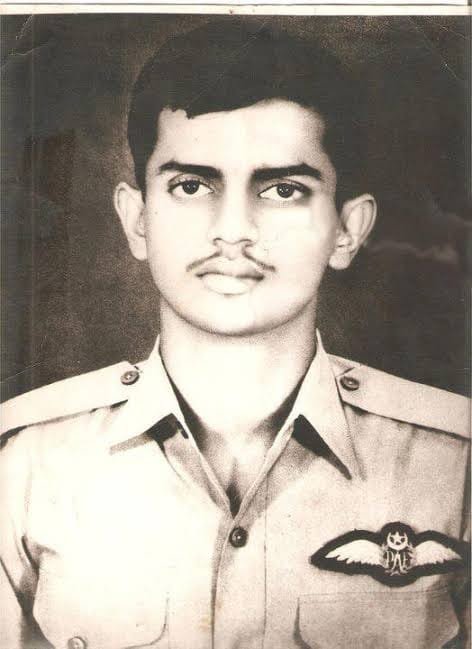
There are moments in aviation history when rank becomes irrelevant, age loses meaning and one decision outweighs an entire lifetime. For Pakistan Air Force, that moment came on 20 August, 1971, not in a grand aerial battle, nor amid the thunder of a large strike package, but inside the narrow cockpit of a T-33 trainer aircraft. There, a 20 year old Pilot Officer, RashidvMinhas, faced an attempted defection, a contested aircraft and an approaching border. He had little time, no easy choice, but a duty. Pilot Officer Rashid Minhas Shaheed, Nishan-e-Haider, holds a place in PAF history that no other officer occupies. He remains PAF’s only holder of Pakistan’s highest military decoration and its youngest-ever awardee. His story is not simply one of martyrdom. It is the story of a young PAF Shaheen who understood, in a matter of minutes, the full weight of the trust placed in him by his Service and his country.
Born in Karachi on 17 February 1951, Rashid Minhas possessed the ambition that has drawn generations of young Shaheens towards the Blue Uniform: the desire to fly for Pakistan. He entered PAF Academy Risalpur, where aviation is not taught as a technical skill alone but as a discipline of mind, nerve and character. The Academy’s purpose is not merely to produce accomplished aviators. It produces Men in Blue capable of carrying responsibility in peace and making decisions in crisis. Rashid Minhas was commissioned in 1971 as a GD(P) and was posted to No 2 Squadron at Mauripur, now PAF Base Masroor, for conversion training on Lockheed T-33 jet trainer. His operational career had barely begun. He was still learning the demanding craft of jet flying. Yet PAF’s central lesson had already become part of his character: an aircraft is not a possession, it is a national trust. A military aircraft carries far more than fuel, weapons or instruments. It carries capability, secrecy and the credibility of the air arm that operates it. Above all, it carries the flag on its roundel. The pilot entrusted with it is therefore entrusted with a portion of national sovereignty. To fly for PAF is to accept that trust without condition, qualification or compromise.
The summer of 1971 was a time of profound national strain. Pakistan faced an increasingly dangerous security environment while the prospect of open war became harder to ignore. Thebcountry’s Armed Forces stood alert. PAF carried the responsibility of maintaining readiness, defending national airspace and ensuring that its platforms remained secure. Against this tense backdrop, a routine training sortie began from Mauripur. Pilot Officer Minhas was preparing to fly a T-33 on only his second solo mission in the aircraft. Before take-off, Flight Lieutenant Matiur Rahman forcibly entered the rear cockpit. Once airborne, the aircraft was turned towards India in an attempted defection. The situation was immediate and perilous. In a two-seat jet trainer, a struggle for control allows neither distance nor deliberation. There is no room to step back, no pause in the sky, the aircraft is moving, the ground is below and the border is ahead.
Minhas recognised the threat at once. He radioed his Base and reported that the aircraft was being hijacked. The message was short but its significance was enormous. It revealed professional awareness under duress and a clear understanding that the danger extended beyond his own life. He knew that a PAF aircraft was being taken from its lawful mission and directed towards hostile territory. That is where Rashid Minhas’s story rises beyond the ordinary language of bravery. He did not merely face danger; he confronted betrayal in the cockpit. He did not merely struggle for survival; he struggled to prevent the misuse of an aircraft entrusted to PAF. He did not merely resist a man; he resisted an attempted violation of Service honour.
A struggle for the controls followed. T-33 aircraft raced towards the frontier as Minhas fought to prevent it from crossing into India. He was younger, less experienced and was caught in a situation for which no training manual could offer a neat solution. Yet the measure of a fighter pilot is not taken when conditions are easy. It is taken when seconds are few, odds are uneven and retreat appears safer than resistance. Rashid Minhas refused retreat. The aircraft ultimately crashed near Goth Khuda Baksh, Thatta, short of the Indian border. Rashid Minhas embraced martyrdom. The intended defection failed. In the harsh arithmetic of war, that was the outcome that mattered. A young Pilot Officer had denied the attempt its objective. He had ensured that the aircraft would not be taken across the frontier. He had chosen the ultimate sacrifice rather than permit a breach of the trust embodied by his uniform. For this exceptional act of valour,
Pilot Officer Rashid Minhas was posthumously awarded Nishan-e-Haider. The award recognised more than his final moments. It recognised the spirit reflected in those moments: courage without hesitation, loyalty without compromise and duty without calculation. He remains the only PAF officer to have received this decoration. His place in PAF heritage is therefore singular. Many PAF Shaheens have displayed brilliance in combat. Many have flown into danger with skill and audacity. Many have served Pakistan with honour across decades of war and peace. Rashid Minhas, however, represents a distinct ideal. He showed that PAF’s strength is not measured solely in its aircraft inventory, weapons systems or operational reach. Its real strength lies in the character of its Shaheens. Technology can be procured, aircraft can be modernised, Bases can be expanded, but courage cannot be imported and loyalty cannot be installed. The will to place country before self is forged through belief, discipline and a deep understanding of duty. That was the force Rashid Minhas carried into the cockpit on his final flight.
PAF has ensured that his legacy remains visible. PAF Base Kamra was renamed PAF Base Minhas in his honour, attaching his name to one of Pakistan’s most significant centres of airpower capability. His sacrifice is recalled through annual commemorations, official tributes and documentary productions that preserve the story for new generations of Shaheens. His most powerful memorial, however, is the standard he left behind. Every cadet at PAF Academy Asghar Khan, every young pilot learning to manage a jet and every Shaheen charged with defending Pakistan’s skies inherits a part of that standard. Rashid Minhas did not command a wing. He did not lead a squadron into a major air battle. He did not live to collect honours or build a long record of service. But in one decisive encounter, he defined the meaning of Service more clearly than many long careers ever could. His final flight was brief but its echo is permanent. Above the skies of Sindh, a young PAF officer confronted an impossible choice. He chose Pakistan. He chose duty. He chose honour. And because he did, he became the pilot who would not surrender the sky.
Also Read: From The Dawn Of Freedom To The Frontiers Of The Future