
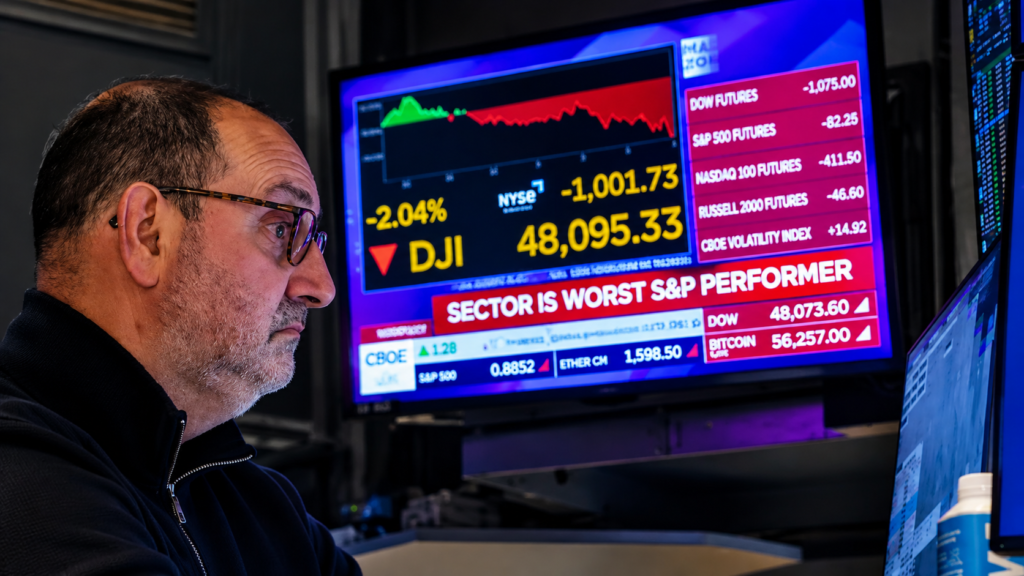
NEW YORK, November 22, 2026: US stock markets ended a turbulent trading week with steep losses as investors continued selling artificial intelligence-related shares, sending the S&P 500 and Dow Jones Industrial Average more than 10 percent below their record closing highs and into correction territory.
The selloff intensified on Friday, November 20, following a disappointing second trading session for Anthropic and a sharp decline in Nvidia shares. Concerns over the enormous investment required for AI development overshadowed strong corporate earnings and the market enthusiasm that had supported technology stocks earlier in the year.
The Nasdaq Composite suffered the heaviest losses, falling 5.28 percent to 22,617.73. The S&P 500 declined 3.70 percent to 6,910.42, while the Dow Jones Industrial Average dropped 1.93 percent to 48,147.33.
The downturn marked the S&P 500’s seventh consecutive losing session, its longest such streak since February 2020. Market figures published by Reuters showed that the Dow and S&P 500 recorded their largest weekly percentage declines since April 2025, while the Nasdaq experienced its steepest weekly fall since March 2020.
The technology-focused Nasdaq also slipped into negative territory for the year, reflecting the scale of the recent reversal in AI-related investments.
Anthropic, whose initial public offering had attracted considerable attention, lost 9.1 percent in its second trading session. The company’s shares had risen 17.1 percent during their first day on the market after being priced at $83 each.
The listing had been viewed as an important indicator of investor confidence in artificial intelligence companies. However, its performance failed to restore optimism across the sector.
Nvidia shares plunged 13.8 percent despite the chipmaker reporting strong quarterly earnings. Investors remained concerned about the financial risks associated with massive spending on AI infrastructure and whether future returns would justify those investments.
The selling extended to other companies closely associated with artificial intelligence. CoreWeave fell 12.1 percent and Nebius declined 16.1 percent, while Meta and Amazon lost 5.9 percent and 3.9 percent, respectively.
The Philadelphia SE Semiconductor Index, which had recorded gains of as much as 106.6 percent earlier in the year, saw its annual advance narrow to 18.7 percent.
Pressure also spread beyond technology companies. Caterpillar shares dropped 5 percent amid concerns about demand for power-generation and backup equipment used in AI-related facilities.
Intuit was another major loser, declining 12.8 percent after reducing its annual revenue growth forecast and announcing an agreement to sell Mailchimp to Bending Spoons for approximately $3.68 billion.
Cryptocurrency-related stocks weakened alongside Bitcoin, which fell below $60,000 during Friday’s trading. Coinbase, Strategy and Robinhood recorded declines ranging from 6.3 percent to 9.6 percent.
UnitedHealth moved against the broader market trend, gaining 2.8 percent after TD Cowen upgraded its investment rating from hold to buy.
Meanwhile, investors faced additional uncertainty over the Federal Reserve’s interest rate outlook.
Federal Reserve Governor Lisa Cook indicated that the central bank’s existing policy rate was not sufficiently restrictive to address elevated inflation. Financial markets were consequently pricing in a near-certain 25-basis-point rate increase at the Fed’s December meeting, according to CME Group’s FedWatch tool.
The upcoming personal consumption expenditures inflation report is expected to provide further information on price pressures following a stronger-than-anticipated October inflation reading.
Market volatility rose significantly during the selloff. The CBOE Volatility Index, widely followed as an indicator of investor anxiety, reached its highest closing level since April 7, 2025.
Selling was also widespread across individual stocks. On the New York Stock Exchange, declining shares outnumbered advancing stocks by nearly four to one, with 1,199 securities touching new lows against just 38 reaching new highs.
The Nasdaq recorded 3,964 declining stocks compared with 928 advancing issues, while 826 securities fell to new 52-week lows.
Trading volumes reflected the intensity of the session, reaching 25.19 billion shares across US exchanges, well above the 20-session average of 19.50 billion.