
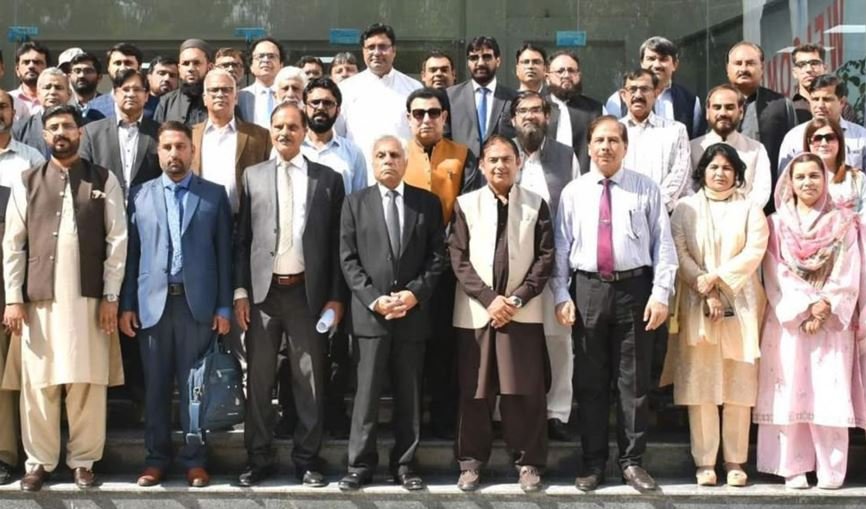
RAWALPINDI: Pir Mehr Ali Shah Arid Agriculture University Rawalpindi (PMAS-AAUR) organised Pakistan’s first national symposium on livestock genomics at its National Center for Livestock Breeding, Genetics and Genomics (NCLBG&G) in Rawat on Thursday, bringing together researchers, scientists and livestock experts from across the country to discuss genetic improvement, productivity and food security.
The symposium, titled Transforming Livestock Through Genomics, focused on the role of modern genomic technologies in improving livestock breeds, enhancing productivity and promoting sustainable development of Pakistan’s livestock sector.
Organised by NCLBG&G, the event provided a national platform for researchers, livestock specialists and stakeholders from all provinces to exchange knowledge, discuss scientific advancements and explore opportunities for collaborative research.
PMAS-AAUR Vice Chancellor Prof. Dr. Qamar-uz-Zaman attended the symposium as chief guest and highlighted the importance of strengthening scientific research to improve Pakistan’s livestock industry.
Addressing participants, he appreciated Federal Minister for Planning, Development and Special Initiatives Prof. Ahsan Iqbal for his continued support in establishing and developing NCLBG&G.
He said the centre’s state-of-the-art laboratories, advanced equipment and modern genomic technologies offered significant opportunities to improve livestock breeding, strengthen research capabilities and increase agricultural productivity.
Vice chancellor stresses practical benefits of livestock research
Prof. Dr. Qamar-uz-Zaman highlighted Pakistan’s livestock potential and emphasised the need to translate scientific research into practical solutions for farmers and livestock producers.
He said genetic improvement of indigenous livestock breeds could increase milk production, improve dairy quality and strengthen the availability of food products.
The vice chancellor observed that improved livestock productivity could contribute to national food security, enhance farmers’ incomes and generate additional economic opportunities.
He stressed the importance of connecting scientific institutions with livestock producers to ensure that modern research benefits the agricultural community.
Genomic selection technology highlighted at symposium
A major highlight of the symposium was the introduction of genomic selection technology in Pakistan, aimed at supporting more accurate livestock breeding decisions and accelerating genetic improvement.
Participants discussed how modern genomic approaches could help researchers identify desirable genetic characteristics and support improvements in livestock productivity.
The symposium also provided an opportunity to examine the potential application of advanced breeding technologies in Pakistan’s livestock sector.
Earlier, NCLBG&G Central Project Director Dr. Ghulam Bilal briefed participants on the centre’s mandate, research activities and institutional network.
He informed the gathering that NCLBG&G operates through seven sub-centres across Pakistan and Azad Jammu and Kashmir, supporting research and development in livestock breeding, genetics and genomics.
The centre’s nationwide presence was highlighted as an important resource for strengthening scientific collaboration and developing research-based solutions for livestock improvement.
Researchers and industry representatives explore collaboration
An exhibition was organised alongside the symposium, featuring research and technical stalls showcasing modern agricultural and livestock technologies.
Technical sessions and consultative meetings brought together scientists, researchers, livestock experts and industry representatives to discuss emerging technologies and potential areas of cooperation.
Participants exchanged knowledge on livestock breeding, genetic research, productivity enhancement and sustainable development.
The discussions also explored opportunities for collaborative research and innovation involving academic institutions, research centres and livestock industry stakeholders.
World Egg Day also celebrated
The Institute of Animal Sciences also celebrated World Egg Day during the symposium, highlighting the nutritional value of eggs and their contribution to food security.
The observance focused on the importance of eggs as a nutritious food source, public awareness about their dietary benefits and the role of the poultry sector in supporting food availability.
The symposium highlighted PMAS-AAUR’s efforts to promote livestock research and strengthen collaboration among scientific institutions, farmers and industry stakeholders through the National Center for Livestock Breeding, Genetics and Genomics.