
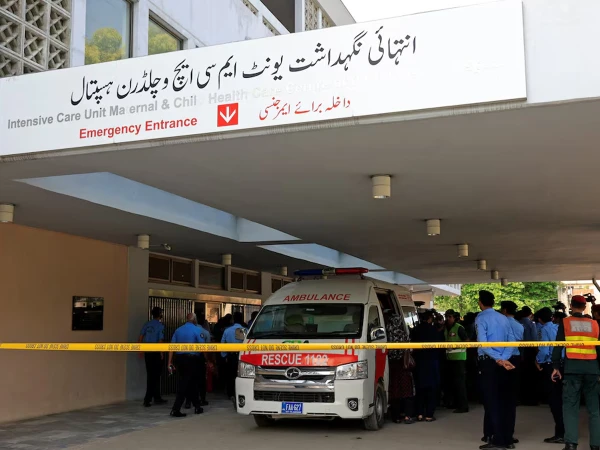
ISLAMABAD, September 15: Fourteen newborns who died in the devastating PIMS nursery fire were not lost because of a single safety failure but due to multiple weaknesses — including inadequate fire protection, limited evacuation capacity, delayed emergency response and longstanding institutional shortcomings — according to an inquiry report released on the orders of Prime Minister Shehbaz Sharif.
The detailed report into the August 26 fire at the Mother and Child Hospital (MCH) nursery of the Pakistan Institute of Medical Sciences (PIMS) said 15 critically ill newborns were inside the facility when the blaze erupted. Fourteen died, while one was rescued.
The inquiry found that the most probable origin of the fire was an electrical cable associated with AC Unit No. 2, near AC Unit No. 1.
According to forensic evidence examined by the committee, abnormal localised electrical heating, excessive current, a high-resistance connection or another local electrical defect may have damaged cable insulation and ignited nearby combustible material.
The evidence did not support arson, multiple points of ignition, an external electrical fault attributed to IESCO, an oxygen leak preceding the fire, or an incubator or warmer as the source, the report said.
Multiple Safety Failures Behind Deaths
The inquiry concluded that the scale of the tragedy resulted from several safety barriers being absent, inadequate, delayed or never independently verified as effective.
The 10-bed nursery was accommodating 15 medically fragile newborns, several of whom depended on oxygen or respiratory support.
Only two doctors and two nurses were present at the time, while resources for rapidly evacuating critically ill newborns were extremely limited.
Investigators found no record of a formally approved and regularly practised newborn-specific evacuation procedure involving trained staff.
The inquiry also found no established evidence of automatic smoke detection, alarm or sprinkler systems in the affected area.
Combustible materials and the oxygen-rich environment contributed to the rapid spread and intensity of the fire and smoke, according to the report.
CCTV Shows Staff Tried to Rescue Babies
The inquiry rejected a general allegation that frontline staff abandoned the newborns during the emergency.
CCTV evidence showed the fire had visibly erupted by approximately 6:38:15pm, after which frontline personnel responded within seconds.
Charge Nurse Nasreen Akhtar, security guard Maria Saleem and Staff Nurse Razia Noreen were among those identified as taking immediate action to rescue the babies.
The report said Razia Noreen managed to rescue one newborn and attempted to re-enter the nursery.
Dr Muhammad Abdul Rehman was also present when the fire broke out.
By around 6:39:15pm, dense smoke had completely obscured the CCTV camera’s view, demonstrating how rapidly conditions deteriorated.
The committee said staff members whose rescue efforts were supported by evidence should not be blamed simply because the outcome of the incident was catastrophic.
Emergency Response Delay Termed ‘Unacceptable’
One of the inquiry’s most serious findings concerned the time taken to activate external emergency assistance.
According to records cited in the report, external notification was recorded at 6:54pm, dispatch occurred at 6:55pm and operational responders arrived at approximately 7:01pm.
The committee described the gap between the fire becoming visible at around 6:38pm and the activation of external assistance as unacceptable.
It found that PIMS could not demonstrate the existence of a tested Incident Command System capable of immediately activating alarms, external notifications, evacuation, hazard containment, access management and coordinated emergency operations once a fire was detected.
Earlier Fire Safety Warnings Were Not Fully Addressed
The inquiry found that the tragedy occurred against a background of known safety risks that required preventive action from the hospital administration.
Previous correspondence from the Capital Development Authority and recommendations issued by the Federal Ombudsman in 2015 had identified shortcomings.
PIMS itself had acknowledged outdated fire-safety infrastructure in 2025, according to the report.
A fire at the hospital’s nursing hostel on July 6, 2026, had also highlighted weaknesses involving early fire detection, alarms, electrical inspections, evacuation, firefighting equipment, fire drills and emergency planning.
However, the inquiry found that these earlier warnings had not been converted into a comprehensive, time-bound and independently verified corrective programme before the nursery tragedy.
Inquiry Finds Systemic and Institutional Failure
The committee concluded that the evidence established systemic and institutional failure, although individual responsibility should be determined separately under applicable rules and on the basis of available evidence.
Primary institutional responsibility rests with PIMS and its senior management for failing to convert known risks and previous warnings into effective safety systems, according to the report.
The inquiry also identified issues requiring further investigation in engineering, electrical systems, HVAC maintenance and repair.
While maintenance records showed that nursery air-conditioning units had been serviced, investigators found no effective comprehensive system for electrical safety testing covering cables, terminations, insulation, earthing and breaker protection.
The committee stressed that equipment being operational did not necessarily mean its electrical installation was adequately protected against fire.
Further Criminal Investigation Recommended
The inquiry said the existing record did not establish the commission of a criminal offence by any specifically identified individual.
However, it recommended further criminal investigation into four potential areas.
These include possible culpable negligence in the electrical installation or maintenance of AC Unit No. 2, a potentially culpable obstruction of a mandatory emergency route, failure to act despite specific previous warnings and a potentially culpable delay in requesting external emergency assistance.
Investigators said determining criminal responsibility would require examining the relevant duties, awareness of risks, authority to act, nature and severity of any negligence, the failed safety measure and its causal role in the deaths.
Committee Calls for Major Fire Safety Reforms
The inquiry recommended immediate fire and life-safety and electrical safety audits, alongside effective systems for fire detection, alarms, suppression and safe evacuation.
It called for dedicated newborn evacuation procedures and realistic fire and evacuation drills involving trained staff.
The committee also recommended stronger electrical safety and asset-management systems, professional and merit-based hospital management, stronger regulatory oversight and an effective compliance framework.
Each identified deficiency should have a responsible officer, deadline, required resources, interim safety measures and independent verification of completion, the report recommended.
The committee stressed that merely approving or initiating a safety measure should not be considered implementation. A measure should only be regarded as implemented when the underlying hazard has actually been addressed and that outcome independently verified.
The inquiry ultimately concluded that the 14 newborns died because multiple safeguards were missing, weak, activated too late or had never been verified as effective.
Longstanding administrative, maintenance and regulatory deficiencies allowed these vulnerabilities to persist, while overcrowding, limited evacuation capacity and the absence of a practised emergency system for newborns further undermined rescue efforts.
Prime Minister Shehbaz Sharif constituted the inquiry committee following the August 26 tragedy. Former federal secretary Shahid Khan headed the committee, while its members included Major General (Retd) Dr Khurshid, Barrister Nabeel Ahmed Awan, the Establishment Secretary and the ICT Deputy Commissioner.
Dr Rashid A. Chotani was subsequently included from the United States as an expert member.
The committee submitted an interim report within 48 hours on August 28 before completing its final draft on September 6. Its investigation used a 52-point framework and examined forensic evidence, CCTV footage, call records, engineering and maintenance documents, medical and incident records, duty and attendance records, witness statements, regulatory material and previous investigations.