
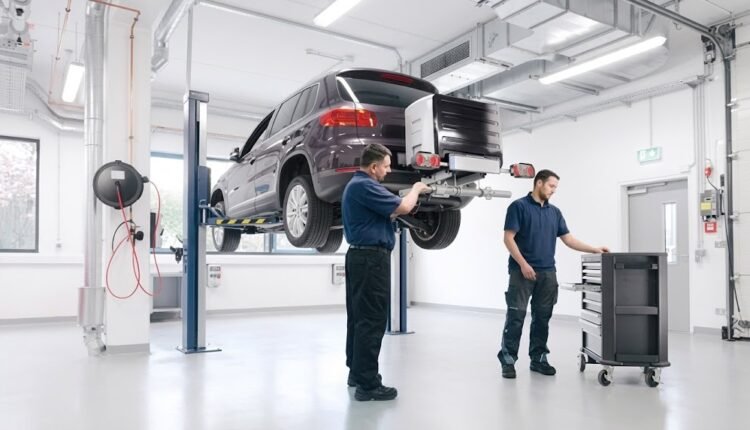
ISLAMABAD: The federal government has proposed establishing the Pakistan Automotive Testing Institute (PATI) to improve vehicle safety, quality certification and regulatory compliance as part of the draft Autos and Auto Parts Manufacturing Policy 2026–31.
The proposed institute would provide a dedicated facility for testing vehicles and automotive components against prescribed safety, environmental and quality standards, addressing gaps in Pakistan’s existing automotive testing infrastructure.
According to the draft policy, the Ministry of Industries and Production and the Engineering Development Board (EDB) would be responsible for establishing the institute.
The government has proposed an estimated Rs1.7 billion for the project, alongside plans to introduce additional international vehicle safety regulations.
However, the initiative remains a policy proposal, and the allocation does not confirm that construction or funding disbursement has begun.
What will Pakistan Automotive Testing Institute do?
The proposed institute would serve as a principal facility for automotive type approval, technical verification and compliance testing.
Type approval, also known as homologation, involves assessing whether a vehicle or its components meet applicable technical and regulatory requirements before receiving the necessary certification.
Under Section 4.5.7 of the draft policy, PATI would focus on testing facilities that private third-party evaluators cannot commercially establish.
This approach would allow the institute to complement existing independent testing services rather than duplicate facilities already available in the private sector.
The proposed infrastructure could help manufacturers verify vehicle safety, improve product quality and meet technical certification requirements.
It could also support Pakistani automotive manufacturers seeking access to international markets, where compliance with recognised standards is often necessary.
Pakistan proposes 45 additional vehicle safety regulations
The testing institute forms part of a broader government plan to strengthen automotive safety standards and regulatory enforcement.
According to the draft policy, Pakistan joined the United Nations Economic Commission for Europe (UNECE) 1958 Agreement in April 2020 and has adopted 62 vehicle-related regulations under the WP-29 framework.
The government now proposes adopting 45 additional vehicle safety regulations by the fourth quarter of 2028.
These regulations are intended to strengthen technical requirements for locally manufactured and imported vehicles.
Existing safety and environmental compliance measures cover areas including braking systems, airbags and occupant protection.
The proposed policy also calls for a statutory framework covering conformity assessments, market surveillance and vehicle recalls.
Internationally accredited third-party organisations could be engaged to conduct compliance audits where appropriate.
PATI would provide testing infrastructure to support the implementation and verification of these requirements.
Rs1.7 billion proposed for automotive testing institute
The draft Auto Policy 2026–31 outlines an estimated Rs1.7 billion allocation for establishing PATI over three financial years.
| Financial year | Proposed allocation |
|---|---|
| 2026–27 | Rs200 million |
| 2027–28 | Rs500 million |
| 2028–29 | Rs1 billion |
| Total | Rs1.7 billion |
The proposed spending would be directed towards developing automotive testing and certification infrastructure.
The policy also proposes financing automotive development initiatives through an Automotive Development Levy (ADL) on specified conventional internal combustion engine vehicles.
These initiatives include research and development, technical certification, testing facilities and automotive vendor development.
The allocations remain part of the draft policy and should not be interpreted as confirmed expenditure.
How could the institute improve car safety in Pakistan?
For Pakistani motorists, the proposed institute could strengthen independent verification of vehicle safety and manufacturing quality.
A dedicated testing facility would potentially allow regulators to assess whether vehicles and components comply with applicable standards.
It could also improve oversight of locally assembled and imported vehicles by providing technical evidence to support compliance decisions.
However, establishing PATI would not automatically mean every vehicle sold in Pakistan would undergo independent crash testing.
The institute’s effectiveness would depend on its equipment, technical capabilities, accreditation, regulatory authority and enforcement procedures.
Similarly, its ability to support automotive exports would depend on whether its certifications and testing results receive recognition in relevant international markets.
What does the proposal mean for Pakistan’s auto industry?
Pakistan’s automotive industry has relied heavily on vehicle assembly, while domestic testing and certification infrastructure has remained comparatively limited.
The proposed institute could help manufacturers and component suppliers improve compliance with technical standards and reduce some certification-related challenges.
For local parts manufacturers, access to improved testing facilities could support product development and quality verification.
The initiative could also encourage greater cooperation between automakers, regulatory authorities and independent testing organisations.
Nevertheless, its benefits would depend on implementation of the proposed policy, development of the required facilities and consistent enforcement of vehicle safety regulations.
For consumers, the most significant improvement would come from having vehicle safety and quality requirements independently tested and verified rather than relying solely on manufacturers’ compliance claims.