
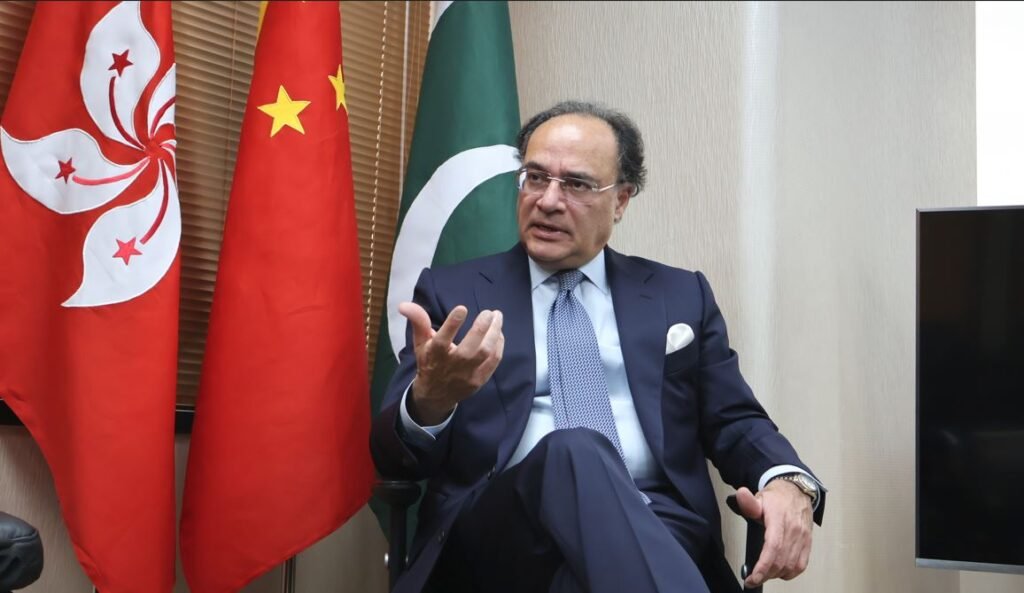
Islamabad, October 13, 2026: Pakistan plans to further diversify its funding sources by issuing more yuan-denominated Panda bonds and is also considering raising funds from the Japanese market through Samurai bonds, Finance Minister Senator Muhammad Aurangzeb has said.
Speaking to Japanese publication Nikkei Asia on the sidelines of the World Bank and International Monetary Fund annual meetings in Bangkok, Aurangzeb said Pakistan’s recent Panda bond issuance was not intended to be a one-off move.
He said the government plans to return to China’s capital market in the future, describing it as the world’s second-largest and one of the deepest financial markets with significant potential for Pakistan.
The finance minister said Pakistan does not want to increase the overall size of its external debt, but is exploring ways to broaden its funding base and reduce reliance on a limited number of financing channels.
Among the options under consideration is the issuance of Samurai bonds denominated in Japanese yen.
Aurangzeb said Samurai bonds could prove to be a suitable financing instrument for Pakistan, though further preparation, market assessment and due diligence would be required before proceeding.
No Compromise on National Tariff Policy
The finance minister also said the government would not compromise on the National Tariff Policy, stressing that the framework applies across industries and is not limited to the automobile sector.
He said Pakistan had historically protected local industries for long periods without setting a clear timeline for phasing out that protection, an approach that ultimately failed to make domestic industries sufficiently competitive.
The government’s current objective, he said, is to strengthen the competitiveness of local industries and use tariff reforms to support export growth, particularly in raw materials and intermediate goods.
Citing the example of ASEAN economies, Aurangzeb said several Southeast Asian countries reduced import tariffs in the late 1990s and later benefited from stronger industrial development and competitiveness.
He said Pakistan could similarly use tariff reforms to support a new phase of economic growth and industrial expansion.
Pakistan Welcomes Chinese Auto Companies
Aurangzeb said Pakistan welcomes all Chinese automobile companies and remains open to investment that can strengthen industrial activity and deepen economic cooperation.
IMF Programme Position Remains Stable
On Pakistan’s programme with the International Monetary Fund, Aurangzeb said the country’s position remained stable and that the programme was also helping improve engagement with international credit rating agencies and investors.
He said the current IMF programme includes a structural reform agenda aimed at putting the economy on a more sustainable footing.
According to the finance minister, Pakistan will only be in a position to move beyond IMF support when international markets and financial institutions are confident that the country no longer needs to repeatedly seek emergency assistance from the Fund.