
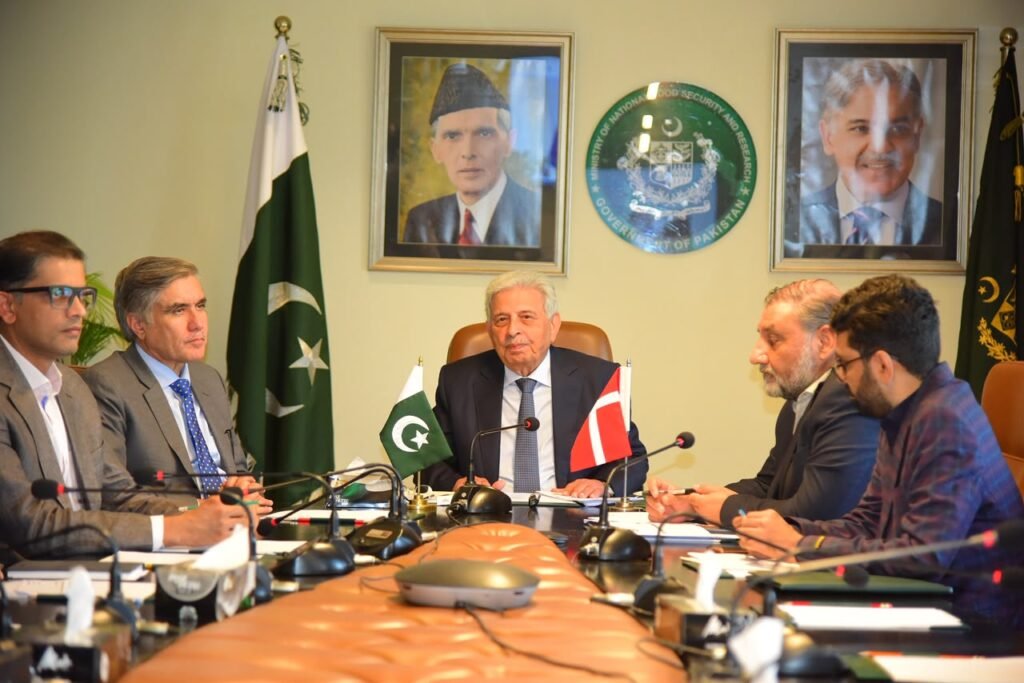
ISLAMABAD, October 28, 2026: Pakistan’s Ministry of National Food Security and Research has signed a memorandum of understanding (MoU) with the Denmark-based International Centre for Antimicrobial Resistance Solutions (ICARS) to combat antimicrobial resistance in the poultry sector through a three-year research project worth $540,855.
The initiative will test alternatives to antibiotics on 30 poultry farms, aiming to reduce antimicrobial treatments by at least 20 percent without affecting poultry health or productivity.
Federal Minister for National Food Security and Research Rana Tanveer Hussain attended the virtual signing ceremony alongside senior ministry officials, ICARS representatives and agricultural researchers.
Under the agreement, ICARS will finance the research project, which will be led by the University of Agriculture Faisalabad in collaboration with the Poultry Research Institute, Rawalpindi.
The partnership seeks to promote responsible antibiotic use, strengthen scientific research and support Pakistan’s efforts to address antimicrobial resistance (AMR), a growing threat to human health, animal health and food security.
Research to test antibiotic alternatives on 30 farms
Rodolphe Mader, Senior Science Advisor for Veterinary Sciences at ICARS, said the project would examine the effectiveness of organic acids as a potential alternative to antibiotics in poultry production.
The research will involve a randomised controlled trial across 30 poultry farms.
Of these, 15 farms will receive the proposed intervention, while the remaining 15 will serve as a control group.
Researchers will assess antibiotic consumption, antimicrobial resistance, poultry health and overall farm performance to determine whether the intervention can reduce dependence on antimicrobial treatments.
The project aims to achieve at least a 20 percent reduction in antimicrobial treatments without compromising poultry productivity.
It will also evaluate the economic feasibility of adopting antibiotic alternatives, helping determine whether the approach can be implemented more widely across Pakistan’s poultry industry.
Minister stresses responsible antibiotic use
Addressing the ceremony, Rana Tanveer Hussain said antimicrobial resistance posed a serious challenge to public health, livestock production and agricultural sustainability.
He emphasised that responsible antibiotic use and scientifically validated interventions were essential to maintaining productivity while protecting human and animal health.
The minister appreciated ICARS and the Government of Denmark for supporting Pakistan’s efforts to address antimicrobial resistance through the One Health approach, which recognises the interconnected health of humans, animals and the environment.
He stressed that scientific research should produce practical solutions for farmers and contribute to the implementation of Pakistan’s National Action Plan on Antimicrobial Resistance.
Rana Tanveer also acknowledged the contributions of Principal Investigator Dr Mashkoor Mohsin Gillani and the research team at the University of Agriculture Faisalabad.
He appreciated the efforts of the ministry’s Animal Health Technical Focal Person, Dr Syed Muzammil Hassan Gillani, in facilitating the initiative.
Partnership to strengthen poultry research
Helle Engslund Krarup, Executive Director of ICARS, said the collaboration would generate scientific evidence on alternatives to antibiotics and support efforts to reduce antimicrobial use and resistance in Pakistan’s poultry industry.
She emphasised that continued leadership from the Ministry of National Food Security and Research would be important for expanding successful interventions across the sector.
According to ICARS representatives, the project is designed to produce practical evidence that can guide future policies and encourage the adoption of effective antibiotic alternatives by poultry farmers.
The research findings are also expected to help policymakers assess the financial and operational implications of reducing antibiotic use in commercial poultry production.
Focus on sustainable livestock production
The ministry said the initiative would strengthen Pakistan’s research capacity and contribute to improved antimicrobial stewardship in the livestock and poultry sectors.
By evaluating both the effectiveness and affordability of alternative treatments, the project aims to identify approaches that can be adopted without placing an additional financial burden on farmers.
Concluding the ceremony, Rana Tanveer Hussain expressed confidence that the partnership would support sustainable livestock development, improve food security and create opportunities for further international research collaboration.
He reiterated the government’s commitment to promoting evidence-based interventions that protect public health while supporting agricultural productivity.