
ISLAMABAD, September 29, 2026: Pakistan Customs has become the first customs administration to integrate with Hong Kong Customs’ blockchain-based ValidAP platform, enabling digital verification of export permits and other trade documents without transferring the documents or their underlying data.
The integration, implemented through Pakistan Single Window (PSW), is intended to strengthen the security of cross-border trade documentation, reduce manual verification and facilitate faster customs clearance for businesses trading with Hong Kong.
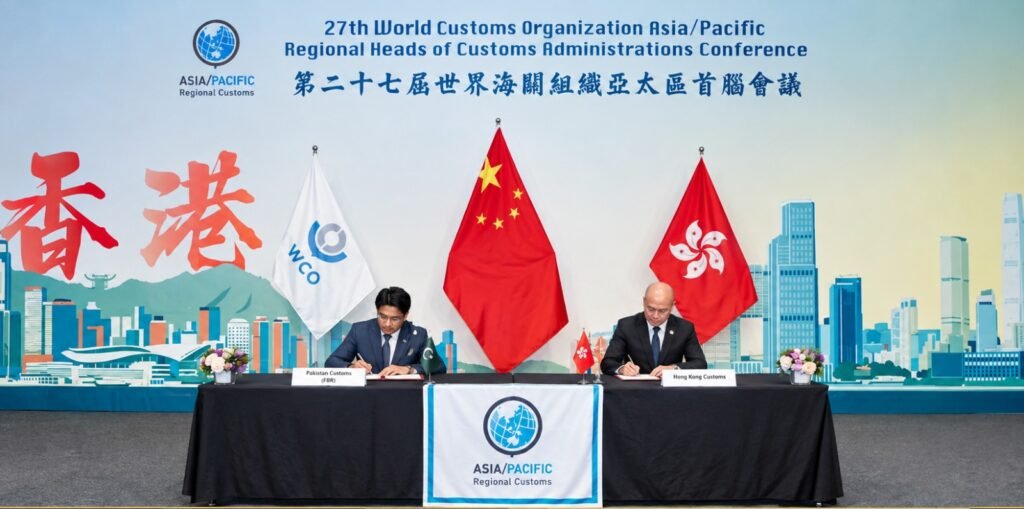
According to the Federal Board of Revenue (FBR), the system has become operational following a memorandum of understanding signed between Pakistan Customs and Hong Kong’s Customs and Excise Department on May 18, 2026.
The development marks a step towards establishing trusted digital trade corridors, allowing participating customs and regulatory authorities to verify the authenticity of electronic documents issued through Pakistan’s trade facilitation system.
How Hong Kong’s ValidAP platform verifies trade documents
ValidAP is a blockchain-based cross-validation platform developed and hosted by Hong Kong Customs to verify electronic trade documents securely.
The system uses cryptographic hash technology to check whether a document matches the version originally registered on the platform.
Rather than requiring authorities to exchange complete documents or their contents, the platform enables verification through a digital record associated with the original document.
If a registered document is subsequently altered, the verification process can detect that the submitted version no longer matches the original record.
According to Pakistan Customs, this mechanism provides additional protection against document tampering and forgery while supporting the integrity of trade documentation.
The integration covers electronic documents issued through Pakistan Single Window, including sanitary and phytosanitary (SPS) certificates and export permits.
These documents are used in international trade to demonstrate compliance with applicable regulatory requirements, including those relating to agricultural products, food safety and other controlled goods.
Digital verification expected to reduce customs clearance delays
Pakistan Customs said the integration would reduce dependence on paper-based procedures and manual document checks, which can add time to international cargo processing.
Through ValidAP, participating authorities can verify registered documents electronically, reducing the need for separate confirmation through conventional communication channels.
The initiative is expected to support quicker document validation, more efficient consignment clearance and shorter cargo dwell times.
Cargo dwell time refers to the period goods remain at a port or other cargo facility before completing the necessary clearance procedures.
The FBR said the digital verification facility would impose no additional cost on traders.
While the integration is operational, its impact on clearance times will depend on its use by participating authorities and the wider procedures involved in processing individual consignments.
Pakistan Single Window plays key technical role
Pakistan Single Window provided the technical integration required to connect Pakistan Customs with Hong Kong’s ValidAP system.
PSW serves as a digital platform through which traders and relevant government agencies can manage documentation and regulatory requirements associated with cross-border trade.
Its integration with ValidAP allows participating authorities to verify the authenticity of eligible electronic documents generated through the Pakistani system.
Pakistan Customs acknowledged PSW’s contribution to making the arrangement operational, describing the collaboration as part of continuing efforts to modernise trade-related processes.
The initiative also demonstrates how separate national digital trade systems can be connected to support secure verification without requiring the routine transfer of underlying documents.
Pakistan, Hong Kong expand customs cooperation
The ValidAP integration follows the cooperation agreement concluded between Pakistan Customs and Hong Kong Customs in May 2026.
The arrangement is intended to strengthen institutional coordination on digital trade, document authentication and customs facilitation.
Pakistan Customs said the initiative supports its broader objective of developing secure and interoperable digital trade corridors.
Such arrangements can help customs administrations establish confidence in electronic documentation issued by partner authorities, while reducing reliance on conventional paper-based verification.
The integration is also aligned with the World Customs Organization’s Asia/Pacific Smart Customs initiative, which encourages customs administrations to adopt digital technologies and improve the efficiency and security of international trade procedures.
According to the FBR, the operationalisation of ValidAP represents another step in Pakistan Customs’ efforts to introduce technology-based solutions for cross-border trade.
The system is expected to improve document verification and support trade facilitation as Pakistan Customs and Pakistan Single Window continue developing digital services for traders and regulatory authorities.