
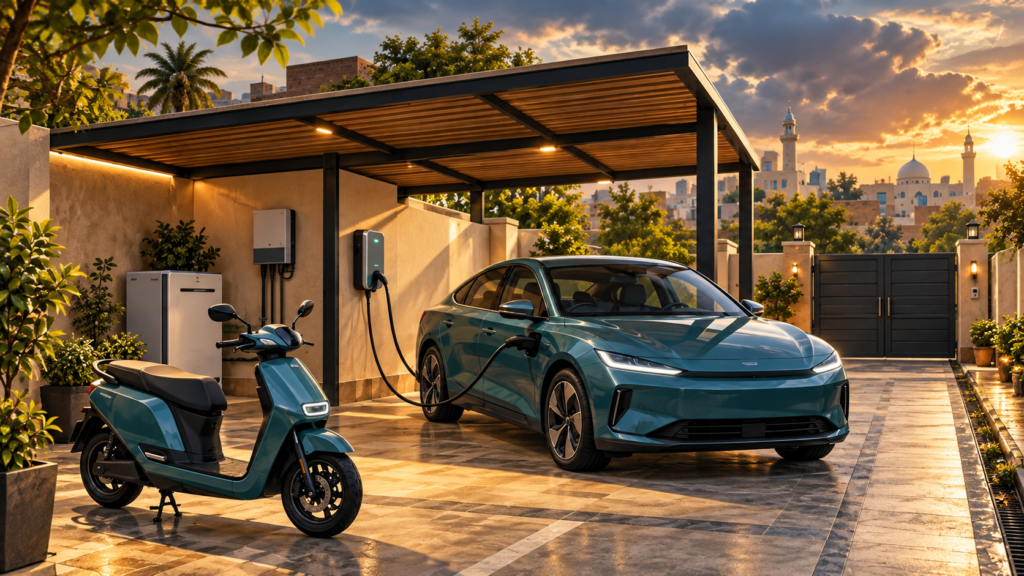
ISLAMABAD: Pakistan’s upcoming Auto Policy is expected to place electric vehicles at the centre of the country’s automotive strategy, with the government reaffirming its target for EVs to account for 30% of new vehicle sales by 2030.
Adviser to the Prime Minister on Industries and Production Haroon Akhtar Khan said the new Auto Policy is expected to be announced in the coming weeks and will give particular emphasis to electric mobility.
The 30% target is not new. Pakistan’s National Electric Vehicle Policy 2025–30 already aims for electric vehicles to account for around 30% of new vehicle sales by the end of the decade.
The latest development is that EVs are also expected to feature prominently in the broader Auto Policy 2026–31, signalling a stronger alignment between the government’s automotive and electric mobility strategies.
Government Says EV Growth Needs More Than New Models
Speaking during a meeting with a European Union delegation, Haroon Akhtar said accelerating EV adoption would require more than simply bringing additional electric vehicles to the Pakistani market.
He highlighted the need for trained EV technicians, automotive engineers, technical education, battery and electrical expertise, and a supporting local industrial ecosystem.
With several manufacturers entering Pakistan’s electric vehicle market, the government expects demand for skilled workers to rise alongside EV sales.
The Engineering Development Board has been directed to explore cooperation with the European Union in technical training and capacity building.
Auto Policy Expected Within Weeks
Haroon Akhtar said the forthcoming Auto Policy would place particular focus on electric vehicles.
An earlier draft of the Auto Policy 2026–31 proposed significant changes covering vehicle taxation, imports, localisation, financing and incentives for New Energy Vehicles.
However, measures contained in a draft do not become final until they are formally approved and notified by the government.
That distinction is particularly important as several proposed tax concessions involving EVs, plug-in hybrids and hybrid vehicles have also been discussed with the International Monetary Fund.
Pakistan’s 30% EV Target Could Be Reached Earlier
Haroon Akhtar recently told Bloomberg that higher petrol and diesel prices could accelerate Pakistan’s shift towards electric mobility and potentially bring the 2030 target forward.
That remains a government expectation rather than evidence that the target has already been achieved.
The pace of EV adoption will depend on several factors beyond vehicle availability, including purchase prices, charging infrastructure, financing options, battery warranties, resale confidence and electricity costs.
These factors will ultimately determine how quickly conventional vehicle buyers shift towards electric alternatives.
Battery Storage Policy Also Under Development
The government is also developing a Battery Energy Storage System Policy, according to Haroon Akhtar.
Battery technology is relevant not only to electric vehicles but also to renewable energy storage and the wider electricity system.
For Pakistan’s automotive sector, greater expertise in battery technologies could eventually support localisation in areas such as battery packs, battery management systems and other high-value EV components.
The government’s direction is becoming increasingly clear: electric vehicles are expected to play a major role in both the National Electric Vehicle Policy and the upcoming Auto Policy.
The key question now is which incentives, tax rates and localisation targets will remain in the final Auto Policy once it is formally approved and notified.