
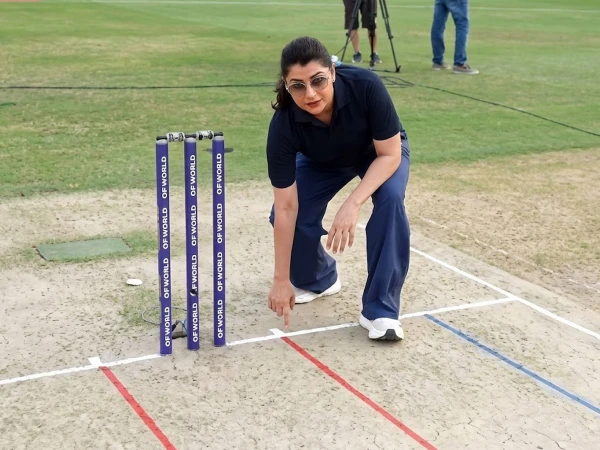
A revised cricket rule introduced last year has changed how umpires assess certain deliveries for a wide, particularly when a batter moves across the crease before or during the delivery. Former Pakistan women’s captain Sana Mir has explained the rule to help spectators understand when a delivery should be called wide.
The change is intended to make wide-ball decisions fairer for bowlers when a batter changes position. Under the revised approach, the batter’s position at the popping crease is used as the reference point when determining whether a delivery passes within the relevant area on the leg side.
How the new wide-ball rule works
Under the revised rule, the position of the batter’s legs is considered when the ball passes the popping crease. A delivery that passes between the leg stump and the protected-area marker at that point is not called wide.
The protected-area line has been extended to the popping crease to give umpires a clearer visual reference when making the decision.
This means that a batter moving towards the off side after taking their initial position does not automatically make a delivery wide. The umpire considers the batter’s position in relation to the designated line when the ball reaches the popping crease.
However, a delivery passing behind the batter’s legs and outside the designated line on the leg side can still be called wide.
Sana Mir explains the rule
Sana Mir demonstrated the rule on a cricket pitch in a video, using the crease and protected-area markings to explain how umpires assess such deliveries.
The explanation is aimed at addressing confusion among spectators, who may find it difficult to understand why similar-looking deliveries are sometimes judged differently under the current playing conditions.
The revised rule places greater emphasis on the batter’s position at the relevant point of the delivery, rather than simply judging the ball according to where the batter moves during the delivery.