
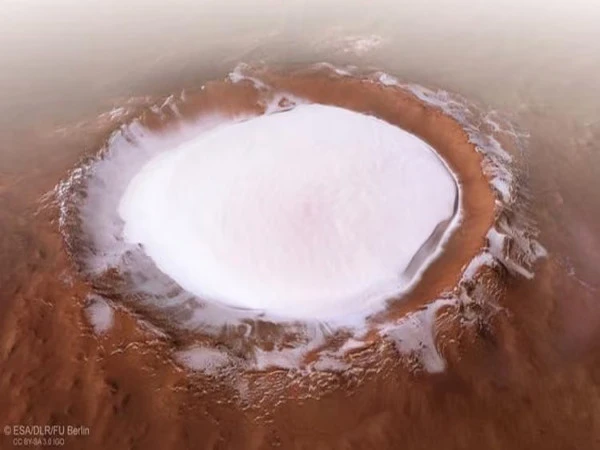
Mars may once have looked more like Earth, but today the Red Planet appears extremely hostile to life.
Even so, scientists remain intensely interested in Martian ice because it may preserve important records of the planet’s ancient climate and help researchers understand whether Mars was ever capable of supporting life.
Much of the ice outside Mars’ polar regions is buried beneath layers of dust. That dust can also influence the planet’s climate by darkening the ice surface and changing how much sunlight is reflected back into space.
A new study by researchers at the University of Washington, published in the journal npj Space Exploration, has found that there is less dust at Mars’ north pole than scientists had previously estimated.
Researchers say the finding could improve understanding of Martian ice and the planet’s climatic history. Information preserved in the ice may also help scientists investigate whether Mars once had conditions suitable for life.
Aditya Khuller, a senior research scientist at the University of Washington’s Applied Physics Laboratory, said scientists already know that water exists as ice around the Martian north pole, but there has long been disagreement over how much dust is mixed with it.
The amount of dust matters because darker ice absorbs more heat.
Khuller explained that the effect is similar to wearing a dark-coloured shirt in sunlight. The darker surface becomes warmer, and on Mars, dustier ice can heat up more quickly and turn into vapour at a faster rate.
The new findings could therefore help researchers better understand how ice behaves on Mars and how the planet’s climate has changed over time.