
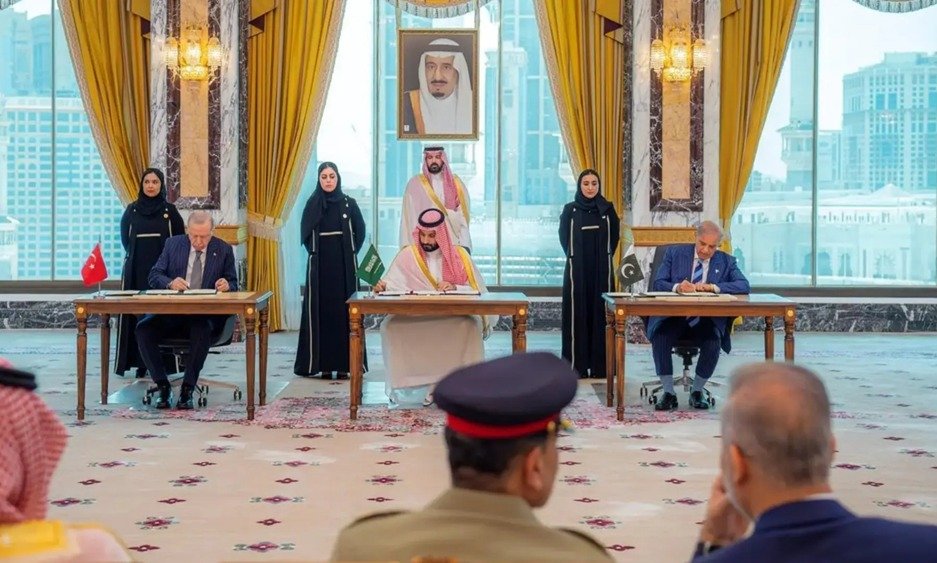
ISLAMABAD, September 14: Pakistan’s role in the emerging Makkah Defence Alliance could give Islamabad greater influence over regional security cooperation and create new opportunities in defence production, technology and military coordination, while also bringing additional strategic and diplomatic responsibilities.
Pakistan, Saudi Arabia and Turkiye have agreed to further institutionalise cooperation under the Makkah Agreement, with the three countries seeking to strengthen collective deterrence, defence coordination and the cohesion of their armed forces. The appointment of a Pakistani as the alliance’s first secretary general places Islamabad at the centre of the grouping’s initial institution-building phase.
The three countries have also committed to expanding defence-industry cooperation, including joint technology development and production.
The move represents a shift from the signing of the trilateral defence pact towards creating formal mechanisms for sustained military and strategic cooperation.
Pakistan’s Influence Will Depend on Alliance Structure
Speaking to Wealth Pakistan, Dr Taimur Khan, Assistant Professor in the Department of International Relations at the Federal Urdu University of Arts, Science and Technology in Islamabad, said Pakistan’s influence would depend on the powers attached to the secretary general’s office and the alliance’s decision-making structure.
He said having a Pakistani official lead the secretariat could provide Islamabad with greater access to Saudi and Turkish policymakers and a role in shaping the alliance during its formative stage.
However, he cautioned that the secretary general would not necessarily have unilateral authority over major decisions.
“Pakistan’s actual influence will depend on the alliance’s decision-making structure, the authority granted to the secretary general and Islamabad’s ability to build consensus among member states,” he said.
Dr Taimur said the position could provide Pakistan with agenda-setting and diplomatic leverage, but its longer-term value would depend on whether Islamabad could convert institutional access into substantive influence.
Defence Cooperation Could Expand Pakistan’s Regional Role
Pakistan already maintains longstanding defence relations with both Saudi Arabia and Turkiye, providing a foundation for deeper trilateral military cooperation.
Dr Taimur said the alliance could strengthen Pakistan’s role as a regional security partner by drawing on its military experience, training capabilities, counterterrorism expertise, intelligence cooperation and strategic planning.
The Makkah Defence Alliance also contains a collective security commitment under which an attack on one member would be treated as an attack on all three.
According to Dr Taimur, the practical implications of that provision will depend on how the alliance defines an attack and establishes procedures for consultation and collective response.
He said Pakistan would need to ensure that any additional security obligations did not limit its ability to respond to challenges along its own borders.
Defence Industry Cooperation Offers Economic Potential
Closer defence-industry cooperation could become one of the most significant areas of the trilateral arrangement.
Turkiye has developed capabilities in drones, aerospace, naval systems, electronic warfare and precision technologies. Pakistan has established defence production and aerospace capacity, while Saudi Arabia has significant financial resources and is seeking to expand its domestic defence industry.
Dr Taimur said the framework could potentially combine Turkish technology, Pakistani technical expertise and Saudi investment.
However, he stressed that membership of the alliance alone would not guarantee joint production or technology transfer.
Pakistan would need detailed agreements covering research and development, joint ventures, financing, production arrangements and technology sharing to secure meaningful economic and technological benefits, he said.
Iran Relationship Creates Diplomatic Balancing Challenge
The alliance could also require careful diplomatic management by Pakistan.
Saudi Arabia remains one of Pakistan’s major strategic and economic partners, while Iran shares Pakistan’s western border and remains an important regional neighbour.
Dr Taimur said Islamabad should clearly communicate that the Makkah Defence Alliance is defensive in nature and not directed against any particular country.
He said Pakistan should also maintain engagement with Tehran as military cooperation with Riyadh and Ankara expands.
“Pakistan should avoid allowing the alliance to become an instrument of regional polarisation,” he said.
Alliance Brings Complementary Strengths
Dr Taimur said Pakistan, Turkiye and Saudi Arabia bring different capabilities to the emerging security framework.
Pakistan contributes military capacity and strategic experience, Turkiye brings an advanced defence industry and its position as a NATO member, while Saudi Arabia adds financial resources and considerable regional influence.
He cautioned, however, against viewing the alliance as an immediate shift in the regional balance of power.
Its initial importance is likely to be political and institutional as the three countries develop mechanisms for military coordination and work towards greater interoperability.
“The real test will be whether the alliance can translate political commitments into regular joint activities, operational coordination and concrete defence projects,” he said.
United States Likely to Watch Alliance Closely
The development of the alliance is also expected to attract attention in Washington.
Dr Taimur said the United States could view greater regional burden-sharing positively if the grouping contributes to counterterrorism, maritime security, deterrence and regional stability.
Concerns could emerge, however, if the alliance develops into a security bloc aimed at reducing US influence in the region.
Turkiye’s NATO membership adds another dimension to the arrangement, although its participation does not make the Makkah Defence Alliance part of NATO.
For Saudi Arabia, the new grouping is more likely to complement its longstanding security relationship with Washington than replace it, while providing Riyadh with additional strategic partnerships.
Pakistan’s Three-Year Term Could Shape Alliance
Pakistan’s three-year tenure as the holder of the alliance’s first secretary general position will provide an early test of how effectively the new framework can be institutionalised.
Dr Taimur said Pakistan’s stewardship could ultimately be judged through concrete outcomes, including functioning institutional mechanisms, regular military activities, defence technology partnerships, joint production projects and clear procedures for responding to security crises.
Whether Pakistan can translate the leadership position into lasting strategic influence will depend on the practical results delivered during the alliance’s formative years.