

By Xian Gan, People’s Daily
On June 25, 2021, the Lhasa-Nyingchi Railway, the first electrified railway in southwest China's
Xizang autonomous region, officially entered service.
Stretching more than 400 kilometers, the "steel dragon" links the cities of Lhasa, Shannan and
Nyingchi, introducing rail service to southeastern Xizang for the first time.
As of June this year, the railway has transported 6.25 million passengers and delivered more than
2 million tons of cargo over five years of safe and stable operation. This latest "heavenly road"
across the snowy plateau has boosted the high-quality development of industries such as
agriculture, animal husbandry and tourism, while bringing a better life to people living along the
route.
With the summer vacation approaching, Galsang Tsom, a student at the Xizang Middle School in
Wuhan, central China's Hubei province, has already begun checking train ticket information on
her phone.
Before attending junior high school and later moving to Wuhan for studies, she lived in Nyingchi.
The train is now her preferred mode of travel between Wuhan, Lhasa, and Nyingchi.
Comparing her experience to her aunt's (the first university graduate in their family) who recalled
arduous journeys starting long before dawn from Motuo County just to reach Lhasa, Galsang
notes the contrast: her train journeys are filled with fellow students sharing campus stories and
parents discussing home, making the carriages lively and connected.
Prior to the railway, residents relied heavily on long-distance buses or private vehicles. Now, as
noted by Han Chunwang, stationmaster of Shannan Railway Station, travel time between
Nyingchi and Lhasa has been dramatically reduced from seven to eight hours by road to just over
three hours. Commuting between Shannan and Lhasa takes roughly one hour, making rail the
preferred choice, with regular travel between Lhasa and Nyingchi becoming commonplace. The
railway now serves an area of over 200,000 square kilometers, directly benefiting more than 1.3
million people.
The freight yard on the western outskirts of Lhasa is a hive of activity. Cases of natural mineral
water produced in Shannan are being loaded into train wagons by forklifts, awaiting shipment.
In the past, transportation constraints made it difficult for products such as mineral water to be
shipped outside the region on a large scale. In recent years, however, the opening of the Lhasa-
Nyingchi Railway and other lines, together with the upgrading of the entire Qinghai-Xizang
Railway, has brought Xizang into much closer contact with the rest of the country.
"More than 40,000 tons of feed are transported here by rail every year. Once the Shannan freight
yard comes into operation, our costs will fall even further," said Zhang Honglin, head of a local
agricultural development company. The company's modern poultry farm now produces 1.5 million
eggs a day.
"We don't just supply the Xizang market," Zhang said. "We also aim to sell our high-quality eggs
to other parts of the country by rail."
The Lhasa-Nyingchi Railway has built a fast track for local goods to be shipped out of Xizang.
Unique local products including Tibetan pigs, yak meat and matsutake, once plagued by high
transport costs and poor preservation conditions, now travel efficiently from the snowy highlands
straight to dining tables across the country. This provides sustained impetus for all-around rural revitalization.
At the same time, building materials, grain, fertilizers and other essential supplies are flowing
steadily into southeastern Xizang, providing stronger support for prosperity and development in
the region.
It is reported that the railway's average daily freight volume in 2026 is 35.7 times higher than in
2021.
"Since the train started running, the rail service has put Gala village firmly on the map," said
villager Bianpa while strolling hand-in-hand with his mother under a peach tree at the village gate
in Bayi district, Nyingchi.
The wild peach trees on the surrounding hills once attracted little attention, but they have now
become one of the area's most beautiful attractions, drawing large numbers of visitors every year.
In recent years during the annual peach blossom festival, local authorities have launched free
shuttle buses with newly added stops at Gala village and the railway station. The routes connect
scenic spots across downtown Nyingchi, offering convenient public transportation and seamless
transfers for visitors and local residents.
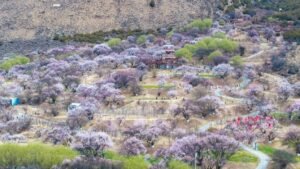
Since the beginning of this year, Gala village has received more than 100,000 visitors and
generated tourism revenue of over 3 million yuan ($442,188). The once-remote mountain village
has become a shining example of a "happy village" on the snowy plateau.
Not far from Nyingchi Railway Station lies the Yani National Wetland Park, the first stop for
many visitors arriving by train. Located at the confluence of the Nyang River and the Yarlung
Zangbo River, the park is known for its shimmering waters and lush forests.
The area once saw very few visitors because of inconvenient travel conditions. The launch of the
Lhasa-Nyingchi Railway and supporting road networks has boosted the integration of rail and
tourism, bringing about remarkable progress.
To cater to growing tourism demand, local authorities have introduced activities like rafting and
boat tours through submerged forests, encouraging longer stays and richer experiences.
"I was worried that, at my age, I might struggle to adapt to the high altitude," said a 66-year-old
tourist surnamed Wang from Shanghai. "But seeing that the trains are equipped with oxygen-
supply facilities really put my mind at ease."
Statistics indicate that monthly passenger volume on the Lhasa-Nyingchi Railway has climbed
from an initial 59,000 to a peak of 153,800. In the recent five years, more than 8,000 passenger
trains have run on the line, alongside over 100