
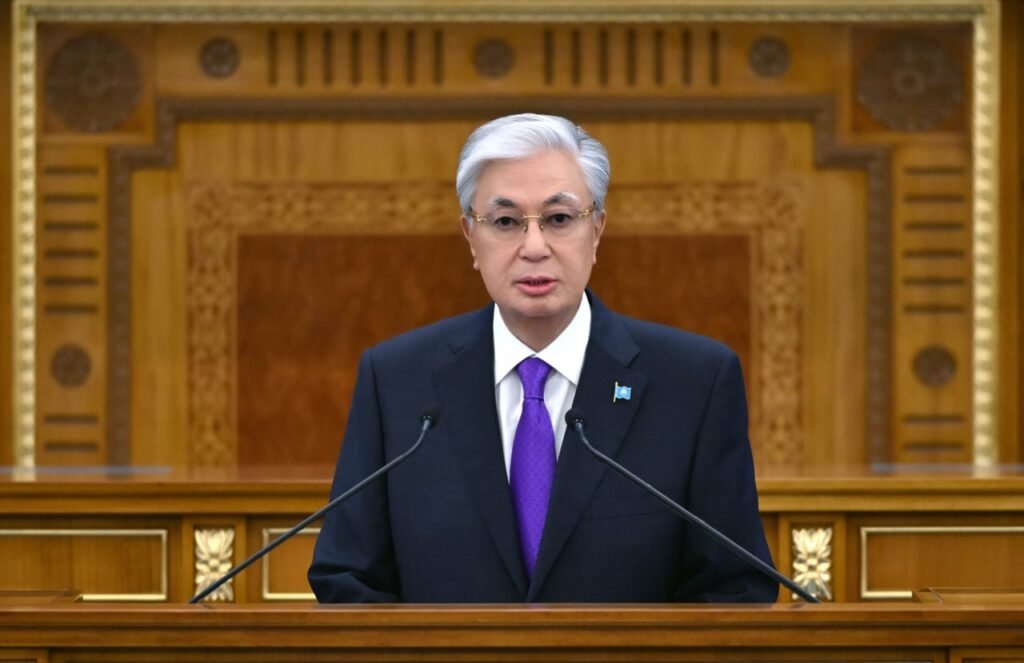
ASTANA, October 28, 2026: Kazakhstan President Kassym-Jomart Tokayev has announced an ambitious programme to modernise infrastructure, accelerate digital transformation and strengthen economic development, outlining a series of reforms aimed at improving living standards and positioning the country as a major transport and technology hub in Eurasia.
Delivering his State of the Nation Address, titled *“Kazakhstan’s Current Priorities in a New Historical Cycle,”* on Wednesday, Tokayev said the country would undertake extensive construction and modernisation projects across its regions while expanding investment in energy, transport, healthcare, education and emerging technologies.
The president proposed declaring 2027 the Year of Nationwide Large-Scale Construction, with the government instructed to accelerate infrastructure development and ensure that economic growth delivers tangible benefits to citizens.
Major investment in national infrastructure
Tokayev announced that approximately 6.5 trillion tenge would be allocated from the National Fund through 2029 to support a large-scale infrastructure development initiative.
Of this amount, 1.5 trillion tenge would be earmarked for social projects during 2026 and the first two months of 2027.
The programme, described as *“People’s Construction,”* will focus on modernising essential infrastructure, including hospitals, schools, roads, utilities and public facilities.
In its initial phase, approximately 70 healthcare facilities will be constructed, including hospitals, perinatal centres, ambulance stations and rehabilitation facilities.
Construction will also begin on around 50 educational, cultural and sporting facilities.
The president said the programme would create employment opportunities and support economic activity across the country, with particular attention to rural development.
He directed the government to ensure strict oversight of construction projects and involve qualified domestic businesses in their implementation.
Kazakhstan seeks stronger Eurasian transport links
Transport and logistics development emerged as another major priority in the presidential address.
Tokayev said Kazakhstan must take advantage of changes in global trade routes and strengthen its position as a major logistics centre connecting Asia and Europe.
He announced that the Bakhty–Ayagoz railway line was expected to become operational in 2027, increasing freight capacity on routes towards China by 20 million tonnes.
The president also highlighted the Aral–Caspian transport corridor, construction of which began in August 2026.
According to the address, the project is expected to shorten the Trans-Caspian Corridor by approximately 1,000 kilometres and reduce freight delivery times to three days.
Tokayev called for improvements to road infrastructure, border crossings and freight-handling facilities to strengthen Kazakhstan’s competitiveness in international trade.
He also emphasised the need to digitalise transport systems and improve coordination among logistics operators.
Digital economy and artificial intelligence prioritised
The president identified digital transformation and artificial intelligence as essential components of Kazakhstan’s future economic development.
He said the government was implementing the Digital Qazaqstan strategy, which includes expanding computing capacity, developing data centres and strengthening digital infrastructure.
According to Tokayev, two supercomputers have already been launched, while a third is expected to become operational before the end of 2026.
He also announced plans to establish a simplified legal framework for digital employment and encourage citizens to use digital platforms for income-generating activities.
The government will launch pilot projects in several regions in 2027 to help rural producers establish online sales channels and access wider markets.
Tokayev stressed that digitalisation should produce measurable economic benefits rather than merely automate existing administrative processes.
He also called for greater use of artificial intelligence in public administration, taxation and financial management.
Energy reforms target electricity surplus by 2029
Addressing the energy sector, Tokayev said Kazakhstan must expand electricity generation to meet rising industrial demand and support its digital economy.
He instructed the government to pursue a sustained electricity surplus by 2029 through the construction of new power plants and modernisation of existing facilities.
The strategy includes renewable energy development, nuclear power generation and improvements to electricity transmission networks.
The president proposed considering a strategic uranium reserve to secure long-term supplies for nuclear power plants.
He also called for preparations to advance the proposed Balkhash and Moyynkum nuclear power projects.
Agriculture, investment and social reforms
Tokayev directed the government to modernise agriculture through advanced technologies, improved financing and more efficient water management.
He highlighted opportunities to introduce artificial intelligence into farming, expand agricultural machinery production and strengthen food-processing industries.
The president also called for reforms to investment management, improved support for small and medium-sized enterprises and measures to reduce unnecessary regulatory burdens.
On social policy, Tokayev announced plans to increase Kazakhstan’s minimum wage from 85,000 to 110,000 tenge from January 1, 2027.
He also directed the government to increase salaries for district-level primary healthcare specialists by up to 40 percent, depending on their length of service.
The address outlined plans to expand healthcare infrastructure, strengthen education and improve support for children with special educational needs.
President calls for stronger governance
Tokayev said Kazakhstan’s long-term development would depend on effective public administration, institutional accountability and responsible economic management.
He instructed the Presidential Administration to submit a comprehensive plan for reforming public administration by June 1, 2027.
The proposed reforms will focus on reducing bureaucracy, improving government efficiency and adapting state institutions to digital technologies and artificial intelligence.
The president emphasised that the ultimate objective of the reforms was to build a just, strong and progressive Kazakhstan while creating greater opportunities for future generations.
He said sustained investment in infrastructure, education, technology and human capital would be essential to maintaining economic growth and strengthening national sovereignty.