
Facts… By Syeda Faiza Shirazi
Kazakhstan is the ninth-largest country in the world by land area. Located in the heart of Central Asia, it has a vast territory but a relatively small population.
Looking back at Kazakhstan’s history reveals a remarkable journey from a land of yurts and horses to a modern, independent nation.
In ancient times, this region was covered by immense green steppes stretching as far as the eye could see. There were no roads or cities. Kazakh tribes lived a nomadic life across these vast grasslands. Sheep and goats were their main sources of wealth, while horses were their most trusted companions.
In the 13th century, Genghis Khan arrived in the region, and his armies conquered the surrounding territories. Various khanates existed over the following centuries. In the 15th century, the Kazakh Khanate was established, and the people became widely known by the name “Kazakh.”
Beginning in the 18th century, the Russian Empire gradually expanded its control over Kazakh lands. In 1936, Kazakhstan became a constituent republic of the Soviet Union.
During the Soviet period, the population endured immense suffering. Millions of Kazakhs died as a result of famine. At the same time, the Baikonur Cosmodrome, one of the world’s largest space launch facilities, was constructed on Kazakhstan’s territory.
On December 16, 1991, as the Soviet Union collapsed, Kazakhstan declared its independence. Nursultan Nazarbayev became the country’s first president.
He faced an enormous challenge: how could a country with such vast territory, a relatively small population and a weakened economy achieve development and prosperity?
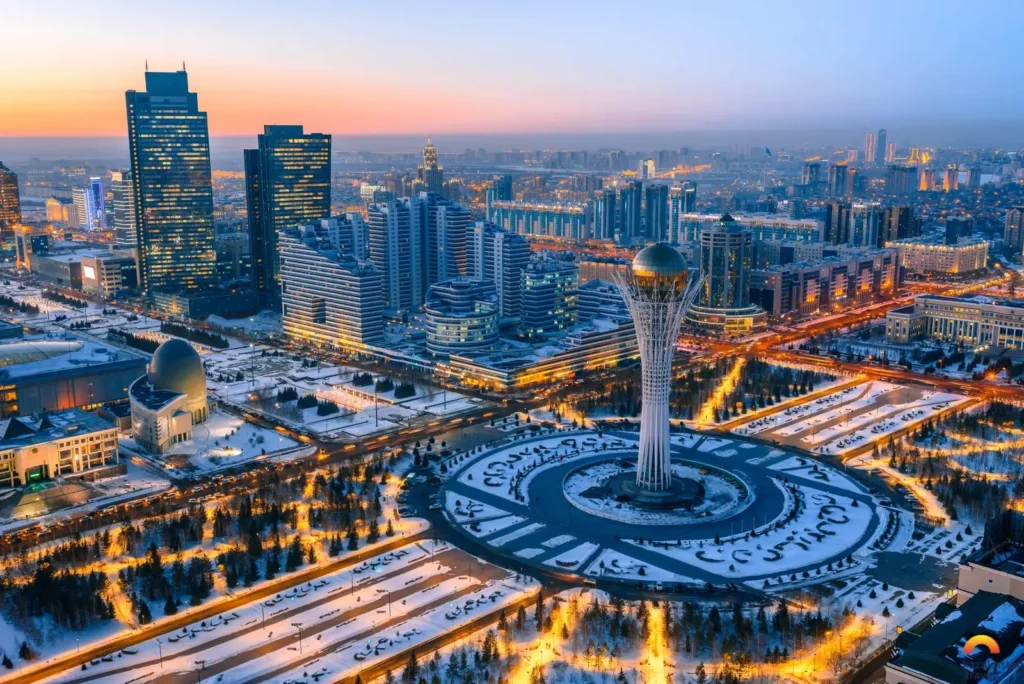
In 1997, a historic decision was made to relocate the capital from Almaty to a more central location. The new capital, Astana, was developed. It was later renamed Nur-Sultan before eventually regaining its original name, Astana.
Today, Astana is a modern city of glass and steel. Its most famous landmarks include the Baiterek Monument, the Khan Shatyr Entertainment Centre and its broad avenues.
Kazakhstan’s natural beauty reflects the splendour of all four seasons. The country’s vast landscapes and geographical diversity are visible across its different regions.
To the northeast lie the forests of Siberia, while the south is dominated by the snow-covered Tian Shan Mountains. The Caspian Sea stretches along the west, China borders the east, and golden steppes extend for thousands of kilometres through the country’s heartland.
Charyn Canyon is one of Kazakhstan’s most extraordinary natural attractions. Its towering red cliffs and deep gorges create an almost otherworldly landscape. It is often described as the “Little Grand Canyon.”
Burabay, commonly called the “Switzerland of Kazakhstan,” is another remarkable destination. Its blue lakes, dense pine forests and beautiful scenery attract large numbers of tourists during the summer.
Near Almaty lies Medeu, one of the world’s highest mountain ice-skating rinks. International sporting competitions are held there during winter.
The Mangystau region, situated along the Caspian Sea, offers a striking combination of white cliffs and blue waters. Its scenery resembles a masterpiece painted by an artist.
Kazakhstan’s climate can be extremely harsh. Summer temperatures may rise to +45°C, while winter temperatures can fall to –40°C.
As the Kazakhs say, “Harsh lands raise strong people.”
Kazakhstan is home to representatives of more than 130 ethnic groups, including Kazakhs, Russians, Uzbeks, Germans, Koreans and many others. These communities live together in peace and harmony, earning Kazakhstan a reputation as a land of friendship and unity.
The country’s official state language is Kazakh, while Russian is also widely spoken.
One of Kazakhstan’s most famous national dishes is beshbarmak, prepared with boiled meat and flat noodles. It is traditionally served with great respect and hospitality.
Among the country’s traditional equestrian sports is kokpar, a game in which riders on horseback compete to gain possession of a goat carcass.
Through its history, landscapes, cultural traditions and modern development, Kazakhstan represents a fascinating blend of ancient nomadic heritage and contemporary national identity.