
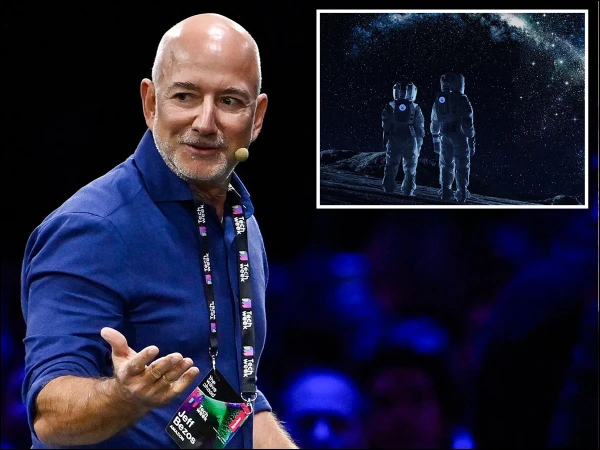
SAN FRANCISCO: Amazon and Blue Origin founder Jeff Bezos has predicted that millions of people could be living in space by 2045, as advances in space technology, artificial intelligence and robotics create new possibilities for human settlement beyond Earth.
Speaking at Italian Tech Week 2025, Bezos said technological progress over the next two decades could transform how people live and work in space, with robots performing dangerous tasks on the Moon and other celestial bodies.
He suggested that millions of people would eventually choose to live in space, not because their presence was essential for carrying out work, but because they wanted to experience life beyond the planet.
Robots could replace humans in dangerous space missions
Bezos said robots would likely perform many difficult tasks on the Moon and other celestial bodies, reducing the need to send humans into dangerous environments.
According to the billionaire entrepreneur, deploying robots for such operations would be more practical and less expensive than transporting people to distant locations.
His prediction reflects growing interest in robotic exploration, artificial intelligence and automated systems capable of operating in extreme space environments.
Bezos believes these technologies could support the development of future space settlements while allowing humans to pursue new opportunities beyond Earth.
Bezos optimistic about AI and future jobs
During the discussion, Bezos also addressed concerns about artificial intelligence replacing human workers and potentially disrupting employment.
He argued that technological innovation has historically improved living standards and created new opportunities.
Drawing a comparison with the invention of the plough thousands of years ago, Bezos said advances in technology have repeatedly contributed to human prosperity.
He maintained that people living today have several reasons to remain optimistic about the future as new inventions continue to reshape society.
Sam Altman predicts high-paying jobs in space
Bezos is not the only technology leader expecting major changes in space exploration and employment.
OpenAI CEO Sam Altman has predicted that university graduates could find exciting, well-paid jobs in space within the next decade.
Altman suggested that future generations may have access to career opportunities far more interesting than those available to earlier generations at the beginning of their professional lives.
His comments reflect expectations that commercial space exploration could eventually create new industries and employment opportunities beyond Earth.
Elon Musk continues to pursue Mars missions
Tesla and SpaceX CEO Elon Musk has also advocated expanding human civilisation beyond Earth, particularly through missions to Mars.
Musk has suggested that humans could reach Mars by 2028, while SpaceX has discussed plans for uncrewed test missions before attempting human landings.
However, such timelines remain ambitious and depend on overcoming substantial technological, financial and operational challenges.
Meanwhile, Voyager Technologies founder and CEO Dylan Taylor told Fortune in August 2026 that humans living and working in space could become a reality sooner than many expect.
Taylor suggested that the first stages of this transition could emerge during the early 2030s.
Can millions of people really live in space by 2045?
Although Bezos and other technology executives remain optimistic, establishing permanent settlements for millions of people beyond Earth would require major advances in transportation, life-support systems, radiation protection and infrastructure.
The enormous costs of constructing and maintaining space habitats also remain a significant obstacle.
For now, Bezos’s vision of millions living in space by 2045 remains a prediction rather than a confirmed development plan.
Nevertheless, growing investment in commercial spaceflight, robotics and artificial intelligence continues to fuel discussions about humanity’s future beyond Earth.