
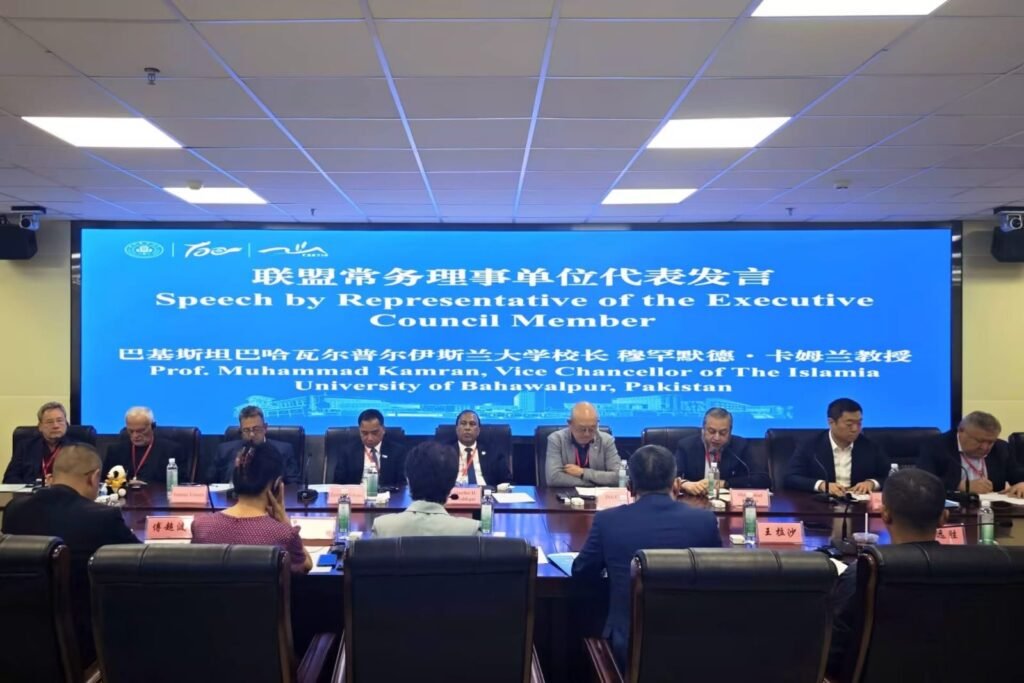
BAHAWALPUR : The Islamia University of Bahawalpur (IUB) has strengthened its international academic and technological collaboration with China following a visit by IUB Vice Chancellor Prof. Dr. Muhammad Kamran to Sichuan Agricultural University (SAU).
Prof. Dr. Kamran visited China to participate in the 120th anniversary celebrations of SAU and explore opportunities for expanded bilateral research cooperation. The visit received international media coverage from China Economic Net (CEN), Associated Press of Pakistan (APP) and the Daily Independent.
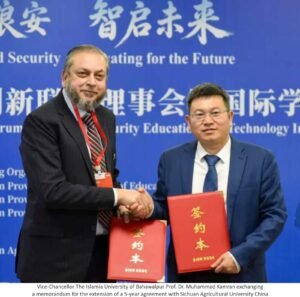
During the visit, IUB and SAU extended their Memorandum of Understanding (MoU) for another five years, further strengthening their cooperation in joint research, particularly in intercropping and food security.
According to IUB, joint intercropping research led by the university’s National Research Center of Intercropping (NRCI), under the direction of Dr. Muhammad Ali Raza, has helped adapt Chinese strip-intercropping technology across more than 12,000 hectares of Pakistani farmland to improve agricultural yields.
The collaboration has also resulted in 56 fully funded scholarships for IUB students at Sichuan Agricultural University.
IUB has further been positioned as the only Pakistani institution represented on the Standing Council of the Food Security Education and Technology Innovation Alliance.
During an exclusive China Economic Net feature comparing China’s clean-energy-driven “East Data, West Computing” artificial intelligence model in Ulanqab with Bahawalpur, Prof. Dr. Kamran highlighted the importance of combining digital infrastructure with strong local research capabilities and human capital.
He said IUB is working to build these capabilities through its Artificial Intelligence Research and Advancement Lab, interdisciplinary AI integration and a specialized Quantum Computing programme launched in 2026.
The university said the developments represent a significant step toward expanding Pakistan-China cooperation in higher education, agricultural research, food security, artificial intelligence and emerging technologies.