
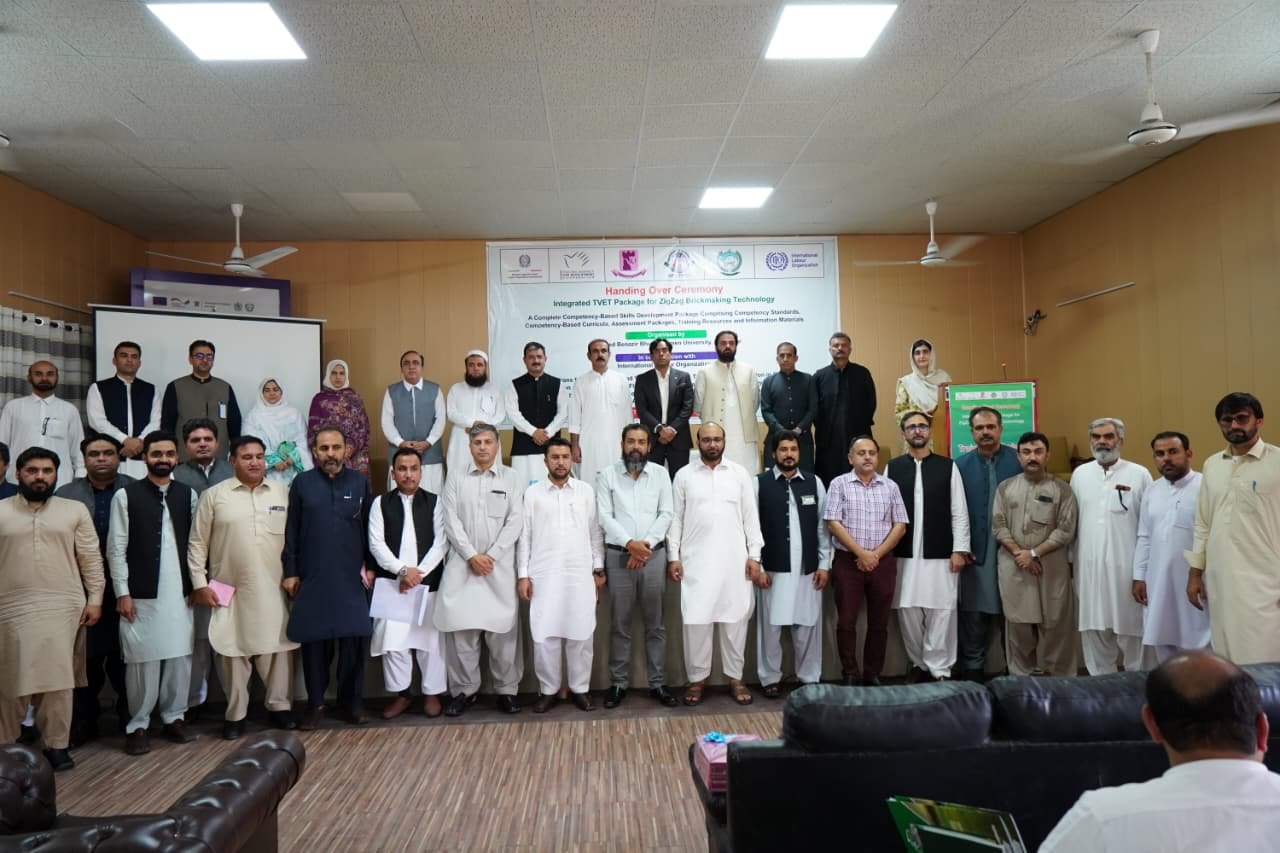
PESHAWAR: The International Labour Organization has formally handed over Pakistan’s first competency-based green skills curriculum and assessment package for the brick kiln sector to the Khyber Pakhtunkhwa Technical Education and Vocational Training Authority.
Developed in collaboration with Shaheed Benazir Bhutto Women University, Peshawar, the programme is designed to provide nationally recognised and industry-aligned qualifications to workers in a sector that employs an estimated 4.5 million people across Pakistan.
A complete copy of the training and assessment material was also presented to Sindh TEVTA in an effort to promote inter-provincial cooperation and expand the programme beyond Khyber Pakhtunkhwa.
The package was developed under the ILO’s Just Transition Programme and focuses on workplace-based training in kiln preparation, brick firing, efficient fuel use, quality control and occupational safety.
Training Designed for the Workplace
ILO officials said brick kiln skills could not be effectively taught through conventional classroom-based instruction alone because most of the required competencies must be developed at operational kiln sites.
Dr Faisal Iqbal, National Coordinator of the ILO’s Just Transition Programme, said the training model had been aligned with Pakistan’s National Vocational Qualifications Framework and the practical needs of the industry.
He said the competency-based approach would allow workers to gain formal recognition for skills acquired at the workplace while improving productivity, safety and environmental performance.
KP, Sindh TEVTAs Receive Training Package
The material for Sindh was received by Junaid Buland, Special Assistant to the Sindh Chief Minister and Chairman of Sindh TEVTA, and Ghulam Murtaza Sheikh, Managing Director of Sindh TEVTA.
Officials said the transfer reflected a shared commitment to expanding recognised green qualifications across provinces and supporting the transition towards cleaner brick production technologies.
Geir Thomas Tonstol, Country Director of the ILO Country Office for Pakistan, described the handover as an important step in the organisation’s support for green skills, decent work and sustainable livelihoods.
He said the transition to cleaner technologies should also protect and improve the livelihoods of workers dependent on the brick kiln industry.
KP Seeks Faster Shift to Zig-Zag Kilns
Muhammad Usman Bettani, Special Assistant to the Khyber Pakhtunkhwa Chief Minister and Chairman of KP-TEVTA, said brick kilns remained an important source of employment and a key part of the province’s construction sector.
However, he said workers had largely remained outside the formal vocational education system, leaving many without recognised qualifications or access to structured training.
Mian Abdul Qadir Shah, Managing Director of KP-TEVTA, said Punjab had converted more than 11,000 kilns to zig-zag technology over the past eight years, while progress in Khyber Pakhtunkhwa had remained limited.
He said zig-zag technology could reduce coal consumption by around 20%, saving a medium-sized kiln more than Rs3 million annually. The investment could be recovered within one or two production seasons, he added.
The technology also helps reduce air pollution, black carbon emissions and greenhouse gases, making the transition both an industrial and environmental reform.
KP-TEVTA has committed to integrating the new qualifications into its training system and implementing them through a workplace-based model.
Officials said the handover marked the beginning of a wider reform effort involving government institutions, industry, academia and development partners to make Pakistan’s brick kiln sector safer, cleaner and more productive.
Also Read: WSSCM Clears 56 Kilometres Of Drains And Seven Flood Hotspots Ahead Of Monsoon