

On Zain Saleem’s “Gujrat Ke Darakhshan Sitare”
Local history usually arrives in one of two forms. The first is built on the dead: every name wears a “the late” in front of it, and the research, if any, comes second. The second is built on lists, so many schools, so many libraries, so many poets, a ledger of a town with the townspeople subtracted. The two have one thing in common. Their subjects cannot talk back. Zain Saleem’s Gujrat Ke Darakhshan Sitare takes a third road. It is the opening chapter of a history still being written, and the people in it are alive and able to read what has been said about them.
The great tragedy of local history is not distortion but loss. Every town has scholars about whom we now know nothing, not because they did not matter, but because nobody asked while they could still answer. When they died, they took with them everything that lived only in their memory. Saleem attacks the problem from the other end. He sits across from his subject and writes. The method carries a risk: proximity breeds politeness, and a writer who will meet his subject at the tea stall next week is tempted toward kindness. But it has an overwhelming advantage. The details come from the source itself, not from hearsay passed through three mouths. Some of this material, a few years from now, simply could not have been recovered. That alone would justify the book.
The range is wide. Among historians and researchers we meet Rai Fasih Jaral, Siddique Mujahid, Sikandar Riaz Chauhan, Nadeemullah Mir and Shahid Hameed Waraich, along with this writer, a conflict of interest I will address below. The poets include Dr Shaheen Mufti, Professor Kaleem Ehsan Butt, Akram Kunjahi, Munir Sabri Kunjahi, Liaqat Gadgor, Munir Chishti Kunjahi, Bashir Malang, Saeed Akhtar and Noman Ahmad. Fiction is represented by Ehsan Faisal Kunjahi, Bilal Hasan Jhakkar and Nomi Chaudhry, and the novel by Rubeen Nawaz. The Punjabi voices belong to Chaudhry Ismail Chechi, Dr Azhar Mehmood Chaudhry and Iftikhar Waraich Kalrvi. Sketches of Shahbaz Ali Qadri, Farooq Riaz, Yawar Abbas, Razzaq Ahmad Ghaffari, Haji Aslam Javed and Shah Jahan round out the volume. Such a spread tells you what the author believes: that service to learning belongs to no single degree, institution or genre.
What sets the book apart from the usual biographical compendium is its beginning. Before he turns to anyone else’s story, the author opens the door of his own home. His family fought cancer, he tells us, and in that long and frightening stretch, books were what held them up. In most volumes, a preface like this is a courtesy. Here it is the engine of the whole project. The reader understands that this is no vanity catalogue. A man who has seen what words can do in a bad hour takes the people who write them seriously, and that seriousness can be felt in every profile.
As for style, Saleem’s prose is plain but careful. The usual habit in our biographical writing is to proceed like a form being filled in: date of birth, degrees, then a count of publications. He avoids it. A scene or an incident opens each piece, and the necessary facts gather inside it. His sentences are short and clean, and nowhere does he strain to impress. That restraint is rare in young writers, and it keeps his praise from curdling into flattery.
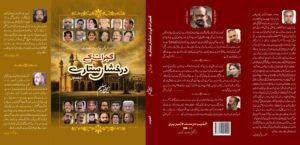
The book was published under the auspices of the Al-Amir Trust Library, whose guiding spirit is Arif Ali Mir, and the volume carries a chapter on his devotion to books. The library is known for putting rare books and manuscripts into readers’ hands free of charge. In a trade that mostly runs on profit and loss, a local scholarly work finding its home in such an institution does not look like coincidence. Work of this kind needs patrons who regard a book as something to be preserved before it is something to be sold.
Now a few reservations, because a review is credible only if it leaves room for disagreement. The first concerns women. Dr Shaheen Mufti and Robeen Nawaz stand out, but the part women have played in this region’s intellectual and literary life is far larger than two names suggest. The second concerns selection. Readers will want to know by what principles names were chosen and others left out, and a short note from the author would have answered the question before it was asked. The third is arrangement. If the profiles were ordered on a clear principle, whether by field or alphabetically, researchers who cite the book would find their work easier. A last point: a profile of a living person is a snapshot, because the work goes on. Room for additions and updates in later editions would strengthen the book’s scholarly standing. These are less faults than directions for growth.
And now the disclosure I owe you. The book includes an entry on the author of this column, so my opinion reaches you attached to a personal connection. I have tried to set my own mention aside and judge only the book. Still, the reader has every right to test my words, read the book with his own eyes and decide for himself.
So what is the book’s real achievement? To my mind, it challenges an old habit of ours: waiting for a person to depart before we recognise what he was worth. The researcher who one day sits down to write the intellectual history of this region will find a document in which people are recorded in their own lifetimes, in their own voices. History rarely receives a better gift.
My wish for Zain Saleem is that he lets this series run on. Volume One is a strong beginning, and those who care for such things are waiting for Volume Two. And to readers, a request: do not let this book decorate a shelf. Open it, read it, and tell the people named inside that someone noticed their work and wrote it down. For a writer, there is no higher applause.