
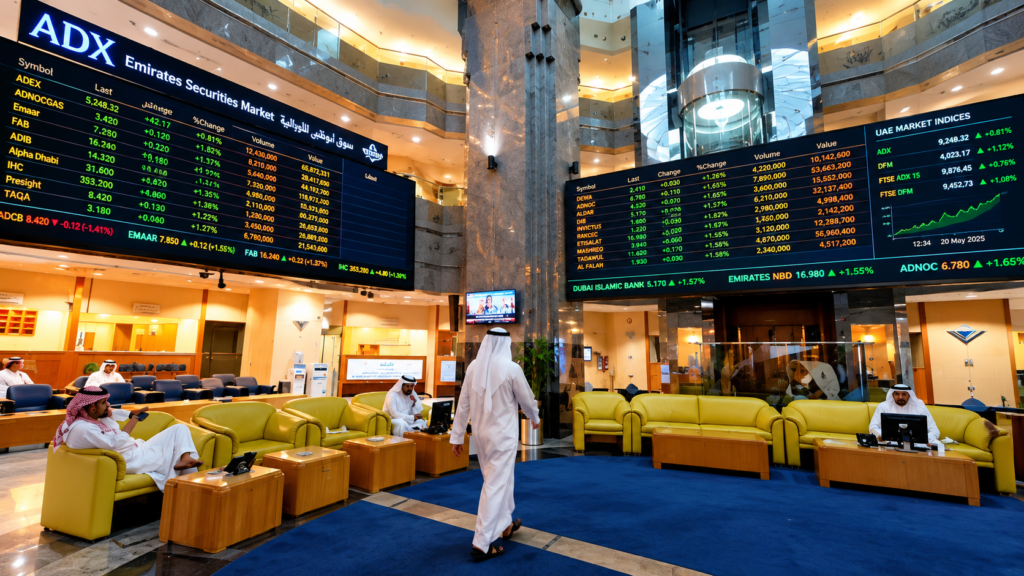
DUBAI, November 9, 2026: Most Gulf stock markets closed higher on Monday after US President Donald Trump indicated that further military strikes against Iran were unlikely as long as negotiations continued, easing investor concerns over regional tensions.
Saudi Arabia, Dubai, Abu Dhabi and Qatar recorded gains as investors responded positively to the possibility of reduced military confrontation following eight months of conflict.
The improvement in market sentiment came despite continuing security concerns around the Strait of Hormuz, a critical global energy shipping route where both US and Iranian sources have reported attacks on vessels.
Trump had previously suggested that Washington could resume military action against Iran following the US midterm elections. However, no large-scale American operation has followed, while Tehran has warned that any renewed strikes would trigger retaliation against US and Israeli targets.
Saudi and UAE stock markets advance
Saudi Arabia’s benchmark Tadawul All Share Index gained 0.9% to close at 10,107 points.
Al Rajhi Bank rose 1.9%, while Perfect Presentation for Commercial Services advanced 4.3% following an increase in quarterly profit.
The gains came as Saudi authorities lifted a security alert in Riyadh on Monday, a day after a Houthi attack damaged an office building belonging to Saudi Aramco.
In the United Arab Emirates, Dubai’s main stock index climbed 1% to 6,087 points, supported by a 2.4% increase in shares of property developer Emaar Properties.
Abu Dhabi’s benchmark index also advanced 1%, closing at 9,483 points.
Daniel Takieddine, co-founder and chief executive of Sky Links Capital Group, said shipping disruptions in the Strait of Hormuz continued to weigh on markets, although resilient regional economic indicators were supporting investor demand.
Qatar gains amid regional uncertainty
Qatar’s benchmark index increased 0.9% to 10,108 points, with Qatar National Bank, the Gulf’s largest lender, rising 1.5%.
Despite the positive trading session, concerns remain over the prospects of a lasting political settlement between Washington and Tehran.
Anwar Gargash, a senior Emirati official, warned at a geopolitical conference in Abu Dhabi that the Middle East could face a prolonged period of instability.
He said reaching a comprehensive agreement between the United States and Iran remained difficult, suggesting that regional governments and investors should prepare for continued uncertainty.
Egypt stocks rise despite pressure on fertilizer companies
Outside the Gulf, Egypt’s blue-chip stock index advanced 1.2% to 51,415 points.
Telecom Egypt gained 3.3%, helping support the broader market.
However, fertilizer producers recorded losses following another reduction in natural gas supplies.
Abu Qir Fertilizers declined 2.7%, while Misr Fertilizers Production fell 2.6%, extending losses from the previous trading session.
Egyptian authorities have notified fertilizer manufacturers of a further 33% reduction in gas allocations, according to company statements and industry officials.
The restrictions form part of Cairo’s efforts to reduce dependence on expensive liquefied natural gas imports.
Natural gas is particularly important to fertilizer producers because it serves as both a production feedstock and an energy source.
Gulf stock market closing performance
| Market | Daily change | Closing index |
|---|---|---|
| Saudi Arabia | +0.9% | 10,107 |
| Dubai | +1.0% | 6,087 |
| Abu Dhabi | +1.0% | 9,483 |
| Qatar | +0.9% | 10,108 |
| Kuwait | +0.2% | 8,967 |
| Bahrain | Unchanged | 1,822 |
| Oman | −0.4% | 7,234 |
| Egypt | +1.2% | 51,415 |
Oman was the only Gulf market among those listed to record a decline, slipping 0.4%, while Bahrain finished unchanged.
Investors remain focused on developments in US-Iran negotiations, maritime security in the Strait of Hormuz and regional economic conditions, which are expected to influence market sentiment in the coming sessions.