
Islamabad: Scientists in Europe and China have developed the world’s first practical nuclear clocks, marking an important step toward more precise timekeeping and new tests of fundamental physics.
The breakthrough, reported in research published in Nature on October 7, shows for the first time that nuclear-clock systems can be used in a practical timekeeping setup.
The research involved scientists from Vienna University of Technology, Germany’s national metrology institute and Tsinghua University in China.
Unlike conventional atomic clocks, which measure time using energy transitions in an atom’s electrons, nuclear clocks rely on energy changes inside the atomic nucleus.
Researchers say this could eventually provide a more stable and highly sensitive basis for measuring time.
Thorium-229 forms the core of the new clocks
Both experimental clocks are based on thorium-229, an isotope considered especially promising for nuclear timekeeping.
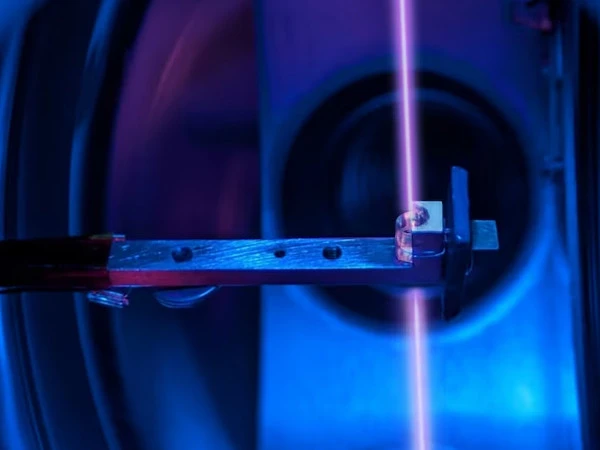
In the new systems, thorium-229 is embedded in calcium fluoride. A specialised ultraviolet laser is used to trigger an energy transition in the atomic nucleus.
The nucleus then acts as a highly stable reference that helps keep the laser frequency locked with extreme precision.
This approach differs fundamentally from existing atomic-clock technology and could open the door to a new generation of ultra-precise clocks.
Why nuclear clocks matter
Scientists believe nuclear clocks could eventually improve time measurement beyond what is possible with today’s best systems.
Because the atomic nucleus is less affected by many external disturbances than electrons are, nuclear clocks may offer exceptional stability and sensitivity.
That could make them useful not only for timekeeping, but also for studying some of the most fundamental questions in physics.
More precise clocks can help researchers test whether physical constants remain unchanged over time, improve measurements of gravitational effects and support future high-precision technologies.
Early prototypes still trail top optical clocks
The two experimental nuclear clocks have not yet matched the performance of the world’s best optical atomic clocks.
Researchers say, however, that the main significance of the achievement is that the concept has now been demonstrated in a practical form.
The new systems provide a foundation for improving nuclear-clock technology and refining the techniques needed to make it more accurate and reliable.
Scientists expect future work to focus on increasing precision, improving laser control and developing more stable thorium-based systems.