
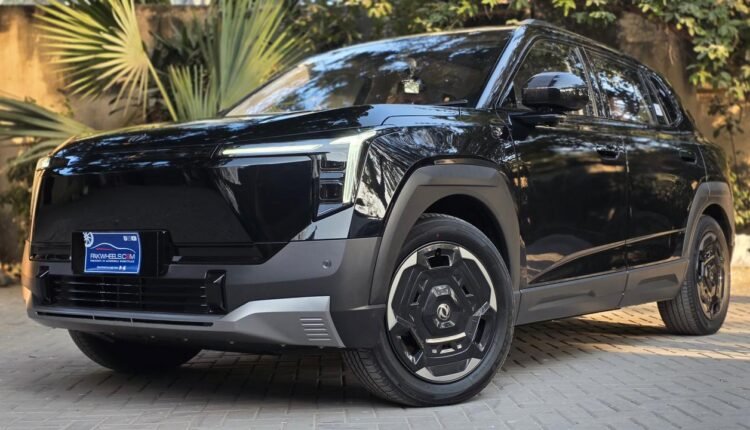
The Dongfeng Vigo may share its name with a pickup long familiar to Pakistani motorists, but this is an entirely different vehicle.
Brought to Pakistan by Chawla Green Motors, the Vigo is a compact all-electric Battery Electric Vehicle (BEV) SUV designed primarily for urban use.
After more than 3,400 kilometres of real-world city driving, the vehicle was put through an extended test to assess its range, comfort, performance, safety systems, charging costs and day-to-day practicality.
Battery, Range and Real-World Performance
The Dongfeng Vigo is powered by a 45 kWh battery pack and is available in three trim levels: E1, E2 and the top-spec variant reviewed here.
The manufacturer quotes a range of 430 km under the NEDC testing cycle. However, real-world figures are lower.
Converted to the WLTP cycle, the expected range comes down to around 400 km, while actual testing was closer to EPA-style figures of between 300 and 330 km with the air conditioning operating.
For prospective EV buyers, this difference between claimed and real-world range remains an important consideration.
Interior, Comfort and Technology
Inside, the Vigo offers a noticeably premium cabin for its segment.
The upper dashboard features soft-padded PVC material, complemented by a faux-wood trim strip and ambient lighting. The lighting is integrated into a fish-scale design on the doors and can respond to music.
The cabin also features an 8.8-inch digital instrument display alongside a 12.8-inch central infotainment touchscreen offering Apple CarPlay and Bluetooth connectivity.
The driver’s seat comes with heating, ventilation and four memory settings. A dedicated Nap Mode allows the seat to recline fully.
Drivers can also adjust steering response through three settings — Comfort, Standard and Sport — while four levels of regenerative braking are available for more controlled single-pedal driving in urban conditions.
Power, Drive Modes and Suspension
Despite its compact appearance, the Vigo delivers strong acceleration through the instant torque typical of electric vehicles.
Switching from Eco to Comfort mode noticeably sharpens throttle response. Sport Mode delivers significantly more aggressive acceleration, with enough torque to produce wheelspin and push occupants firmly into their seats.
That level of response also means the car demands careful handling, particularly in the hands of younger or inexperienced drivers.
The Vigo rides on 18-inch alloy wheels and its suspension performs well over broken city roads and large speed bumps.
The setup remains relatively quiet and compliant, avoiding the harsh impact often experienced in some imported crossovers.
ADAS and Safety Systems in Pakistani Traffic
The Vigo is equipped with a broad Advanced Driver Assistance Systems package, although some features may require adaptation to local traffic conditions.
The forward collision warning and emergency braking systems can react strongly in congested environments where motorcycles or pedestrians frequently move across a vehicle’s path.
In such situations, sudden braking may create a risk of rear-end collisions, and some drivers may prefer switching the system off in dense traffic.
Lane Keep Assist can also feel assertive when drivers are navigating around motorcycles or tightly spaced obstacles.
Adaptive Cruise Control presents another quirk: activating the system automatically re-enables certain safety functions, including lane assistance, even if those settings had previously been disabled.
One of the more useful features is the 540-degree camera system, which provides strong visibility around the vehicle and displays parking distance measurements in centimetres.
Charging Costs and Running Expense
The Vigo’s operating economics vary significantly depending on where the vehicle is charged.
With a 45 kWh battery and a residential electricity rate of PKR 50 per unit, a full home charge costs around PKR 2,250.
Based on a real-world range of 330 km, this works out to approximately PKR 6.8 per kilometre.
If the vehicle is charged through solar power, the running cost can fall below PKR 3.5 per kilometre.
Commercial charging is considerably more expensive.
| Charging Source | Rate Per Unit | Full Charge Cost | Cost Per KM |
|---|---|---|---|
| Home WAPDA | PKR 50 | PKR 2,250 | PKR 6.8/km |
| City Commercial DC | PKR 100–110 | PKR 4,500 | PKR 13.6/km |
| Highway Fast DC | PKR 150 | PKR 6,750 | PKR 30/km |
The figures reinforce the Vigo’s strongest use case as an urban EV.
Highway driving, combined with more expensive fast charging, can significantly increase operating costs, while home charging offers much greater savings.
Dongfeng Vigo Specifications
| Specification | Details |
|---|---|
| Body Type | Compact All-Electric SUV (BEV) |
| Drivetrain | Front-Wheel Drive |
| Battery Capacity | 45 kWh Lithium-Ion |
| Claimed Range | 430 km NEDC |
| Tested Range | 313–330 km |
| AC Home Charging | 6.5 hours with 7 kW wallbox / around 15 hours with 3.3 kW portable charger |
| DC Fast Charging | 30% to 80% in under 40 minutes |
| Wheels | 18-inch alloy wheels |
Warranty, Dealership Support and Delivery
Chawla Green Motors is supporting the Dongfeng Vigo through seven dealerships across the country.
The vehicle comes with a five-year or 150,000 km warranty, while the battery is covered for eight years or 200,000 km.
The Vigo is imported as a Completely Built Unit (CBU), with delivery expected approximately 45 to 60 days after booking.
Final Verdict
The Dongfeng Vigo emerges as a competitive option in Pakistan’s growing electric SUV market and stands alongside rivals such as the BYD Atto 3.
Its strongest qualities include a quiet ride, rapid electric acceleration, modern styling, a feature-rich cabin and relatively low running costs when charged at home.
At less than PKR 7 per kilometre on residential charging, the Vigo makes a strong case as an everyday urban commuter.
Its economics are less attractive for frequent highway use, particularly when expensive DC fast charging is involved, but for city-focused buyers, the combination of efficiency, comfort and technology gives it a compelling position in the EV market.