
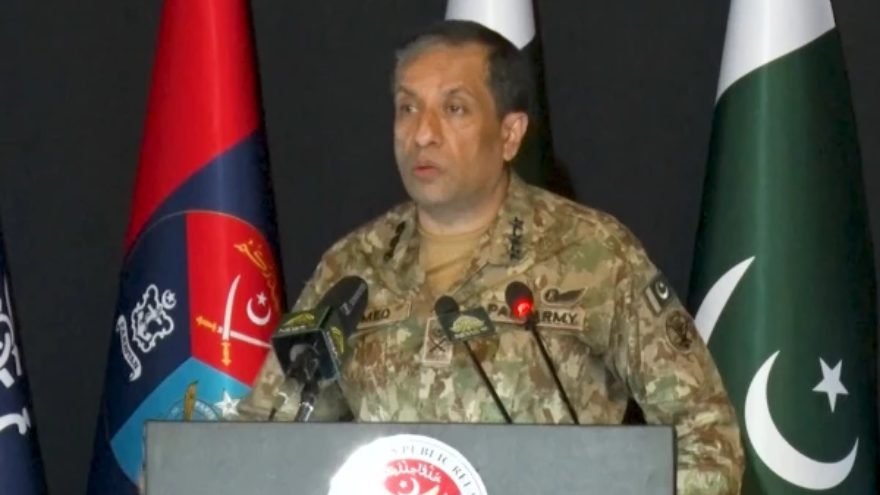
ISLAMABAD: Pakistan’s long-term security depends not only on military operations but also on effective governance, stronger institutions and an administrative system capable of serving a rapidly growing population, the military’s spokesperson said on Friday.
Inter-Services Public Relations Director General Lieutenant General Ahmed Sharif Chaudhry said structural and administrative reforms should be considered through constitutional channels where necessary to improve public service delivery and strengthen national stability.
Speaking at a press conference on Pakistan’s security situation, the DG ISPR said governance remained a central pillar of national security and argued that many longstanding challenges could not be resolved without improving the way state institutions function.
He noted that Pakistan’s population had increased sharply over the past five decades, while its basic administrative structure had remained largely unchanged.
“In 1972, our population was around 70 to 80 million. Today it has reached about 250 million,” he said, adding that Pakistan continued to operate with the same four provinces despite the significant demographic expansion.
Lt Gen Chaudhry said the country needed to assess whether its existing administrative model remained suitable for present and future needs.
“If an administrative reset is required to achieve good governance, then it should take place,” he said.
He stressed, however, that any changes must be made in accordance with the Constitution and should reflect public opinion.
“If the people are satisfied with the existing governance system, then that is their decision. If they are not satisfied, the matter should also be resolved according to the Constitution,” he said.
Governance Linked to National Stability
The military spokesperson said better administration would improve public services, strengthen state institutions and help address grievances that could otherwise contribute to instability.
His remarks came during a wider briefing covering Pakistan’s counterterrorism campaign, the security situation in Balochistan and the state’s policy towards militant groups.
Lt Gen Chaudhry said effective governance and public confidence in institutions were directly connected to the country’s overall security environment.
More Than 40,000 Intelligence-Based Operations Conducted
Presenting an overview of counterterrorism activity, the DG ISPR said security forces had carried out 40,348 intelligence-based operations across Pakistan during 2026.
The figure included operations conducted by the armed forces, police, civil armed forces and intelligence agencies.
According to the briefing, 31,080 operations were carried out in Balochistan, 7,177 in Khyber Pakhtunkhwa and 2,091 in other parts of the country.
Lt Gen Chaudhry said security agencies were conducting an average of around 194 intelligence-based operations each day, describing the pace as evidence of an uninterrupted nationwide campaign against terrorism.
He said 2,084 confirmed terrorists had been killed during the operations so far this year, averaging approximately 10 militant deaths per day.
For comparison, he said 2,597 terrorists were killed during 2025.
Pakistan Records 3,145 Terrorism Incidents in 2026
The DG ISPR said Pakistan had recorded 3,145 terrorism incidents during the ongoing year.
Of these, 1,971 occurred in Khyber Pakhtunkhwa, 1,148 in Balochistan and 26 in other parts of the country.
He said 28 suicide attacks had taken place in 2026 and alleged that most involved Afghan nationals. He referred to recent attacks in Tank district and Karachi and claimed that individuals linked to Afghan security institutions had also been involved in some incidents.
Lt Gen Chaudhry said 819 Pakistanis had lost their lives in terrorism-related violence during the year.
The casualties included 303 army personnel, 194 police and other law-enforcement officials, and 322 civilians.
He said the ratio between terrorists killed and Pakistani casualties had improved in recent years. According to the DG ISPR, security forces killed around two militants for every person martyred in 2025, while the ratio had risen to roughly 2.5 to one in 2026.
No Negotiations With Terrorist Groups
Reaffirming the state’s policy, Lt Gen Chaudhry ruled out negotiations with terrorist organisations.
He said militants had two options: surrender their weapons or face military action.
“There is no room for negotiations with terrorists,” he said, adding that the state would not show leniency towards armed groups challenging Pakistan.
DG ISPR Rejects Claims of Growing Instability in Balochistan
Addressing the situation in Balochistan, the military spokesperson said what he described as negative propaganda was being used to portray the province as increasingly unstable.
He stressed that Pakistan’s Constitution and laws applied equally to every citizen and said loyalty to the state was a constitutional obligation.
“Pakistan is our ultimate identity,” he said.
Lt Gen Chaudhry accused some influential tribal leaders and local elites of obstructing education, development and economic opportunities in parts of Balochistan to protect their own interests.
He also alleged that certain groups opposed development projects, targeted labourers and sought control over provincial resources.
The DG ISPR further claimed that some tribal figures treated the Levies Force as a personal force and benefited from smuggling networks involving narcotics and diesel.
These allegations were not independently verified in the briefing.
Afghan Taliban Accused of Supporting Militants
Lt Gen Chaudhry alleged that the Afghan Taliban administration was supporting terrorist groups operating against Pakistan.
He also questioned what shared interests existed between Afghanistan, India and the banned Balochistan Liberation Army.
The Afghan authorities did not immediately respond to the allegations cited during the press conference.
The DG ISPR said Pakistan would continue its counterterrorism operations while relying on the Constitution and law to address political, administrative and governance challenges.
He described a “hard state” as one in which institutions, citizens and political actors remained subject to constitutional and legal authority.
Also Read: DG ISPR holds special session with university leaders on national security