
By Prof. Dr. Umer Farooq
I remember the days when people of our generation- Gen X, generally defined as those born between 1965 to 1980- would occasionally invoke the term ‘Generation Gap’ when speaking to our fathers, who belonged to the Baby Boomers generation (born between 1946-1964). The mere mention of a ‘generation gap’, was often enough to make them furious. They simply refused to believe that such a gap existed. To them generations were not fundamentally different; people were people, and the values, expectations and ways of life of one generation were not supposed to be all that different from those of another. Rightly so or not? The debate can never be conclusively settled, for it is the events we experience and the environments in which we grow that ultimately shape our thoughts and perspectives.
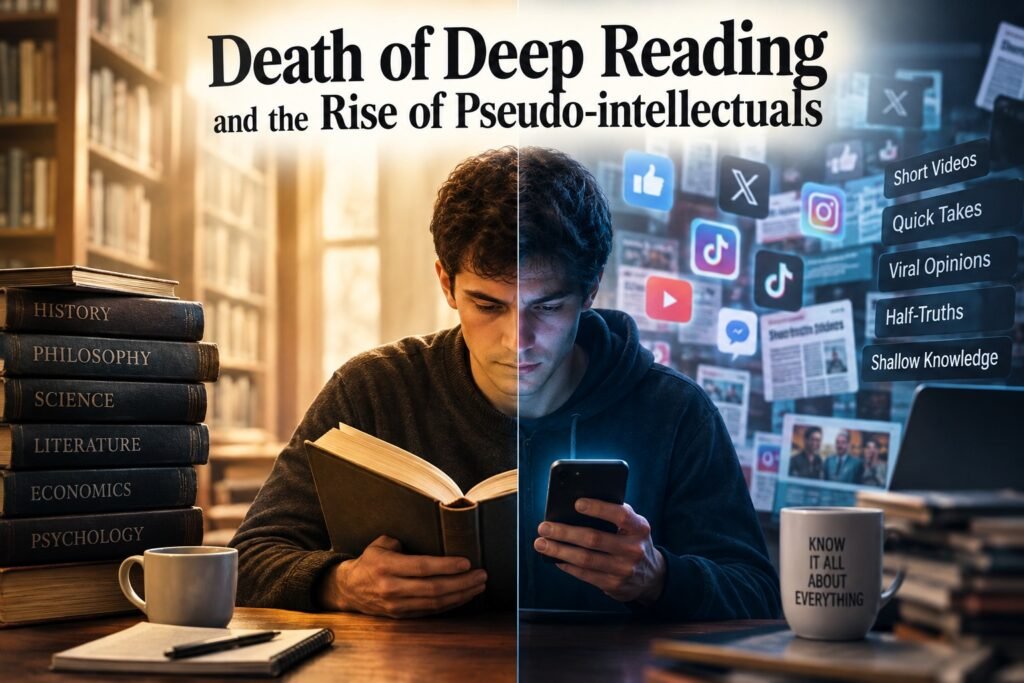
The ever-evolving landscape of technology has taken us from bulky fewer-channel TVs to slim HD screens, from heavy telephones with cords to wireless smart phones, from film-developed cameras to digital cameras, from in-person gossips to social media apps, from board games and action figures to video gaming, and from readers to scrollers and skimmers. We seem to have unprecedented access to information, yet serious reading seems to be disappearing. Types of reading material such as posts, blogs, snippets, headlines, captions, and scroll feeds are in vogue, whereas physical books and printed newspapers are vanishing.
We have more information than any generation before us, but perhaps less depth of knowledge.
Reading used to be a deliberate activity which needed patience, concentration, mental exercise, and uninterrupted time. It demanded that a reader remain focused on an argument while understanding its entire relevant context. Consequently, it contributed to the development of the reader’s mental capacities, broadening both the mind and the soul. True intellectuals were thus shaped, eventually influencing societies and nations. On the contrary, the skimmers/scrollers tend to start up with a few keywords, extract isolated ideas without any context, move rapidly from one issue to another without establishing coherent relationships, and prioritize speed over understanding. This often leads to hasty conclusions because the scroller/skimmer is always looking for ‘what is next?’ rather than asking ‘what does this mean?’ This know-it-all generation has, in many ways, given birth to the pseudo-intellectuals.
Today, everyone can access information about almost anything within seconds, and can discuss politics, medicine, economics, psychology, history, religion, climate change, AI and international affairs—all within the same day. I presume that knowing a little about everything is not the same as understanding anything deeply. Is it not, perhaps, an illusion of expertise?
We are witnessing the emergence of a generation that knows where to find the answers but is gradually forgetting how to understand the questions.
At this point it seems inevitable that the distinct differences between ‘information’, ‘understanding’, ‘knowledge’ and ‘wisdom’ should be grasped. Information is easy to acquire, whereas understanding requires deep study and analysis. Knowledge, on the other hand, requires sustained learning and experience, whereas wisdom requires reflection and judgment. Thus, it remains a well-established fact that information is not knowledge.
By this time, many of the readers of this article may have perceived the term ‘pseudo-intellectuals’ in a negative sense. If so, read ahead because this is not how I intend it.
I consider this term as more of a phenomenon rather than a label. A pseudo-intellectual is not necessarily an uneducated person; rather, it is someone who mistakes the appearance of knowledge for genuine understanding. Such a person may quote famous thinkers without having read their works, present internet opinions as their own conclusions, use sophisticated terminology without understanding the concepts behind it, or confuse confidence with competence. He or she may rely on summaries instead of original books, and participate in every debate without possessing sufficient knowledge of the subject. In an age of instant information, it has become remarkably easy to develop opinions about almost everything while possessing very little intellectual depth. There is yet another disturbing consequence of this culture of speed. Could the decline in deep reading and an increase in screen reading be contributing, at least in part, to the growing toxicity we encounter in our workplaces and society? We increasingly encounter intolerance, impulsive reactions, personal attacks, character assassination, vindictiveness, and an inability to listen to or understand an opposing viewpoint. Even some of the disturbing and perverse behavior and crimes witnessed around us may reflect a broader erosion of empathy, self-restraint, reflection and moral reasoning. Perhaps, this should not be, simplistically attributed to screen time alone. Yet, when minds are continuously trained to skim, scroll, react, judge and move ahead rather than to read, analyze, reflect, question and understand, we may be nurturing a culture of impatience and superficiality. Perhaps the loss is therefore not merely that of the book reader; it is also, gradually, the loss of a more reflective, tolerant and intellectually disciplined human being.
Every scroller/skimmer is not intellectually shallow. The real danger lies in allowing this abundance of information to create an appearance of intellectual sophistication without the patience, discipline and sustained reading required to develop genuine understanding.
I merely wish to stress the role of critical and deep reading because of its benefits at the societal level. A few of the consequences that I often witness during my research and academic experience with university students and faculty members include weaker mental capacity and critical thinking, shorter attention spans declining quality of expressions, poor analytical writing, susceptibility to misinformation and disinformation, louder opinions accompanied by weaker arguments, difficulty in understanding social problems, and the erosion of intellectual culture.
I presume that when students and teachers stop reading deeply, educational institutes merely become examination centers rather than centers of thought.
Is technology the main problem wreaking havoc with human minds and our intellectuality? Will returning to the pre-digital world help solve these issues? Is it a struggle between books and screens? Presumably not. The advantages of digital reading are numerous- accessibility, affordability, instant searching, access to global literature, open educational sources, and much more- and they can never be denied. The real issue at hand is in fact, deep reading versus distracted and patchy reading.
A person can read a 500-page book on a tablet just as deeply as on paper. Conversely, someone can own hundreds of physical books and never read them.
How about bringing in a ‘Reading Renaissance’ instead of waging a war against technology and digitization.
At schools, dedicated reading periods could be assigned, with emphasis on reading entire books rather than selected passages. School libraries could be transformed into active spaces rather than remaining locked rooms. At the university level, foundational textbook reading should be an explicit part of courses. Instead of examination-oriented assignments alone, textbook-based discussions should be incorporated into teaching. Reading clubs should be established with specified reading materials followed by post-reading discussions.
The greatest responsibility lies with the teaching community of every educational institute. Firstly, if teachers want to bring about a positive change in their students, they themselves need to be active and deep readers. Secondly, they may prescribe books as part of academic learning and conduct book-based discussions in class. Additionally, rewarding curiosity and understanding over memorization may help inculcate a culture of deep reading.
A grave issue that remains largely neglected in Pakistan is the creation of a conducive reading environment within the family. Parents and families can inculcate the habit of book reading by keeping books visible and accessible at home. Instead of buying gadgets alone, buying books should become a norm.
Intellectualism is not merely having ready access to information. Intellectual societies are built by people who read deeply, think patiently and are willing to change their minds when evidence demands it. The challenge is not to choose between books and technology, but to restore depth to an age obsessed with speed.
Probably, we are failing to inculcate the attitude of knowledge-seeking through the pleasures of book reading in our children and our students.
Let’s scroll less, and read more.